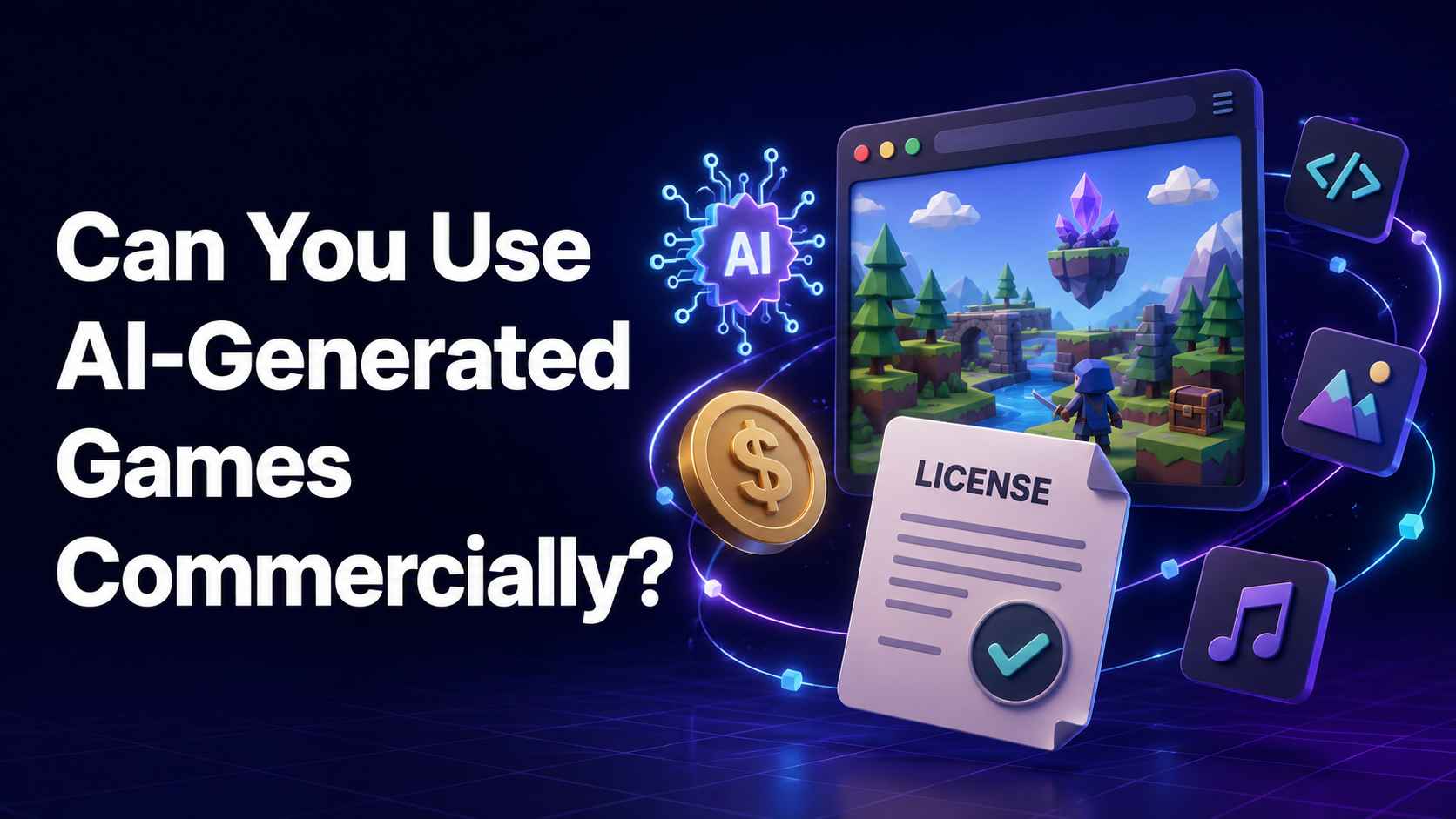
Yes, an AI-generated game can sometimes be sold, licensed, supported by ads, or released on a game store. But the word generated does not give you automatic commercial rights.
Before you monetize the game, you need permission to use every part of it commercially. That includes the code, images, 3D models, music, sound effects, fonts, names, characters, and any third-party packages. You must also follow the rules of the AI service and the platform where you publish.
There is another important distinction: permission to sell an output is not the same as owning copyright in it. In the United States, purely AI-generated material may not receive copyright protection, even when a service allows commercial use. This guide explains the difference and gives you a practical review process. It provides general information, not legal advice.
Quick Answer: When Can You Sell an AI-Generated Game?
You are in a stronger position to sell or monetize an AI-generated game when all of the following are true:
- The game-making service grants the commercial rights needed for your account and plan.
- Every external asset, library, font, and sound has a compatible commercial license.
- The game does not copy protected characters, art, music, logos, or other recognizable material.
- You have reviewed and substantially shaped the final code, design, writing, visuals, and gameplay.
- You make any AI disclosures required by the store, publisher, client, or local law.
- You can prove where important assets came from and which license applied when you obtained them.
| Question | Short answer |
|---|---|
| Can you sell an AI-generated game? | Often, but only when the tool and every included asset allow commercial use. |
| Do you automatically own the game? | No. Contract terms and copyright law answer different parts of ownership. |
| Can you monetize it with ads or in-app purchases? | Potentially, but both models are commercial use and need the same rights review. |
| Can an AI-generated game be published on Steam? | Yes, if it meets Steam's rules, contains no illegal or infringing material, and the required AI disclosure is complete. |
| Is the whole game protected by copyright? | Not necessarily. Human-authored parts may be protected while purely AI-generated elements may not be. |
Commercial Use, Ownership, and Copyright Are Different
Creators often treat these ideas as if they mean the same thing. They do not.
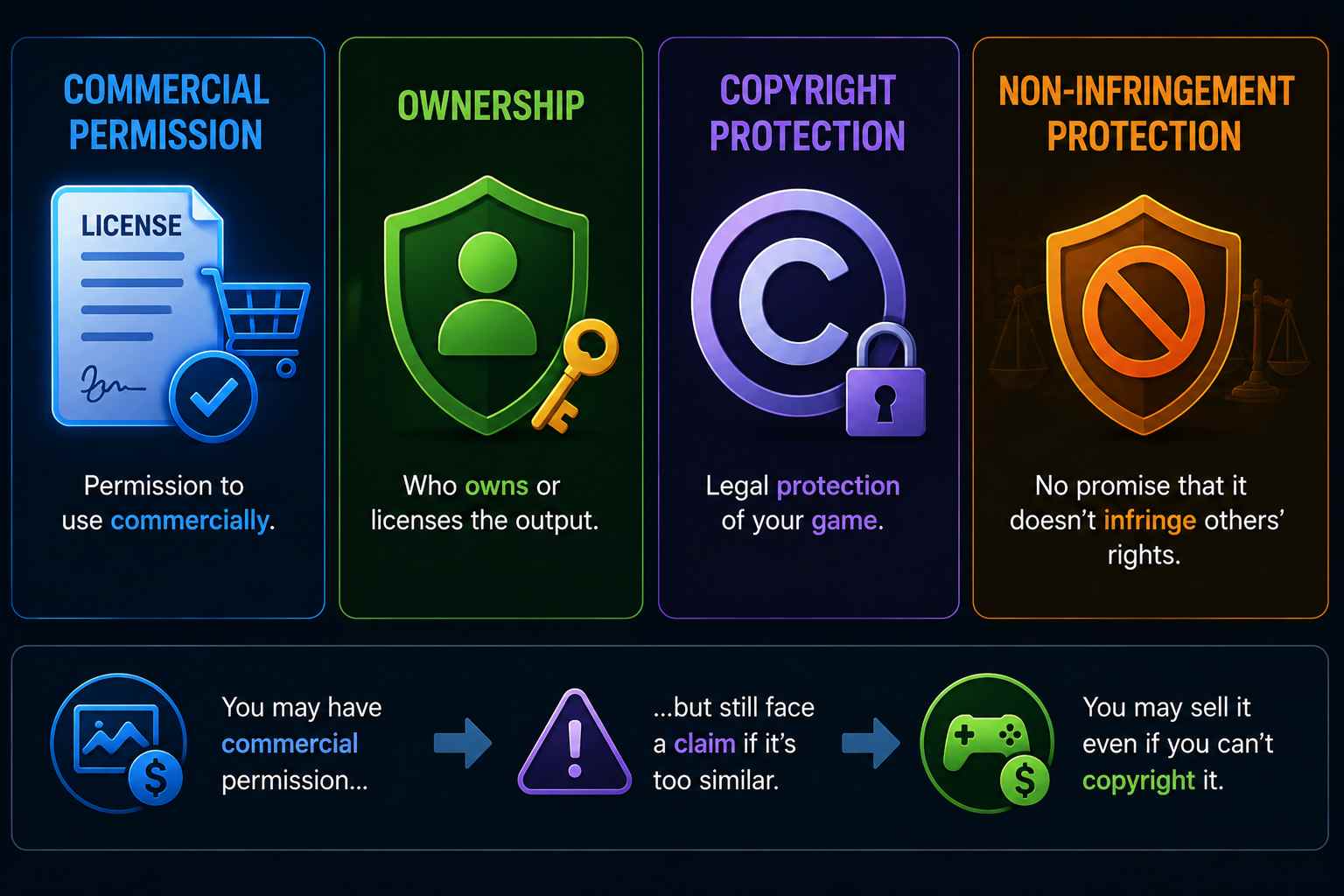
- Commercial permission comes from a license or service agreement. It tells you whether you may sell, advertise with, distribute, or otherwise monetize an output.
- Ownership describes which rights the contract says you retain or receive. A provider may assign an output to you, grant only a license, or keep broad rights to reuse it.
- Copyright protection comes from law. It affects whether you can stop someone else from copying protected parts of your game.
- Non-infringement protection concerns whether the provider promises that the output does not violate someone else's rights. Many AI services do not make that promise.
A tool may let you use an image commercially without guaranteeing that the image is unique. You may therefore have permission from the tool but still face a claim if the result is too close to protected work. You may also be allowed to sell an AI-generated element that you cannot copyright on its own.
Check Every Part of the AI-Generated Game
A game is not one file or one right. Treat it as a bundle of code, art, audio, text, brands, and third-party materials. One unclear component can hold up the whole release.
1. Game Code
Check both the generated source code and every dependency it calls. Copyright may protect original expression in a computer program, but not ideas, program logic, algorithms, systems, or methods. If your workflow combines separate coding, art, animation, or voice services, this guide to AI tools for game development can help you map which tool created each part.
Generated code may contain open-source libraries, copied snippets, packages, fonts, or remote assets. Do not assume a working build is a clean build. Review imports, package files, comments, credits, network requests, and bundled folders. Keep all required copyright notices and satisfy any attribution, source-sharing, or redistribution conditions.
Open source does not mean “no rules.” Open-source software can generally be used commercially, but each license still has conditions. A permissive MIT dependency and a copyleft dependency can create very different obligations. A public repository with no license is not automatically free to reuse.
2. Images, Animation, and 3D Assets
Read the terms of the exact image or 3D generator, including differences between free and paid plans. Look for commercial use, output ownership, reuse by the provider, attribution, plan limits, indemnity, and restrictions on particular content. The same review applies when using an AI 3D game maker to create a playable prototype.
Then inspect the result itself. Replace assets that reproduce a famous character, distinctive costume, logo, interface, or recognizable artwork. Avoid prompts that ask for an existing game, artist, studio, or franchise to be copied. Save your prompts, versions, edits, and source files so you can show how the final asset developed.
Human editing can matter for protection. Redrawing characters, combining multiple elements, designing the composition, correcting animation frames, and making original visual choices give you a clearer record of human authorship than accepting a one-prompt output unchanged.
3. Music and Sound Effects
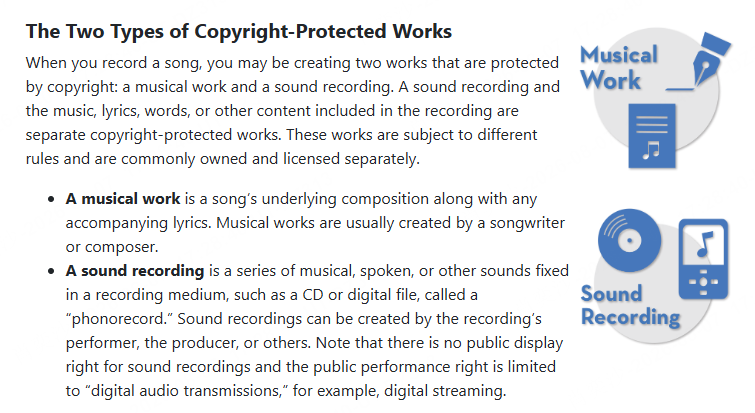
Audio needs its own review. The U.S. Copyright Office explains that a musical composition and a sound recording are separate copyright-protected works. Permission to use one does not automatically clear the other.
Confirm that the music generator or asset library permits commercial synchronization inside a game, trailers, store pages, livestreams, and paid advertising. Check whether attribution is required and whether the license applies to the free plan. The guide to making video game music explains how to create and test original loops instead of imitating a famous soundtrack or artist.
4. Characters, Brands, and Real People
A prompt can create legal risk before the model produces anything. Using a famous superhero, game character, logo, celebrity likeness, or confusingly similar game title may involve copyright, trademark, or publicity rights.
The USPTO explains that trademarks identify the source of goods or services and protect brand identity. It recommends a clearance search because similar marks used for related products can create a likelihood of confusion. Before release, search the proposed game title and replace borrowed brand elements. “The AI made it” is not a defense to an infringement claim.
5. Third-Party Assets and Templates
“Free” describes price, not permission. A free sprite, font, song, or texture may require credit, prohibit commercial use, restrict modifications, or prevent redistribution as a standalone file.
Creative Commons licenses illustrate the difference. CC BY permits commercial reuse with attribution, while licenses containing NC restrict commercial use. SA and ND add other conditions. Review the Creative Commons license conditions instead of relying only on the download-page label.
Asset marketplaces also have their own rules. A license may let you embed an asset in a finished game while prohibiting you from redistributing the source file by itself. Use the SoonLab guide to free game asset websites to find sources, then verify the license on each individual asset.
6. The AI Service and Its Underlying Models
Check the agreement for the service you actually use. A paid subscription does not automatically mean that every output is commercially cleared. Terms can differ by plan, feature, model, country, and output type. If you are comparing services, start with the best AI game makers for playable game creation, then confirm the current license on each provider's own website.
If a game maker uses third-party models behind the scenes, the game maker should have the vendor rights needed to provide its service. End users still need a clear agreement from the game maker that explains what they may do with the final output. Do not assume that a model provider's public terms apply directly to you when you did not contract with that provider.
Can You Copyright an AI-Generated Game?
In the United States, the strongest current answer is: human-authored parts can be protected, while purely AI-generated material may not be.
The U.S. Copyright Office's 2025 report on AI and copyrightability says copyright protects original human expression even when a work includes AI-generated material. It does not extend to purely AI-generated material or material over which a person had insufficient creative control. The Office also concluded that prompts alone generally do not provide enough control under current technology.
Two official examples make the distinction clearer:
- In Zarya of the Dawn, the Copyright Office recognized the human-authored text and the creative selection and arrangement of the comic, but not the individual Midjourney-generated images.
- In Thaler v. Perlmutter, the U.S. Court of Appeals for the D.C. Circuit affirmed that a work identified as autonomously created by a machine could not be registered with the machine as author. The decision also explained that the human-authorship rule does not prevent protection for works made with AI assistance.
For a game, this can produce a mixed result. Your original code edits, level design, dialogue, visual arrangement, story, rules presentation, and revised assets may be protected if they contain sufficient human authorship. A raw AI image or other element may not be protected by itself. The answer is fact-specific, and other countries may apply different rules.
Can You Publish an AI-Generated Game on Steam?
Steam does not impose a blanket ban on every game made with generative AI. Its current Steamworks Content Survey asks developers to describe generative AI used during development or inside the released product.
Steam separates AI use into two broad types:
- Pre-generated content: AI-assisted art, sound, writing, localization, or other material created during development and shipped with the game.
- Live-generated content: material produced while the game is running. Developers must also explain the guardrails used to prevent illegal content.
Disclosure is not a license and does not solve ownership. Valve still requires the game to be legal, non-infringing, and consistent with its store materials. Hiding AI use or relying on old forum claims about Steam's policy is riskier than following the current official survey. For a closer look at disclosure, player response, and quality concerns, read Can AI Games Survive on Steam?
When the build is ready, the Steam publishing guide covers the account, store page, build upload, review, and release steps. Other stores also place responsibility for content rights on the developer; AI does not create an exception.
Legal Permission Does Not Guarantee Commercial Success
A game can pass a license review and still struggle with players, publishers, or clients. In GDC's 2026 industry survey, 52% of respondents said generative AI was having a negative effect on the game industry, while 7% viewed it positively. The GDC summary shows that resistance was especially high among people working in art, design, narrative, and programming.
Recent developer discussions show a similar divide. In one r/gamedev discussion about selling an AI-generated Steam game, replies distinguished Steam disclosure from legality but also objected strongly to low-effort, minimally edited releases. One thread does not represent every player, but it reveals a real commercial concern: buyers often judge quality, originality, and transparency separately from legal compliance.
Use AI to accelerate work, not to skip responsibility. Test the game, fix obvious generation errors, replace generic key art, credit human contributors, and disclose material AI use honestly where required. A clear creative direction and visible human judgment are more defensible than a one-prompt game uploaded unchanged.
Can You Use a SoonLab-Generated Game Commercially?
Yes. At SoonLab, we allow paid users to use games created with SoonLab for commercial purposes.
This means you can sell access to your game, monetize it through advertising or sponsorships, or use it in a client, branded, or other commercial project. If you want to prototype a game for a product launch, event, or marketing campaign, SoonLab's AI advergame maker can help you turn the campaign idea into a short playable browser game. You can also continue editing and improving the game before release.
This commercial-use permission applies to games you create with SoonLab. It does not grant rights to third-party content that you upload, reference, or request in a prompt. You are still responsible for making sure your game does not use copyrighted characters, logos, music, artwork, code, or other protected material without permission.
Before releasing your game commercially:
- use original or properly licensed characters, images, music, fonts, and other assets;
- review the generated content and replace anything that is too similar to an existing game, brand, or creative work;
- follow the rules and AI disclosure requirements of Steam or any other platform where you publish;
- keep records for third-party licenses, purchased assets, and written permissions.
With SoonLab, you can create a playable game from a prompt, test it in the browser, and refine it through follow-up instructions. When your game is ready for a commercial release, complete the rights and platform checks above before publishing.
Turn your idea into aplayable game
Describe the game you want to make, and SoonLab will help you start building it.
If you need a structured testing process, follow this guide to prototyping video games with AI before investing in a larger production build.
A Commercial-Use Checklist Before You Launch
- List every component. Include code, packages, images, models, animations, fonts, music, sounds, writing, voices, and store-page materials.
- Record the source. Save the service, asset page, creator, model or feature, account plan, download date, and applicable terms.
- Confirm commercial permission. Check distribution, advertising, client work, sublicensing, modification, and attribution rather than searching only for the word “commercial.”
- Review third-party licenses. Keep notices and replace anything with missing, incompatible, non-commercial, or unclear terms.
- Check originality. Search for similar game titles and inspect outputs for copied logos, characters, music, art, code, or interface elements.
- Add human authorship. Rewrite, redraw, arrange, edit, balance, and document the creative decisions that shape the final game.
- Complete platform disclosures. Use the current official rules for Steam, the App Store, Google Play, your publisher, or the client's distribution channel.
- Keep an evidence folder. Store license copies, receipts, prompts, source files, edit history, credits, and written permissions.
- Get professional advice when the stakes justify it. A lawyer should review unclear rights before a major launch, publishing agreement, branded campaign, or investment round.
If you plan to monetize a small web game directly, the technical path may be simpler than a store release, but the rights review is not. The SoonLab guide to making a web browser game explains the build process; apply the same license checklist before adding ads, sponsorships, paid access, or client branding.
FAQs About Commercial AI-Generated Games
Can you sell AI-generated games?
Yes, in some cases. You need commercial permission from the game-making service and compatible rights for every included asset. You must also avoid infringing content and meet the rules of the store or publisher.
Can you monetize an AI-generated game with ads?
Potentially. Advertising, sponsorship, paid access, in-app purchases, and client work should all be treated as commercial use. A license limited to personal or non-commercial use is not enough.
Do you own an AI-generated game?
It depends on the service agreement and the law that applies. A contract may assign output rights or grant a license, while copyright law may protect only the parts created or sufficiently shaped by a human.
Are AI-generated game assets legal to use commercially?
They can be, but not automatically. Check the generator's terms, your plan, the output itself, and every added asset. Commercial permission from a generator is not a guarantee that an output is unique or non-infringing.
Can you publish an AI-generated game on Steam?
Yes, if the game satisfies Steam's current rules. You must disclose relevant pre-generated or live-generated AI content, have the rights to the content, and describe guardrails for live generation.
Can you copyright an AI-generated game?
In the United States, copyright may protect eligible human-authored code, writing, art, selection, arrangement, and modifications. Purely AI-generated elements without sufficient human creative control may not be protected.
Can you use famous characters in an AI-generated game?
Do not use a protected character, logo, celebrity likeness, or confusingly similar brand without permission. Generating it with AI does not remove the underlying copyright, trademark, or publicity-right risk.
Final Answer
You can use some AI-generated games commercially, but only after checking the complete rights chain. Start with the game maker's commercial-use terms, then review the code, art, 3D assets, music, characters, third-party materials, and publishing platform separately.
Do not confuse permission to sell with copyright ownership. Build a record of your human creative work, keep every license, disclose AI use where required, and replace anything uncertain before launch. If the service terms do not clearly cover generated output, pause commercial distribution and get written confirmation.