
In 2026, AI games are flooding Steam faster than players can process them. For many, the "AI-generated" label has become a modern warning sign—a red flag for low-quality "slop."
But as Valve refines its policies to separate invisible efficiency tools from generative assets, a complex reality emerges. This article explores the roots of player anger, the developers' economic necessity, and the specific strategies that allow AI-assisted games to survive and even succeed on Steam today.
Are AI Games Allowed on Steam?
The short answer is yes.
As of January 2026, Steam has refined its rules to distinguish between internal "efficiency tools" and "consumer-facing content." If you use AI-powered coding assistants or background productivity tools to speed up development, you are no longer required to disclose them. Valve recognizes that in 2026, these tools are built into almost every professional software environment.
However, the "Red Flag" remains on anything the player actually sees or hears.
Why Are Players Angry About AI Games on Steam?
The current atmosphere on Steam is defined by a deep-seated skepticism.
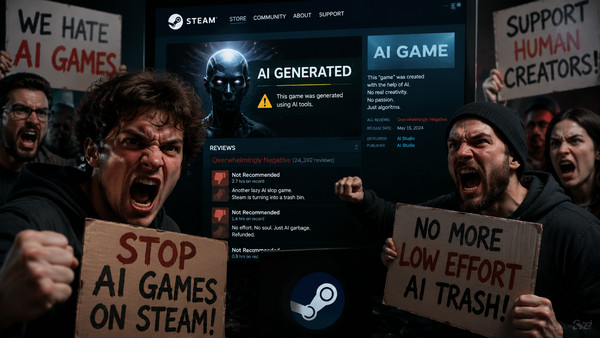
The dominant sentiment isn't necessarily a luddite rejection of technology, but a protective stance over the medium’s soul. Players are reacting against a perceived "infestation" of low-effort, mass-produced titles that prioritize cost-cutting over creative vision. The primary reasons for this backlash include:

The outcry is a defense of human passion, yet it creates a fascinating tension: while gamers voice loud opposition to visible generative AI, they are often unknowingly embracing the technology when it works behind the scenes.
Players Already Accept AI More Than They Realize
Despite the vocal protests currently echoing across Steam, the irony of 2026 is that AI has already become the silent backbone of the gaming industry.
From performance-boosting upscaling like DLSS to the complex pathfinding of enemies, players have spent decades demanding the reactive and polished experiences that only AI can provide.
Procedural generation in titles like No Man’s Sky, AI-assisted animation systems, and sophisticated NPC behavior are rarely protested; instead, they are viewed as essential production tools, comparable to middleware or stock assets.
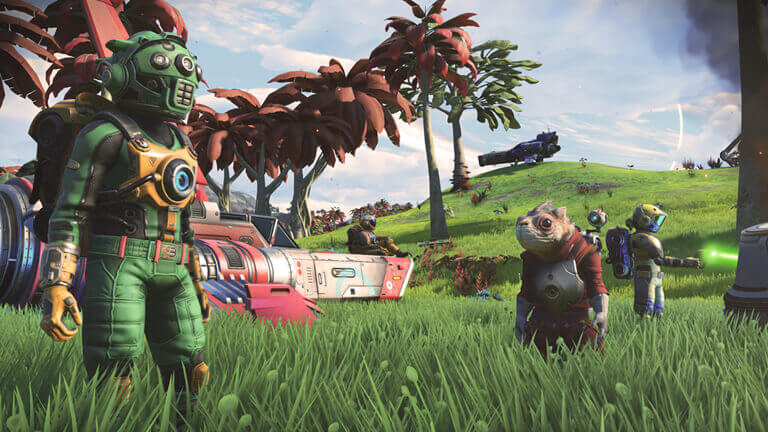
In these contexts, AI acts as a force multiplier—a tool that allows a developer’s intent to scale without the need to manually hand-craft every repetitive detail.
The divide in sentiment often falls along lines of community engagement. While highly online enthusiasts on platforms like Reddit or Steam forums scrutinize every texture for "AI artifacts," the broader mainstream and mobile audiences remain largely indifferent.
For the average player, the ultimate metric remains quality. If AI assists in localization to make a game playable in twenty languages, or refines a character's movement to feel more fluid, the player benefits without ever feeling the need to object.
The friction only ignites when the technology shifts from an "Invisible Wingman" to a "Visible Shortcut." When AI produces "slop", it feels lazy and deceptive.

Why Developers Are Turning to AI Anyway
For the dev behind the screen, the adoption of AI is rarely about laziness; it is increasingly about survival.
As the barrier to entry for the gaming market rises, AI has transitioned from an experimental luxury to a necessary tool for maintaining competitiveness.
Indie Game Development Is Brutally Expensive
In 2026, the "Indie-pocalypse" is marching towards a financial reality. Building an indie game is no longer just about having a strong idea or good taste. Small studios are facing a perfect storm of economic pressures:
AI Helps Small Teams Compete
For a small team, AI acts as a "force multiplier" that allows them to punch above their weight class:
Steam's Current Policy on AI-Generated Games
Valve’s stance on AI has evolved from a cautious "wait-and-see" approach to a formal system of transparency and accountability.
What Valve Actually Requires
To release a game on Steam in 2026, developers must complete a specific AI disclosure section within the Content Survey. Valve categorizes AI usage into two distinct buckets:
AI disclosure is only one part of the release process. Steam approval does not automatically confirm that every generated component is cleared for sale. Our guide to commercial use of AI-generated games explains how to review the tool's license, generated code, art, music, and third-party assets before launch.
If you are preparing a game for submission, our guide on how to publish a game on Steam explains the Steam Direct fee, store page setup, SteamPipe upload, Valve review, and final release steps.
Why Valve Is Walking a Tightrope
Valve is currently performing a delicate balancing act between two opposing forces.
On one hand, they want to remain the primary hub for technological innovation, recognizing that AI can empower creators to build experiences that were previously impossible.
On the other hand, Valve must avoid legal and reputational chaos. The murky waters of copyrighted training data present a constant threat of litigation, and the sheer volume of "AI slop" threatens to degrade the storefront's brand.
Why Some AI Games Succeed While Others Fail
In 2026, the market has matured enough to realize that AI itself is not a "death sentence" for a game’s reputation.
Successful AI Games Still Feel Human
The most successful AI-integrated games share one common trait: strong human direction.
Interestingly, players often cannot tell when AI is used effectively. There have been several high-profile cases in 2026 where human-made games were falsely accused of using AI simply because the art style was too "clean," proving that audiences aren't reacting to the tool, but to perceived quality signals.
The "AI Slop" Warning Signs Players Instantly Notice
Developers often accidentally signal low quality before a player even downloads the game. On Steam, gamers have developed a "sixth sense" for identifying "AI Slop" through specific red flags:
Trust Signals Matter More Than AI Usage
Building a successful game in the AI era is about managing the relationship with the community. Trust is the most valuable currency on Steam, and developers can build it through:
Ultimately, if the storytelling feels human and the artistic vision is consistent, players are remarkably forgiving of the tools used to get there.
Can AI Games Still Succeed on Steam in 2026?
Yes, but the novelty phase is officially over.
In 2026, players have developed a high sensitivity to low-effort automation, and quality expectations have skyrocketed.
The future of the platform belongs to AI-assisted games, not AI-generated ones. Success now requires a hybrid workflow where AI handles the heavy lifting of repetitive tasks—like generating base textures or boilerplate code—while human creators provide the final 20% of polish, soul, and intentionality. By using AI as a curated procedural system rather than a "make game" button, developers can deliver the scale of a larger studio while maintaining the unique, quirky perspective that players expect from indie titles.
Best Platforms for Experimental AI Games Besides Steam
If your project is highly experimental or relies on controversial "Live-Generated" AI, Steam’s rigid disclosure rules and critical user base might be a hurdle. Consider these alternatives:
| Platform | AI Community Reception | Discoverability | Best For |
| SoonLab | Highly Positive | Built specifically for AI creators; no stigma for prompt-based workflows or AI-generated logic. | Rapid Prototyping & AI Natives. |
| Itch.io | More accepting. A "no-barrier" culture. | Easier for niche projects but easy to get buried without a marketing push. | Early Alpha & Experimental games |
| Steam | Competitive and skeptical. High "AI Slop" alert. | Massive audience with powerful algorithm. | Polished Commercial Hits. |
| Epic Games Store | More curated. Focused on high-fidelity AI tools (Unreal Engine integration) | Harder entry for solo indie devs | AA/AAA AI Innovation. |
| Game Jolt | Younger indie audience. Receptive to new tech. | Social-driven with easier visibility | Community Building. |
Conclusion: The Future Depends on Human Creativity
In the end, the "AI-pocalypse" on Steam hasn’t destroyed AI game development; it has simply raised the bar for what constitutes a "real" experience. As we move through 2026, it is clear that AI is becoming a normalized part of the production pipeline, but "low-effort spam" is a fundamentally unsustainable business model. The novelty of automation has worn off, leaving players more discerning than ever.
The winners in this new landscape will be the developers who view AI as a sophisticated brush rather than a replacement for the painter. Players are not searching for mathematically perfect games generated by machines; they are searching for the messy, brilliant, and authentic experiences that only human intentionality can provide. AI can build a world, but only human creativity can give players a reason to stay in it. To survive on Steam, use AI for efficiency—but keep your soul at the center of the design.