
Choosing a game engine is often framed as a simple question: proprietary or open source?
It is not. The more useful question is what kind of responsibility you are ready to take on.
A proprietary engine can give you polished tools, documentation, support, and a workflow that many other developers already understand. An open-source engine can give you greater control, clearer access to the code, and fewer worries about being locked into one company's roadmap. Neither choice is automatically better. The right one depends on the game you want to make, the skills on your team, and how much technical ownership you can realistically carry after launch.
For most small teams, the goal should not be to find the most powerful engine in the abstract. It should be to choose the path that lets them finish, maintain, and grow the game they are actually trying to make. If you are new to development, learning how to make a small 2D game can clarify which engine features you actually need.
What Is a Proprietary Game Engine?
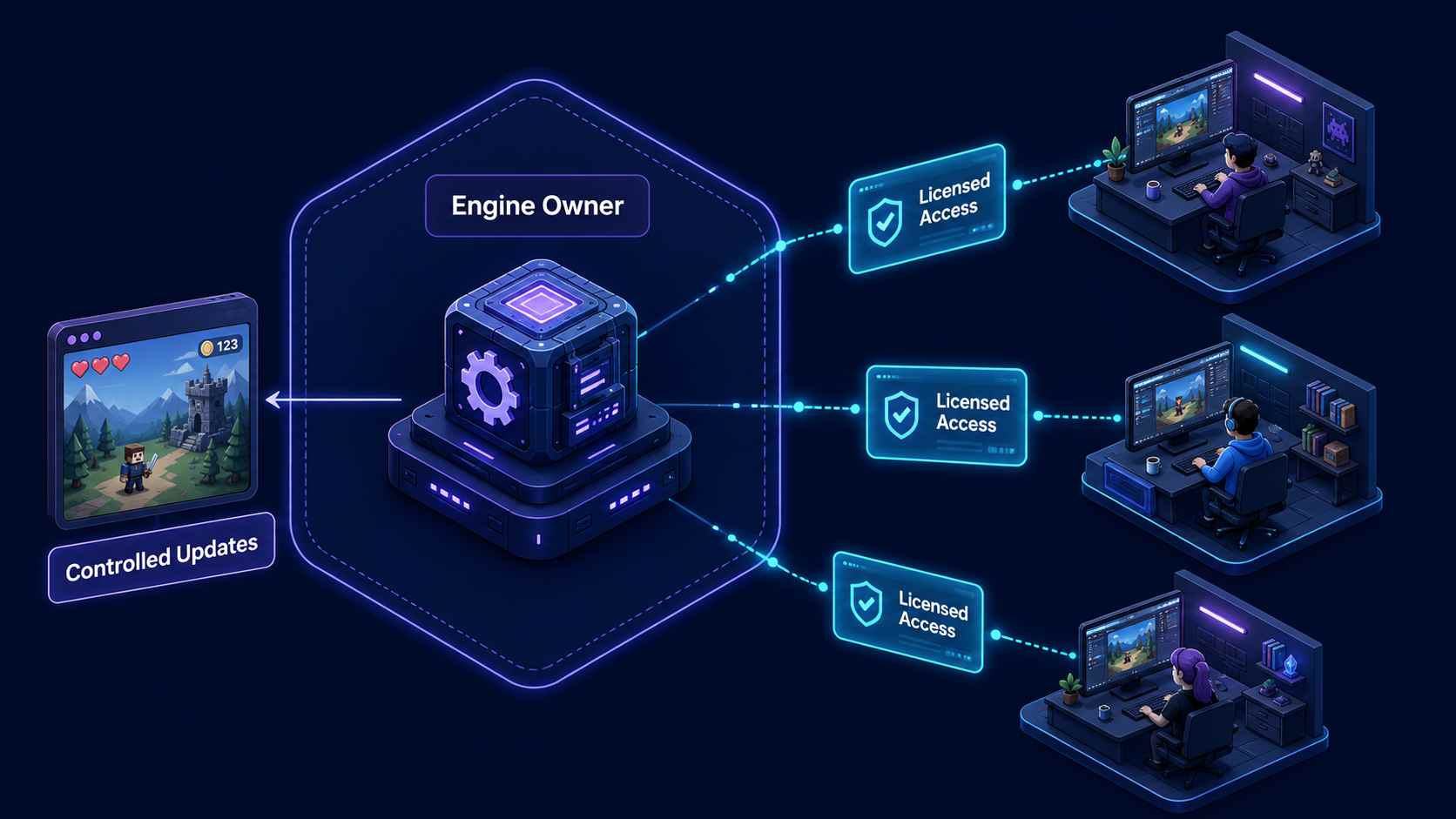
A proprietary game engine is a game-development framework owned by a company rather than released under an open-source licence. The owner sets the terms for access, use, distribution, and modification.
This does not always mean the engine is unavailable to independent developers. Unreal Engine, Unity, and GameMaker are proprietary tools available under their own licences, while Frostbite, RE Engine, and Rockstar’s RAGE are primarily built for the studios that own them. The key question is not whether an engine is powerful. It is how much control you keep when its terms, pricing, or roadmap change.
The Difference Is About Responsibility, Not Just Source Code
The usual comparison starts with source-code access. Open-source engines let developers inspect, modify, and distribute the code under the relevant licence. Godot, for example, uses the MIT licence, allowing commercial use and modification without engine royalties.
You can see this trade-off more clearly when comparing GameMaker, a proprietary engine focused mainly on streamlined 2D production, with Godot, an open-source engine that supports both 2D and 3D development. Our GameMaker vs Godot guide explains how their licensing, workflows, scripting options, and project scope differ in practice.
But source code is only one part of the decision. A proprietary engine may give you mature tools, official documentation, platform support, and an ecosystem that solves common production problems.
That is why "closed versus open" is too shallow a way to make the decision. The real trade-off is between relying on a mature external ecosystem and taking more responsibility for the technology underneath your game.
When a Proprietary Engine Is the Better Choice
A proprietary engine is usually the safer choice when your project needs established workflows more than it needs deep control over the engine itself.
This matters when you are working with contractors, hiring experienced developers, targeting several platforms, or using middleware that already has reliable integration. A familiar engine gives your team a shared language. You can search for common problems, find existing tutorials, and use tools that other studios have already tested in production.
Unreal Engine is a good example of why "proprietary" does not always mean inaccessible. Developers can access its source code, use its editor and tools, and build commercial games with it. However, the engine remains governed by Epic's licence. Under its current standard terms, royalties apply after a product passes $1 million in lifetime gross revenue, with separate rules for non-game use and certain distribution choices. Epic's current licensing page is worth reading directly before a project becomes commercially serious.
I would lean toward a proprietary engine when your team needs one or more of the following:
- a proven editor and asset pipeline;
- strong console, mobile, or platform support;
- third-party tools that your game depends on;
- documentation and support that reduce onboarding time;
- a workflow that collaborators or future hires already know.
The hidden value here is not simply visual quality or technical power. It is reduced uncertainty. A smaller team can often move faster by using an engine that already solves common problems well enough, rather than becoming responsible for every underlying system.
Where Proprietary Engines Can Become Expensive
The main risk is not that proprietary engines are bad. It is that your game becomes deeply tied to decisions you do not control.
Licensing terms can change. Pricing can change. A useful feature may be delayed, replaced, or removed. A platform update may force you to wait for an official fix. None of these risks automatically make an engine unsuitable, but they do matter more once your game, tools, team knowledge, and publishing process all depend on one ecosystem.
Many developers became more sensitive to this after Unity's attempted runtime-fee policy. Unity later cancelled the fee, but the episode made a lasting point: a development tool is not only a technical choice. It is also a business dependency. Coverage of the reversal shows why many teams began reassessing how much trust they were placing in a single platform.
There is also a practical limit to source access. Even when a proprietary engine lets you inspect some source code, you may not be free to distribute modified engine code, combine it with every licence you want, or build your own long-term fork without consequences. Access is useful, but ownership and freedom are not the same thing.
What Open Source Really Gives You
Open source is valuable when control over the technology is central to your game or business.
You may need to change a core system, fix a bug without waiting for an official release, build a specialised tool, keep an older version alive, or avoid being locked into a vendor's pricing and roadmap. In these cases, access to the engine code is not an abstract ideological benefit. It can be a practical way to protect your project.
Open source can also make a game easier to preserve and adapt over time. A team is not automatically dependent on one company continuing to support the editor, build pipeline, or platform integration in exactly the same way.
However, this freedom comes with work. If you modify the engine, you now need to maintain those changes. If a plugin is abandoned, you need to replace it. If your project depends on a platform feature that the community has not prioritised, the responsibility may eventually land on your team.
That is why an open-source engine is not simply "free." It can exchange licence costs for engineering time, technical ownership, and maintenance risk.
Open Source Is Not Automatically Easier for Small Teams
It is easy to assume that open source is the obvious choice for an indie team because there are no royalties. That can be true, but only when the team has enough confidence in the rest of the workflow.
A game is not shipped by an engine licence. It is shipped through an editor, assets, builds, testing, platform requirements, bug fixes, marketing deadlines, and the quiet work of keeping the project usable as it grows. A free engine can still become costly if it slows down every one of those steps.
This is especially important for beginners. If you are learning game development, an engine with a large tutorial library and a familiar workflow may help you finish your first game sooner than an engine that gives you more theoretical freedom. The best learning tool is often the one that gets you to a complete, playable result while you still have the energy to improve it. For a practical example of this visual, open-source approach, follow this GDevelop tutorial for beginners.
For creators who want a visual, browser-based way to begin, our guide to Roblox Studio alternatives is also useful because it separates full game engines from lighter no-code tools instead of treating them as identical choices.
Why Big Studios Build Proprietary Engines
When players hear that a studio uses a proprietary engine, it can sound like proof that custom technology is always superior. Usually, it means something more specific: the studio has a repeated technical problem large enough to justify owning the solution.
A studio making several open-world games may need a specialised streaming system. A team that ships multiplayer shooters repeatedly may benefit from tools built around its own networking, animation, and production pipeline. A company with many projects, experienced engine programmers, and long development cycles can spread the cost of that technology across several games.
That is very different from an independent developer making one game. Building a custom engine means delaying game-specific work while creating rendering, input, tools, asset handling, debugging, builds, and many other systems that existing engines already provide.
There are exceptions. A custom engine can make sense when the game's core idea truly depends on a technical capability that existing tools cannot support well. But "I want full control" is rarely enough on its own. Control is only useful if the team has time and expertise to use it.
For most small teams, borrowing mature technology is not a compromise in ambition. It is a way to keep ambition focused on the game rather than the infrastructure around it. If your first project is designed to be easy to share and test, this guide to making a web browser game can help you choose a lighter path before committing to a larger production setup.
A Better Way to Choose Your Engine
Before comparing feature lists, answer these questions honestly.
| Question | Choose proprietary engine | Choose open-source engine |
|---|---|---|
| What are you building? | You need a proven path to ship on your target platforms. | You need unusual technical control or a highly custom workflow. |
| Who will maintain the technology? | You want the engine owner and its ecosystem to carry more of that burden. | You have people who can inspect, modify, and maintain engine-level work. |
| How important is vendor independence? | You accept the licence and roadmap in exchange for mature tools. | You need the option to keep the technology alive on your own terms. |
| What is your real constraint? | Speed, hiring, platform support, and production reliability matter most. | Long-term control, custom systems, or licence flexibility matter most. |
If your answers are unclear, choose the option that lets you test the game sooner. Engine decisions become easier after you know whether the core loop, art direction, and player experience are worth building out. A focused video game prototype can answer those questions before you spend weeks committing to a technical stack.
You May Not Need an Engine Yet
Many creators start researching engines before they have a playable idea. That is understandable, but it can turn a creative question into a technology question too early.
If you are still deciding whether your puzzle, platformer, rhythm game, or simulation idea is fun, you may not need to commit to an engine at all. First make a small version with a clear goal, player controls, failure state, and restart loop. Let someone else play it. Notice where they hesitate, what they understand immediately, and whether they want another try.
That is where a prompt-to-play tool can be helpful. You can use SoonLab's game creation flow to turn a written idea into a playable browser prototype, then adjust the rules after testing. It is not a replacement for Unreal, Godot, or a custom engine when you need a full production pipeline. It is a practical way to find out whether your idea deserves that larger investment.
Once a prototype proves itself, you can make a more informed choice: continue refining a browser game, use a no-code game maker, or move into a traditional engine with a clearer technical target.
Conclusion
Choose a proprietary engine when mature tooling, support, team familiarity, and a reliable production path matter more than controlling the engine itself. Choose an open-source engine when the ability to inspect, modify, and maintain the technology is genuinely important to your game or business.
But do not build a custom engine simply because studios with much larger teams do. And do not choose open source only because it sounds freer. The best engine is the one whose trade-offs your team can still live with when the project is larger, slower, and more demanding than it is today.
If you are still at the idea stage, make something playable first. A real prototype will tell you far more about the engine you need than another week of feature comparisons.