
SoonLab promises a short path from a game idea to game you can actually play. You describe the game using prompts, answer a few questions from the AI, and wait while it builds a playable browser version.
This SoonLab review looks at how well the AI game maker handles real 2D and 3D projects. I tested the full process, from the initial prompt and AI confirmation to gameplay, controls, UI, and follow-up editing.
My short verdict is that SoonLab currently performs better with 2D games. The 2D result felt more complete and needed fewer changes. SoonLab also created a playable 3D game, but it worked better as a prototype, with some UI and visual details still needing refinement.
What Is SoonLab?
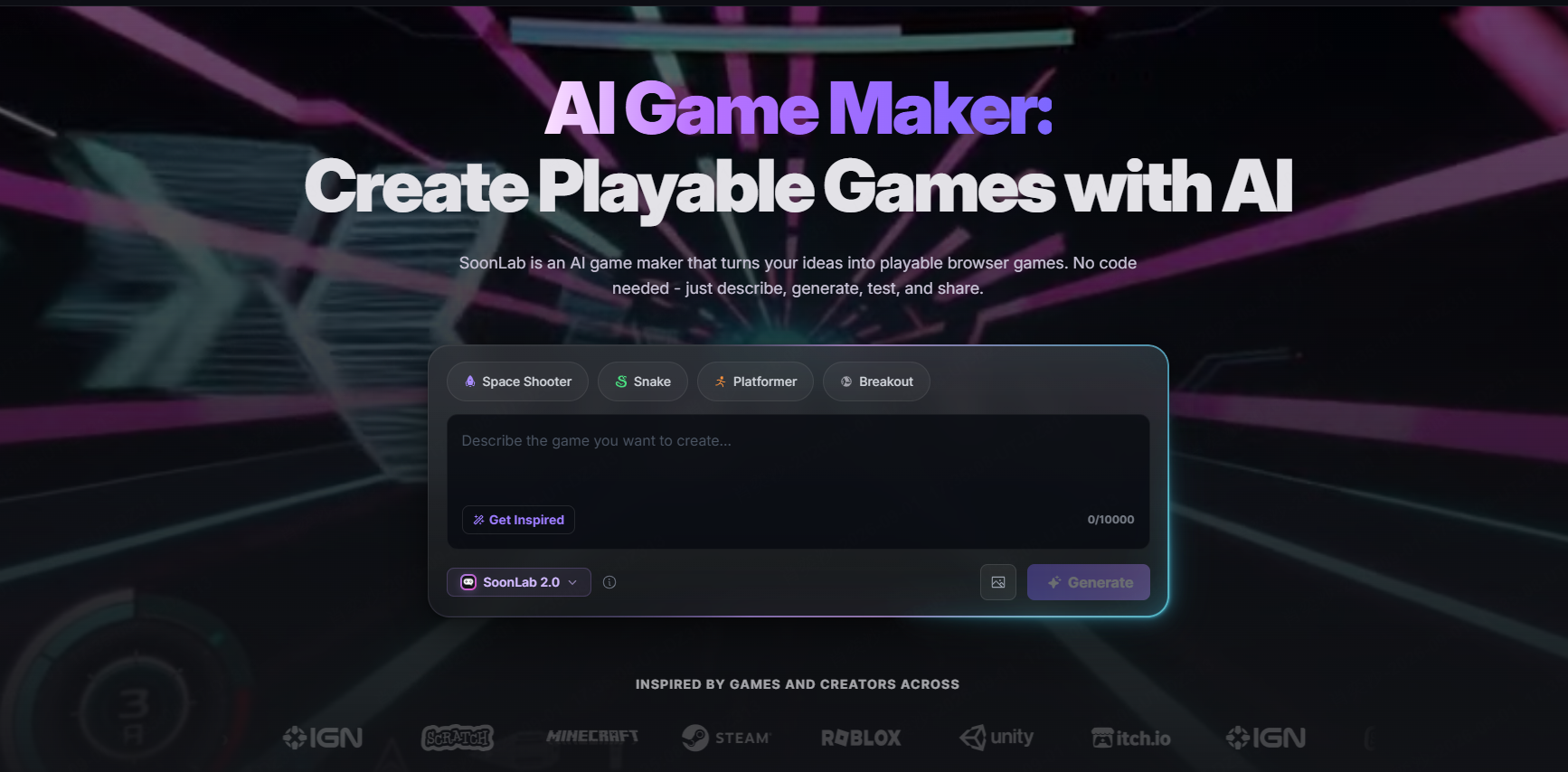
SoonLab is an AI game maker that turns a written idea into a playable browser game. Instead of building scenes, writing scripts, and connecting game logic manually, you explain what you want in natural language.
A typical SoonLab workflow looks like this:
- Describe the game, including its genre, controls, goal, and visual style.
- Answer questions from the AI when it needs more detail.
- Wait for SoonLab to generate the first playable version.
- Test the game in your browser.
- Request changes through follow-up prompts.
- Publish, share, or download the finished project when the relevant option is available.
SoonLab 2.0 supports both 2D and 3D game generation. It also adds a confirmation stage before generation, which gives users an opportunity to clarify the gameplay requirements before the AI starts building.
This workflow is different from using an engine such as Godot or Unity. SoonLab handles much more of the initial setup, but it gives you less direct control over every object and system. That tradeoff matters when deciding whether it fits your project.
Turn your idea into aplayable game
Describe the game you want to make, and SoonLab will help you start building it.
SoonLab Review: Quick Verdict
| Question | My Finding |
|---|---|
| Is SoonLab easy to use? | Yes. You can create the first version without writing code. |
| Can it make playable games? | Yes. Both test projects produced playable browser games. |
| Is it better for 2D or 3D? | The 2D result was more polished in my test. |
| Can it make 3D games? | Yes, but the result was more suitable for prototyping. |
| Can you edit the game? | Yes. You can request changes with follow-up prompts. |
| Does the first version need work? | Usually. Testing and focused revisions remain important. |
| Who is it best for? | Beginners, game idea prototyping, small browser games, educators, and creators. |
SoonLab is worth trying if your priority is getting from an idea to a playable version quickly. It does not remove the need to test and refine the game, but it makes the first step much easier for someone who does not want to begin with code or a traditional game engine.
SoonLab Review: Testing 2D and 3D Game Creation
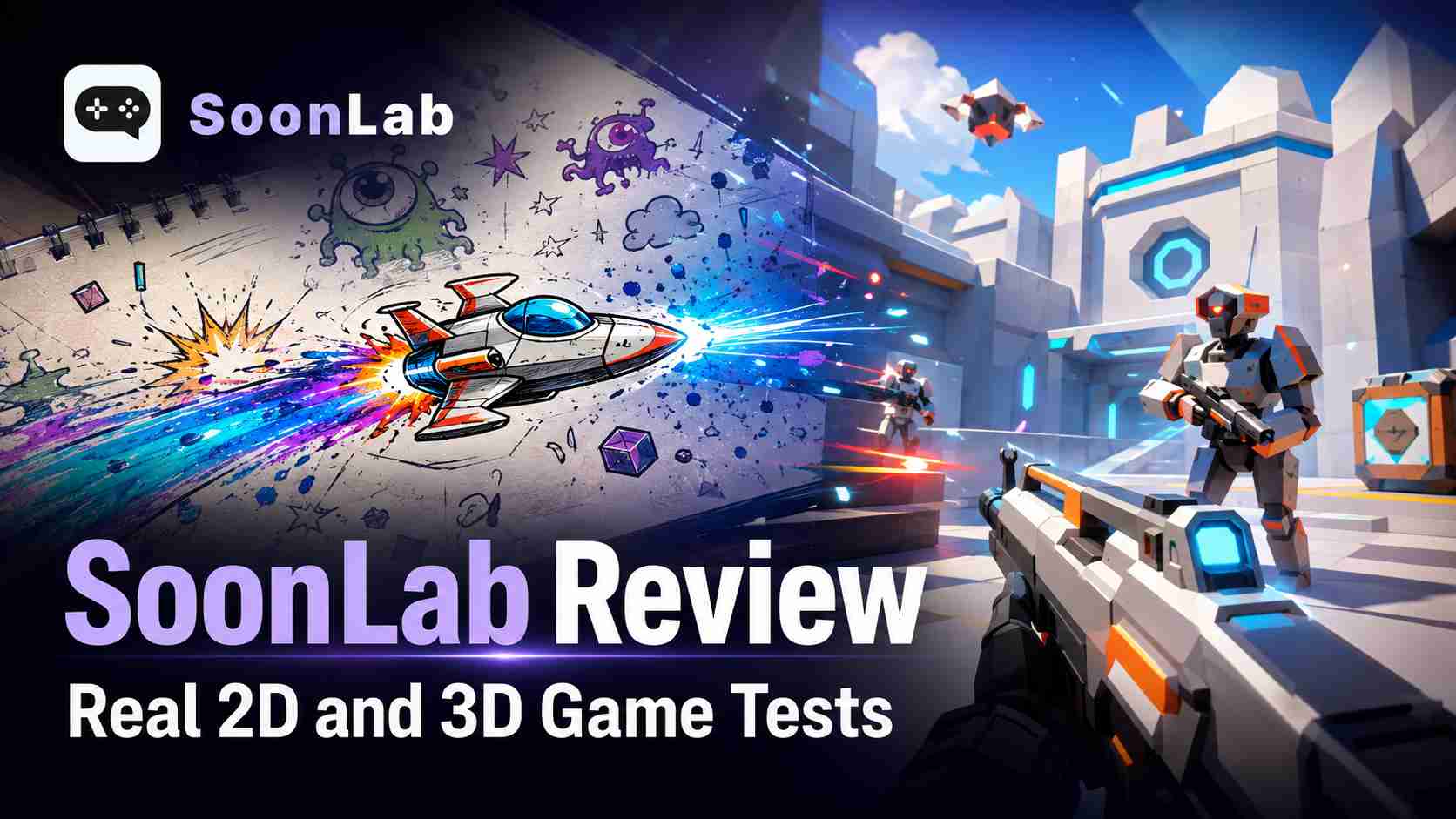
This SoonLab review covers two playable projects: the 2D mobile arcade game Ink Dash and the 3D arena FPS Pistol Colosseum. The tests focused on gameplay, controls, visual consistency, UI, and overall polish.
SoonLab 2D Game Test: Ink Dash
Ink Dash was designed as a one-tap mobile arcade game. The spaceship rotates until the player taps, then dashes in the direction it is facing. It leaves a permanent colorful ink trail, scores a point when it reaches a target, and ends the run if it hits the screen boundary.
2D Game Prompt
Create a portrait mobile arcade game called Ink Dash with a hand-drawn sketchbook style. Use one-tap controls, smooth rotation, fast directional dashes, persistent colorful trails, random targets, ink splashes, particles, screen shake, scoring, and arcade sound effects.
SoonLab captured the main gameplay loop well. The controls were easy to understand, the ink trails gave the game a clear visual identity, and the scoring and failure conditions worked together as a complete arcade experience.
The 2D result also felt visually consistent and needed less refinement than the 3D test. It showed that SoonLab works particularly well when a game has one clear mechanic and a focused scope.
- Clear one-tap gameplay
- Consistent sketchbook presentation
- Distinctive persistent ink trails
- Playable mobile-friendly result
SoonLab 3D Game Test: Pistol Colosseum
Pistol Colosseum was a more demanding test. The prompt requested a real browser-based 3D FPS with first-person controls, physics, shooting, enemies, health, ammo, scoring, a match timer, and a stylized sci-fi arena.
3D Game Prompt
Create a browser-based 3D FPS using Three.js, TypeScript, Vite, Rapier Physics, a perspective camera, and GLB/glTF assets. Include WASD movement, mouse look, jumping, collisions, shooting, raycast hit detection, enemies, health, ammo, reload, a crosshair, score, and a match timer. Use a bright low-poly sci-fi arena with white surfaces, cyan accents, strong sunlight, and soft shadows.
SoonLab produced a playable 3D FPS with the main movement, combat, and match systems in place. This made it useful for testing the core idea without first building the project in a traditional game engine.
The result was less polished than Ink Dash. Some UI elements did not feel fully integrated with the visual style, while parts of the environment still looked like an early prototype. The game worked, but it would need further UI and visual refinement before feeling ready for a polished release.
- Playable first-person controls and combat
- Working arena game structure
- Useful for rapid 3D prototyping
- UI and presentation still needed refinement
The two tests show that SoonLab currently performs best with focused 2D games. Its 3D generation can still create a working browser game, but the result is more suitable for testing mechanics and visual direction than producing a finished release in one step.
SoonLab Features and Editing Experience
1. Prompt-to-Game Generation
Describe the gameplay, controls, visual style, and goals in natural language. SoonLab turns the prompt into a playable browser game without requiring manual coding.
2. 2D and 3D Game Creation
SoonLab supports both 2D and 3D games. Based on this review, focused 2D projects generally feel more polished, while 3D generation is especially useful for rapid prototyping.
3. Game Preference Confirmation
Before generation begins, the AI confirms details such as the camera, controls, visual direction, and gameplay rules. This helps reduce misunderstandings caused by an incomplete prompt.
4. AI Game Editing
After testing the first version, you can use follow-up prompts to change the gameplay, controls, difficulty, UI, or visuals. Specific instructions usually produce more reliable changes than broad requests.
5. Image Input
You can upload an image with your prompt to provide visual direction, character references, or other context for the game you want to create.
6. Music and Sound
SoonLab can add audio to generated games, including background music and gameplay sound effects. Creators can also import music when they want more control over the game’s atmosphere.
7. Browser Playtesting
Generated games can be played directly in the browser, making it easy to check the controls, mechanics, difficulty, and bugs without installing a game engine.
8. Mobile Game Support
SoonLab can create browser games designed for mobile screens and touch controls. Prompts can specify portrait or landscape orientation and the intended input method.
9. Publishing and Sharing
Games can be published online and shared through a playable link. This is useful for collecting feedback, showing a prototype, or letting other people play immediately.
10. HTML Download
SoonLab supports downloading generated games as HTML when the option is included in the selected plan. The downloaded game can be saved, hosted, or developed further outside SoonLab.
11. Game Library and Discovery
Published games can appear in SoonLab’s game library and genre categories, where users can explore and play games made by other creators.
12. Community Features
Users can follow creators, favorite games, leave comments, and discover popular projects through rankings and community activity.
SoonLab Pricing: Is It Worth It?
SoonLab is free to try. New users receive 200 points after registration and can claim another 400 points by joining the SoonLab Discord community, bringing the available free balance to 600 points.
With these points, you can create up to three games using the more advanced SoonLab 2.0 or up to six games with SoonLab 1.0. This gives new users enough free credit to test several ideas before choosing a paid plan.
Paid plans provide more points and access to additional models and features. The value depends on your project: a focused 2D game may require fewer revisions, while a more complex 3D game may use more points as its mechanics, UI, and visuals are refined. Check the official SoonLab pricing page for current plans and limits.
SoonLab Pros and Cons You Should Know
 Where SoonLab Performs Well
 Current SoonLab Limitations
SoonLab vs Rosebud AI, Astrocade, and GDevelop
SoonLab, Rosebud AI, and Astrocade all reduce the time needed to turn a prompt into a playable browser game. GDevelop follows a different approach, combining a visual no-code engine with optional AI assistance.
| Tool | Best For | Main Difference |
|---|---|---|
| SoonLab | Fast 2D games and browser prototypes | Guided prompt-to-play workflow with browser testing and AI editing |
| Rosebud AI | 2D, 3D, and voxel browser games | Chat-based creation with broader creator and code-editing options |
| Astrocade | Casual games and social sharing | Combines AI creation with a social arcade platform |
| GDevelop | Projects that need more manual control | Uses a visual no-code engine and supports wider publishing options |
SoonLab is the better fit when speed and a guided AI workflow matter most. GDevelop offers more control for longer development projects, while Rosebud AI and Astrocade provide alternative approaches to prompt-based creation. See the full SoonLab vs Rosebud AI comparison for a closer look at the two platforms.
FAQs About SoonLab AI Game Maker
Is SoonLab Legit?
Yes. SoonLab is a working AI game maker that creates playable browser games from text prompts. The 2D and 3D examples in this review can be played directly on SoonLab.
Is SoonLab Free?
Yes. SoonLab is free to try. Additional generations, advanced models, export options, and commercial-use features may depend on the selected plan. Check the SoonLab pricing page for current limits.
Can SoonLab Make a Complete Game?
Yes. SoonLab can create a complete gameplay loop with controls, objectives, scoring, and win or failure conditions. Small, focused projects are more likely to feel polished than games with many complex systems.
Is SoonLab Better for 2D or 3D Games?
SoonLab supports both, but the 2D game in this test was more polished and visually consistent. The 3D result was playable but better suited to prototyping.
Do I Need Coding Experience to Use SoonLab?
No. Games can be generated and edited with natural-language prompts. However, understanding the intended controls, goal, difficulty, and failure conditions will help you write a clearer request.
Can I Edit and Download a SoonLab Game?
Yes. You can request changes through follow-up prompts and download the game as HTML when that option is included in the selected plan or workflow.
Can SoonLab Games Be Used Commercially?
Yes. However commercial-use rights may depend on the current plan and terms. Review SoonLab’s latest pricing and usage terms before selling or monetizing a generated game.
Who Is SoonLab Best For?
SoonLab is best suited to beginners, students, game jam participants, and creators who want to test an idea without setting up a traditional game engine. It is especially useful for focused 2D browser games and early 3D prototypes that need to be shared or tested quickly.
It is less suitable as the only development tool for large open worlds, complex multiplayer games, or highly polished commercial 3D projects. Developers who need direct control over every asset, object, and system may prefer Godot, Unity, Unreal Engine, or GDevelop.
Final Verdict
SoonLab is worth trying if you want to turn a game idea into a playable browser experience without starting with code. The 2D test produced the more cohesive result, while the 3D test showed that SoonLab can build a working FPS prototype but may need further UI and visual refinement.
SoonLab’s main strength is not producing a finished commercial game from one prompt. It is helping creators reach a playable version quickly, test the idea, and improve it through focused instructions.