
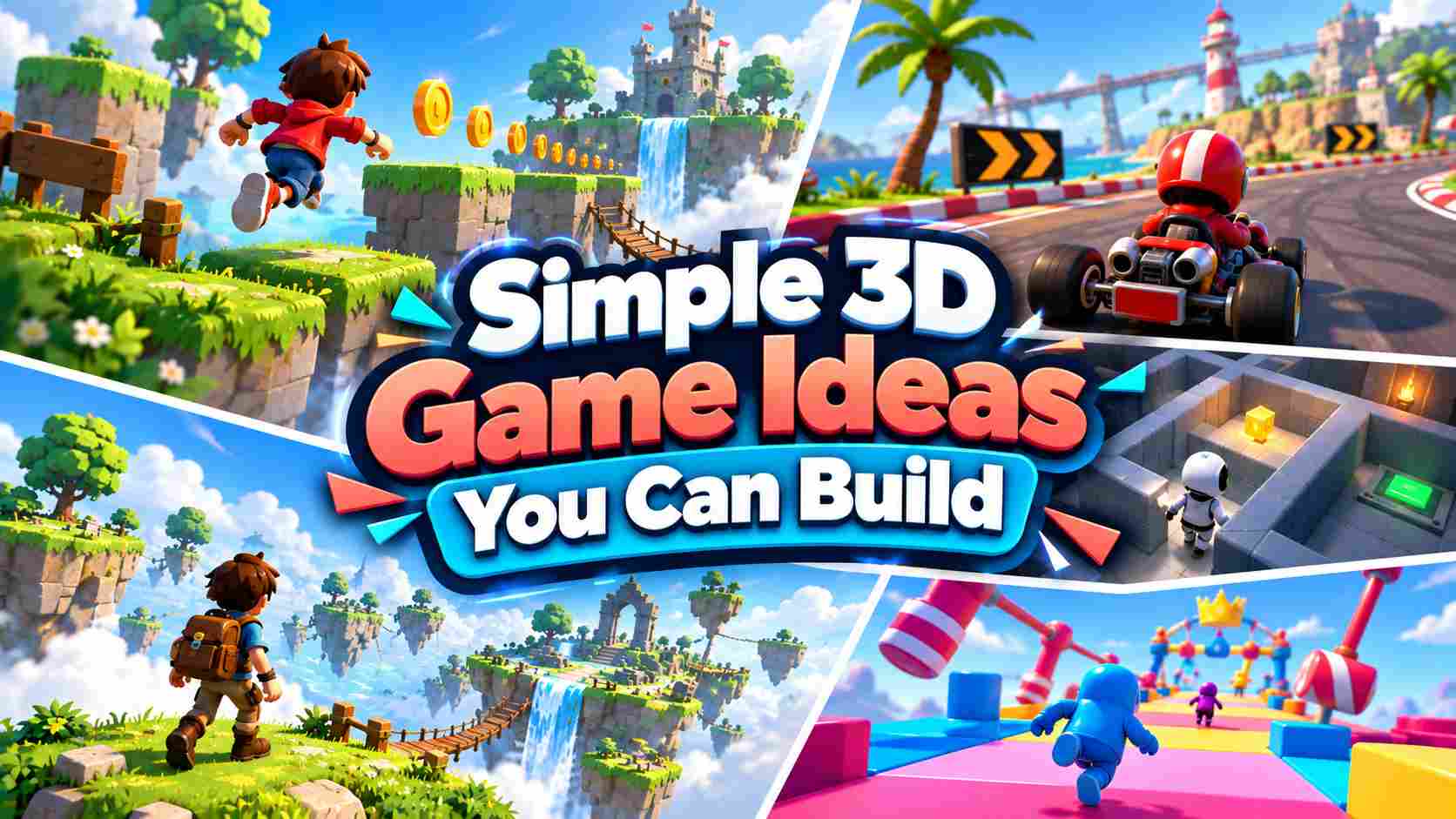
A robot that walks in its sleep. A bowl of soup you must deliver without spilling. A museum statue that moves when nobody is watching. A small 3D game can have a memorable idea without needing a huge world or a long story.
I would start with a familiar action and give it one unusual rule. Below are 15 simple 3D game ideas you can adapt, followed by advice on choosing a manageable project and turning it into a playable version.
Turn your idea into aplayable 3D game
Describe the game you want to make, and SoonLab will help you start building it.
15 Simple 3D Game Ideas You Can Build
Pick an idea that makes you curious, then build just the scene described. Each concept has one main action and a clear goal, so you have a focused starting point.
 Also Read
1. Rescue the Last Plant on a Space Station
"Carry a thirsty plant through a small space station to a sunlit window. Stop at three water stations along the way, but avoid hot pipes that drain its water. The plant droops when it is thirsty and grows new leaves when you reach the light."
I like the clear relationship between care and progress: the plant shows you how well you are doing. Start with one corridor, one water station, and a visible water meter. Keep the plant attached to the player so you do not need a separate carrying system.
2. Deliver Soup Without Spilling It
"Carry a bowl of soup across a tiny café and place it on a customer's table. Move slowly around chairs and floor bumps because sudden turns spill the soup. Finish with at least half the bowl remaining, then try again to beat your delivery time."
The interesting choice is whether to hurry or protect the soup. You can represent spills with a meter that drops when the player turns too quickly. The first version does not need realistic liquid simulation.
3. Catch Escaping Shadows
"Explore one room where three objects have lost their shadows. Rotate a lamp to move each shadow across the floor and guide it back beneath its object. When all three shadows return, a hidden door appears."
This is a good fit if you enjoy visual puzzles. Treat each shadow as a flat shape on the floor and let the lamp move it along a set path. Matching the shape to an outline gives you a simpler first version than simulating accurate shadows.
4. Park a Shopping Cart in the Wind
"Push an empty shopping cart across a small parking lot into its marked bay. Short gusts of wind nudge it sideways, so use walls as shelter and choose when to move. Reach the bay without bumping into parked cars."
The wind gives an ordinary parking task a playful twist. Use one cart, one gust direction, and a wide parking bay first. Show the next gust with a moving flag so players can plan instead of guessing.
5. Guide a Sleepwalking Robot
"A sleepy robot walks straight ahead through a small workshop. Place three arrow tiles on the floor to guide it around hazards and back to its charging dock. You can move the tiles before starting the robot, then watch whether your route works."
Planning comes before movement here, so the player can solve the puzzle at their own pace. Begin with a small grid and a robot that turns when it reaches an arrow. Add a reset button so a failed route is easy to try again.
Turn your idea into aplayable 3D game
Describe the game you want to make, and SoonLab will help you start building it.
6. Return Lost Stars to the Sky
"Collect five fallen stars scattered across a rooftop and carry them to a small telescope. Each returned star lights up part of a constellation above you. Find all five to reveal a glowing creature in the night sky."
The reward is seeing the sky change after each delivery. Use a fixed camera and a flat rooftop for the first version. The constellation can be a simple group of lights that turns on one star at a time.
7. Photograph a Shy Ghost
"Search a small house for a ghost that hides when you look directly at it. Spot it in mirrors, line up your camera, and take a photo before it moves. Capture it in three different rooms to complete your ghost album."
The mirror rule gives players a reason to look at the room differently. It is also one of the more demanding ideas in this list. Start with a ghost that appears only inside a framed mirror image, then add a photo button and one success state.
8. Roll a Marble Through a Giant Breakfast
"Guide a marble across a breakfast table, using a spoon as a ramp and toast as a bridge. Avoid sticky jam patches that slow you down and reach an egg cup at the far end. Keep the first course to one plate and three obstacles."
Oversized everyday objects make the course easy to imagine. Use simple ramps shaped like cutlery and wide bridges before adding narrow paths. The main task is making the ball and camera feel predictable, not creating detailed food models.
9. Sort Packages on a Tiny Floating Island
"Pick up three packages and deliver them to houses on a floating island. Each package changes how you move: one is heavy, one makes you bounce, and one slides when you stop. Match the symbols on the packages to the houses and return to the landing pad."
The package changes how you approach the same route. Start with only the heavy package, which slows movement, and one destination. Add the bouncing and sliding versions separately once picking up and delivering work reliably.
10. Turn a Room into a Musical Instrument
"Walk around a small room and tap hanging bells, wooden boxes, and glass bottles. Repeat a short melody played by a bird at the window. Each correct note adds color to the room, and completing the melody opens the window to let the bird inside."
Sound becomes both the clue and the reward. Start with three objects and a three-note pattern, with symbols lighting up as each note plays. A replay button lets players hear the pattern again without restarting the game.
Turn your idea into aplayable 3D game
Describe the game you want to make, and SoonLab will help you start building it.
11. Sweep Clouds Away from a Picnic
Control a little weather drone above a picnic blanket. Push three rain clouds toward an empty pond before they soak the food. Clouds drift back slowly, so choose which one to move first and keep the blanket dry until the timer ends.
You create a small game about managing space rather than fighting enemies. Begin with one cloud that moves away when the drone touches it. Add a visible rain meter over the blanket before introducing several clouds at once.
12. Escape a Museum as a Runaway Statue
"Play as a small statue trying to reach the museum's delivery door. Move when a rotating security light points away, then stand still on a display base when it turns toward you. Cross one gallery without being spotted."
The fun comes from switching between movement and pretending to be part of the display. Use one light rotating on a fixed path and two display bases. Show clearly when the statue is hidden so players understand why they were caught.
13. Build a Bridge with Your Own Footprints
"Walk across a small island where every few steps create a solid footprint tile behind you. Pick up those tiles and place them across a narrow gap to reach the exit. You have just enough tiles, so plan where the bridge begins before placing them."
Your own movement creates the material you need to finish. In the first version, place bridge tiles only in marked spaces and let players take them back. This keeps the puzzle focused and avoids a complex free-building system.
14. Feed a Lighthouse Its Missing Colors
"Carry red, blue, and yellow light orbs to a lighthouse on a tiny coastal island. Deliver them in the order shown by a passing boat's signal. Each correct orb changes the lighthouse beam, and the final color guides the boat safely to shore."
This idea combines delivery with a small memory challenge. Start with one boat signal and three orb stands beside the lighthouse. Use different symbols for the colors and allow the player to replay the signal.
15. Play Mini Golf in a Clockwork Garden
"Aim a golf ball through a small garden where one flower opens and closes like a gate. Time your shot to pass through the petals and reach the hole. Start with one hole, one moving flower, and a stroke counter."
The flower adds a timing decision to a familiar game. First make a flat hole with a barrier that opens and closes. Add the petals and garden theme after aiming, shot strength, and the stroke counter work.
Turn your idea into aplayable 3D game
Describe the game you want to make, and SoonLab will help you start building it.
Which 3D Game Idea Should You Start With?
Choose the action you want to work on, then check which extra systems it needs. A short description can hide a lot of work: a mirror game may need special rendering, while mini golf depends on reliable physics.
For a First Project: Start with Collection or Delivery
I would choose Return Lost Stars to the Sky or the smallest version of Feed a Lighthouse Its Missing Colors. Both can work with basic movement, collecting objects, and visible progress. Use a fixed camera and let touching an object collect it automatically.
For a Puzzle: Make the Rules Visible
Try Guide a Sleepwalking Robot if you enjoy planning routes. Choose Turn a Room into a Musical Instrument if you want a memory challenge. In either case, the player should see or hear why an action worked. A wrong answer should lead to another attempt, not an unclear failure.
For Movement and Physics: Expect More Tuning
Roll a Marble Through a Giant Breakfast, Deliver Soup Without Spilling It, and Clockwork Mini Golf depend on how movement feels. Keep the first level short so you can repeat it while adjusting speed, stopping distance, and collision behavior.
If you want to turn one of these concepts into a larger puzzle or driving project later, our guides to making a puzzle game and creating a car game explain the next steps.
How to Come Up with Original 3D Game Ideas
I would start with an action you enjoy, then imagine an unusual place to do it. Rolling a ball becomes more memorable when the course is a giant breakfast table. Delivering an object feels different when you are carrying soup that might spill.
Next, give the player one interesting choice. In the star collection game, carrying only one star at a time could make the order of collection matter. In the soup game, a short, bumpy route and a longer, smooth route create a choice between speed and safety.
To develop your own 3D game idea, answer four questions:
- What does the player do? Choose one main action, such as collecting, pushing, aiming, or rolling.
- What makes the setting interesting? Try a familiar place at an unusual scale, or give an everyday task a surprising purpose.
- What choice does the player make? Add a shortcut, a carrying limit, or an obstacle that changes when or where they move.
- Why does the game need 3D? Use height, depth, slopes, or objects that players must move around. Make the space part of the challenge.
Then describe the idea in one sentence: “The player does X in Y, but must deal with Z.” For example: “Deliver soup across a tiny café, but choose between a bumpy shortcut and a longer, safer path.” If the idea needs several sentences to explain its basic rules, simplify it before building.
Keep the first version focused on that action and choice. In a Reddit discussion about beginner game ideas, replies suggested reducing a game the creator enjoyed to its smallest complete version. You can use the same approach: keep the part that interests you, give it your own setting or rule, and save extra systems for later.
Try the idea in one small level with a clear goal and a restart. Ask whether the choice actually changes how you play. If both routes feel the same, adjust their risks or rewards before adding more content.
Turn a Simple 3D Game Idea into a Real Game
With SoonLab's AI 3D game maker, you can turn an idea into a playable browser game without writing code. Describe the setting, controls, and goal, then play the result and ask for changes through chat. You can update several parts in one message, share the playable link, or download the HTML.
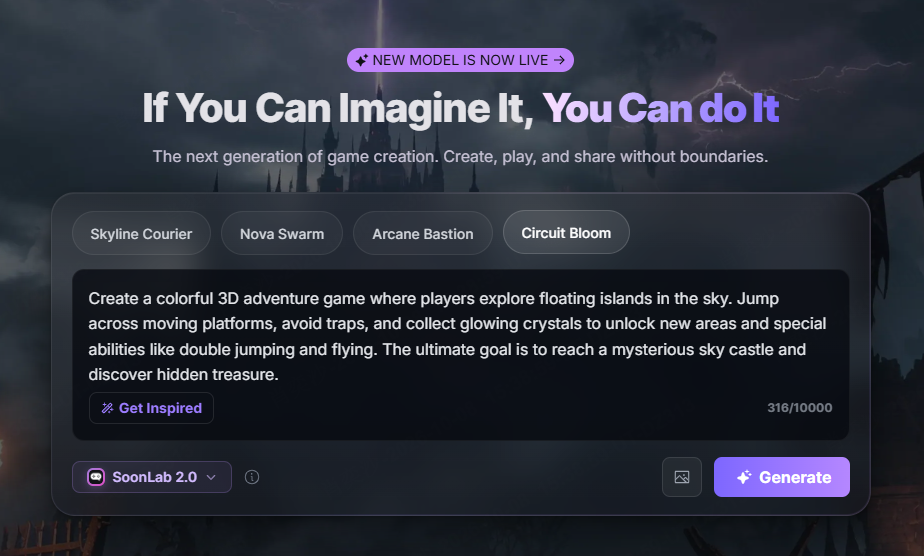
STEP 1 Describe Your Game
Explain what the player does, how they move, and how they win. For example: “Make a small 3D rooftop game with a fixed camera. Use arrow keys to move and collect five stars. Show a star counter and a restart button.” For more inspiration, see our AI game prompt examples.
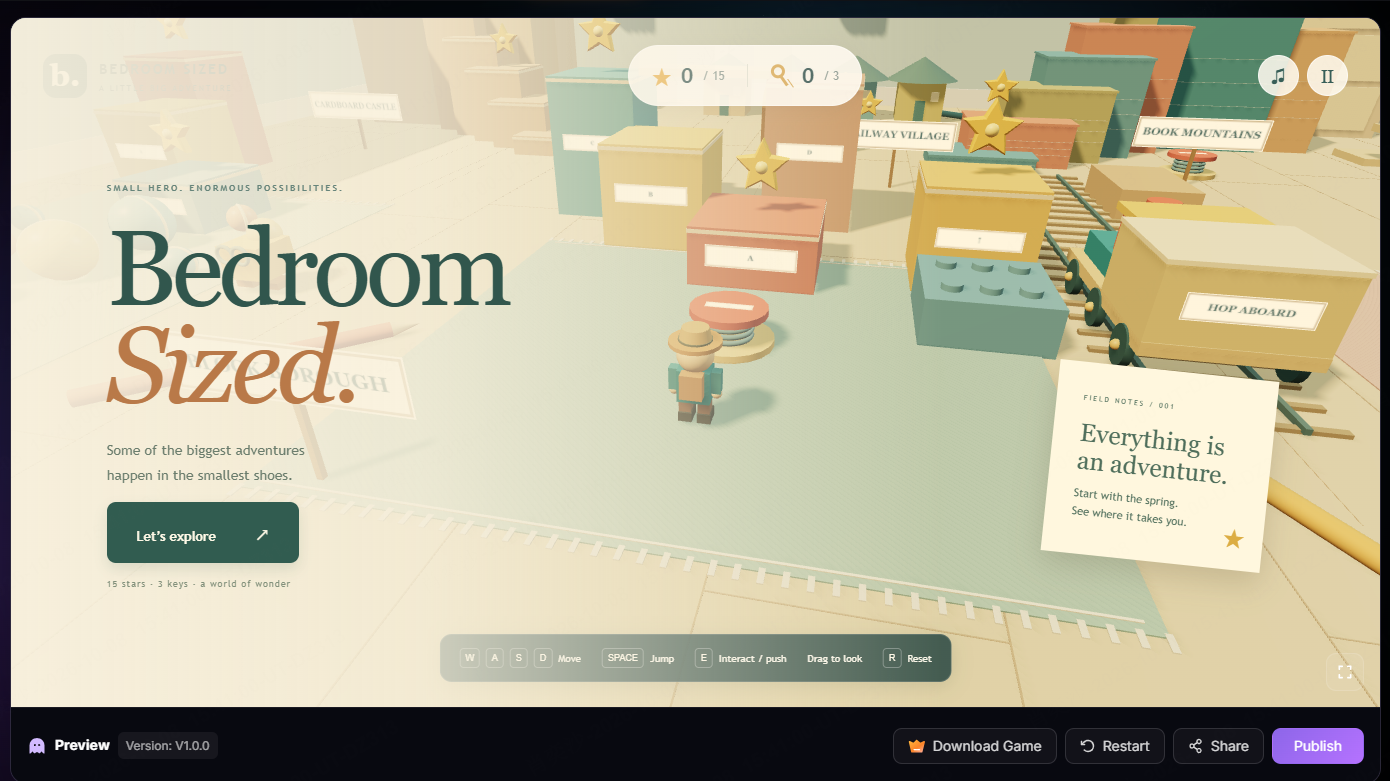
STEP 2 Play the First Version
Try the controls, collect all five stars, and restart. Check that each star counts once and that restarting resets the game. Our game prototyping guide offers more help when you need it.
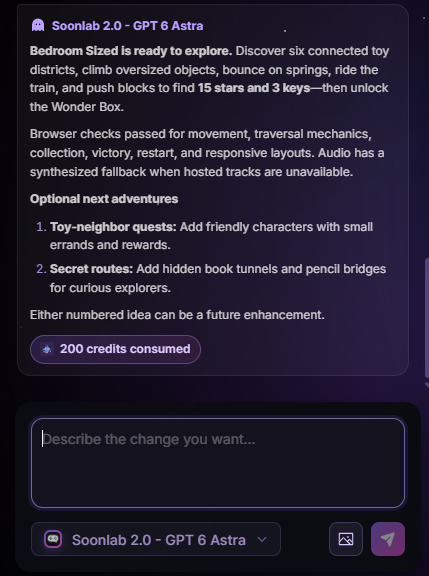
STEP 3 Describe Your Changes
Tell SoonLab what you want to change. You can include several updates in one message, such as “Move the camera higher, slow down the character, and make the stars brighter.” Play the updated game and keep refining it through chat.
If you prefer working in a game engine, explore our 3D game engine comparison to find a tool that fits your project and skills.
FAQs About Simple 3D Game Ideas
What is a good first 3D game to make?
A small collection game is a good starting point. Use a fixed camera, place a few objects in one area, and give the player a clear goal. The star collection idea above is a practical choice: you can focus on movement, collecting, and finishing a round before adding jumping, enemies, or complex physics.
How small should my first 3D game be?
Aim for one short, complete level with one main action. The player should be able to understand the goal, reach an ending, and restart. A few minutes of gameplay is enough for a first project. Keep the artwork simple too—detailed models and animation can add a lot of work even when the map is small.
Should I learn 2D game development before 3D?
You do not have to, though a small 2D game can make the basics easier to learn. If 3D is what interests you, start with a fixed camera, simple shapes, and a small level. Avoid learning movement, camera controls, animation, and complex physics all at once. Our 2D vs 3D game guide can help you compare the two approaches.
Do I need to make my own 3D models?
No. You can test a game with cubes, spheres, and other basic shapes. If you are working in an engine, ready-made models are another option. Check that the engine supports their file format and that their license allows your intended use. Our list of free game asset websites can help you find assets when you are ready to replace the placeholders.
Conclusion
A simple 3D game idea can still give players an interesting choice. Collecting stars, guiding a sleepwalking robot, or delivering soup each offers a clear action you can turn into a small, complete game. I would pick the one you most want to play and start with its simplest version.
Ready to try yours? Describe it to SoonLab's AI 3D game maker to create a playable browser game without writing code. Play the result, ask for changes through chat, and share it for feedback. Let that first version show you what makes the idea fun and what to improve next.