
If you are wondering whether GPT-5.6 Sol can turn a game idea into something you can actually play, the short answer is yes—but only within a clear scope.
It can build a small browser game, create or improve a Godot prototype, connect several gameplay systems, and fix problems after testing its own work. It cannot take one vague prompt and independently deliver a balanced, polished commercial game.
For this GPT-5.6 Sol game development review, I examined OpenAI's documentation, the latest GameDevBench results, and public projects shared online. I did not reproduce every demo, so I treat official facts, benchmark results, and community examples as different levels of evidence.
Can GPT-5.6 Sol Really Build a Playable Game?
Yes, it can build a playable game when the project is small enough and the development environment gives it a proper feedback loop.
GPT-5.6 Sol is OpenAI's flagship model for complex coding and tool-based work. It accepts text and image input and has a 1.05 million-token context window, according to the official GPT-5.6 Sol model page.
In practice, that means giving it:
- A clear game loop
- A codebase or starter project
- Access to the engine, browser, or terminal
- Concrete acceptance criteria
- Screenshots, gameplay state, tests, or error logs
- A human who reviews the result
With those pieces in place, Sol can write player controls, enemy behavior, scoring, inventory, UI, checkpoints, save logic, and other connected systems. It can also run the project, find errors, and improve the first version.
Without them, you are mostly asking a LLM to guess what a finished game should be. That is why a detailed build-and-test process produces much stronger results than a one-shot prompt.
How Strong Is GPT-5.6 Sol for Game Development?
GPT-5.6 Sol is currently one of the strongest LLM for technical game development. It performs especially well when it can work inside a real codebase, run the game, inspect errors or screenshots, and improve its work through several testing cycles.
Its main strengths are writing gameplay systems, modifying several connected files, debugging technical problems, and turning a clear game plan into a playable prototype. It is less reliable at visual polish, UI quality, game balance, and deciding whether a game is actually fun.
Based on the available evidence, I would describe its game development ability this way:
| Game Development Task | GPT-5.6 Sol's Strength | What This Means |
|---|---|---|
| Gameplay logic | Strong | It can build movement, combat, enemy behavior, scoring, inventory, checkpoints, and win or loss conditions. |
| Multi-file implementation | Strong | It can connect gameplay code, UI, save data, and tests across an existing project. |
| Debugging with feedback | Strong | It performs better when it can run the game, inspect logs, view screenshots, and test controls. |
| Rapid game prototyping | Strong | It can turn a well-defined game loop into a small playable browser or Godot prototype. |
| UI and visual polish | Uneven | It can create functional interfaces and visual effects, but the result often needs human design review. |
| Game balance and player experience | Limited | It cannot reliably judge pacing, difficulty, clarity, or long-term enjoyment without human playtesting. |
| Building a complete commercial game alone | Not reliable | Large games still require human direction, code review, art, QA, playtesting, and production decisions. |
What Does GameDevBench Show?
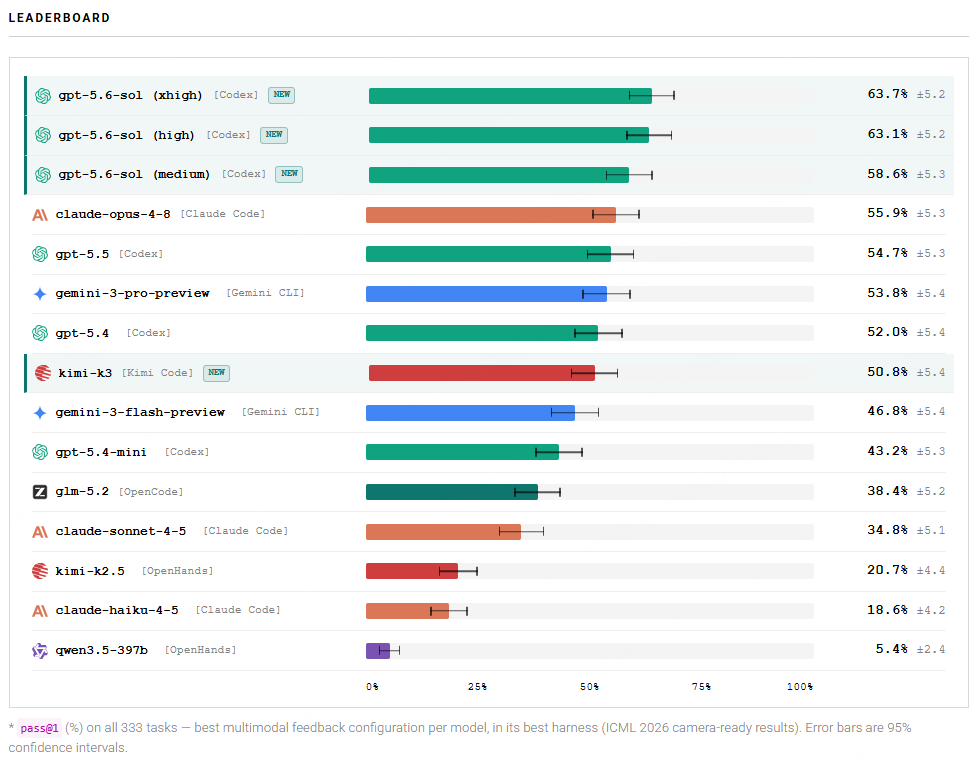
The strongest public evidence comes from GameDevBench. Created by researchers from Carnegie Mellon University and Princeton University, the benchmark evaluates coding agents on 333 real Godot tasks.
These tasks cover gameplay logic, UI, shaders, sprites, animation, and 2D and 3D graphics. This makes the benchmark more relevant to game development than a general coding test.
As of 2026, GPT-5.6 Sol leads the public leaderboard:
| Model and Setup | GameDevBench Pass@1 |
|---|---|
| GPT-5.6 Sol xhigh in Codex | 63.7% |
| GPT-5.6 Sol high in Codex | 63.1% |
| GPT-5.6 Sol medium in Codex | 58.6% |
| Claude Opus 4.8 in Claude Code | 55.9% |
| GPT-5.5 in Codex | 54.7% |
| Kimi K3 in Kimi Code | 50.8% |
There are three important takeaways from these results.
- Sol has a meaningful lead. The xhigh configuration scores 7.8 percentage points above Claude Opus 4.8 and 9 points above GPT-5.5.
- Higher reasoning helps, but the gains are not always large. Sol high reaches 63.1%, only 0.6 percentage points below xhigh. This suggests that the highest reasoning setting may not be necessary for every game development task.
- Sol is still far from fully autonomous. Even its best configuration fails about 36% of the benchmark tasks. A leading score does not mean that the model can complete every feature correctly without review.
The benchmark also shows that visual work remains harder for AI agents than gameplay logic. Across the tested models, the average success rate was 51.4% for gameplay tasks, compared with 33% for 2D graphics and 32% for UI tasks.
This difference matters in real projects. Sol may successfully build a health system, enemy wave system, or checkpoint mechanic while still producing a confusing interface, awkward animation, or visually unbalanced scene.
Do Real GPT-5.6 Sol Game Projects Support the Results?
Public projects generally support the benchmark findings. They show that Sol can build connected game systems quickly, but they also show that the development process matters as much as the model.
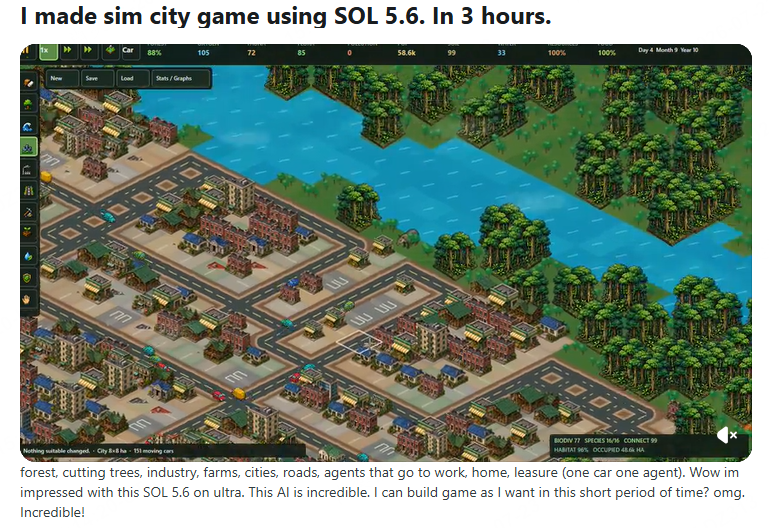
- One creator used Sol Ultra to build a small city simulation with forests, farms, roads, industry, cities, and agents moving between work and home. The prototype was created in about three hours. This is strong evidence for rapid prototyping, but it does not prove that Sol could independently develop and maintain a complete SimCity-scale game.
- Another creator used GPT-5.6 Sol to improve a freerun game with movement, animation, camera behavior, effects, audio, HUD, and course design. In this game development case study, Sol could play the game with real input, inspect its state, compare screenshots, and revise the code. The result still needed human polish, but the creator started with a coherent game instead of a broken prototype.
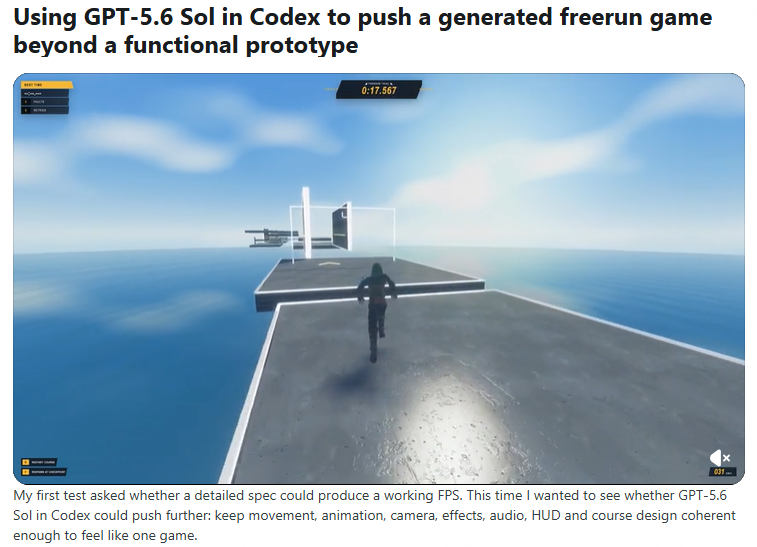
The second example is more useful for judging Sol's real ability. It shows that GPT-5.6 Sol becomes much stronger when it receives continuous feedback from the running game. A one-shot prompt may produce something playable, but a build-test-inspect-revise loop produces a more coherent result.
Short demonstrations on X and YouTube can show the model's range, but they are weaker evidence of reliability. Viewers usually cannot inspect the full prompt, failed attempts, manual edits, source code, or test results.
How Strong Is GPT-5.6 Sol Overall?
My conclusion is that GPT-5.6 Sol is strong enough to be a serious game development assistant and prototype builder. It can handle more than isolated code snippets. With the right tools, it can work across a project, connect several mechanics, test the result, and fix many of its own mistakes.
However, it is not strong enough to replace a complete game development team. It still needs a human to define the creative direction, limit the scope, review the code, judge visual quality, test the player experience, and decide when the game is ready.
The best way to use Sol is not to ask it to "make a full game." Give it one clear gameplay loop, one feature, or one technical problem at a time. That is where its current game development ability is strongest and most reliable.
What Are the Limitations of GPT-5.6 Sol in Game Development?
GPT-5.6 Sol is strong at writing game code, connecting systems, and fixing technical problems. However, game development involves much more than producing code that runs.
The model still needs human direction in the areas that shape the quality, stability, and long-term value of a game.
1. It Cannot Reliably Judge Whether a Game Is Fun
Sol can check whether an attack deals the correct damage or whether a level ends when the player reaches the exit. It cannot reliably decide whether the combat feels satisfying, whether the difficulty increases at the right pace, or whether players will want to continue playing.
These questions depend on player behavior and experience. Game balance, pacing, progression, reward systems, and difficulty still require human playtesting.
You can ask Sol to analyze playtest data or suggest possible improvements, but it should not be the final judge of whether a mechanic is fun.
2. Visual Quality and Art Direction Can Be Inconsistent
GPT-5.6 Sol accepts image input, but the model itself produces text. It can write shaders, SVG graphics, procedural objects, particle systems, and UI code. It can also use screenshots to identify visible problems.
However, it does not replace a complete game art pipeline. Character design, animation quality, visual hierarchy, environmental storytelling, and consistency across scenes still need artists or specialized visual tools.
This weakness also appears in GameDevBench. Across the tested agents, success rates were lower for UI and 2D graphics tasks than for gameplay logic.
3. It Can Lose Control of Large, Connected Projects
A small prototype may contain only a few systems. A complete game can include combat, inventory, quests, dialogue, saves, UI, audio, physics, multiplayer, monetization, and platform services.
When too many systems are changed in one task, Sol may create unnecessary complexity, modify unrelated files, or solve one problem while introducing another. A large context window helps it read more of the project, but it does not guarantee that every dependency will remain correct.
For this reason, developers should divide large features into smaller tasks. Each change should have clear acceptance criteria, tests, and a reviewable set of modified files.
4. It Depends on the Tools and Feedback You Give It
Sol performs best when it can read the repository, run the game, inspect logs, capture screenshots, and test the result. Without this feedback loop, it may produce code that looks correct but fails inside the real project.
A successful compilation is also not enough. The game may still contain broken collisions, confusing controls, camera problems, incorrect save behavior, or UI elements that fail on smaller screens.
The model becomes more reliable when it can see and test these problems. It should not be treated as equally capable in a simple chat window and a complete game development environment.
Bonus Tip: A Simpler Way to Test a Game Idea
GPT-5.6 Sol is most useful when you need code-level control and already have a repository, game engine, and testing workflow. However, that setup may be more than you need when you only want to find out whether a game idea works.
For early concept testing, a dedicated AI game maker can offer a faster route to something playable. SoonLab lets you describe the gameplay, rules, controls, and visual style in a prompt, then turns the idea into a playable browser game that you can test and refine.
Turn your idea into aplayable game
Describe the game you want to make, and SoonLab will help you start building it.
SoonLab cannot create a complete AAA game from one prompt, and it does not replace a full production pipeline. Its value is rapid prototyping: you can test a core mechanic, show the concept to teammates, collect early feedback, and decide whether the idea is worth developing further.
Use Sol when you need deeper implementation or want to modify an existing codebase. If you first need a playable version of an idea without setting up a full development environment, you can create a game prototype with SoonLab.
You can test the game that I generated using the prompt on SoonLab:
FAQs
Can GPT-5.6 Sol create a complete video game?
No. It can create a small video game or strong prototype. Commercial games still need human design, engineering, art, QA, and maintenance.
Do I need coding experience to use GPT-5.6 Sol for game development?
You can start without deep coding knowledge, but you still need to judge whether the result works. Beginners should keep the first project small, save working versions, and require the model to test and explain its changes.
Does GPT-5.6 Sol work with Unity, Godot, and Unreal Engine?
It can edit projects in engines, such as Unity and Unreal when it has the files and tools. GameDevBench is based on Godot, so results may differ in other engines.
Is GPT-5.6 Sol better than Claude Fable 5 for game development?
There is not enough independent, game-specific evidence to name one winner for every project. Sol leads GameDevBench, but Claude Fable 5 is not listed there. Community comparisons remain mixed.
My Final Verdict
GPT-5.6 Sol is a capable game development agent, but it is not an autonomous game studio.
I would use it to build a vertical slice, add a clearly defined feature, investigate a difficult bug, or improve a prototype through repeated testing. I would not ask it to design and ship a large game with little supervision.
The 63.7% GameDevBench result shows that Sol can complete serious game development work. The remaining failures show why your workflow still needs tests, visual inspection, code review, and human playtesting.
Choose GPT-5.6 Sol when you want code-level control and already have—or want to manage—a real development project. If your priority is simply reaching a first playable browser game without handling a repository or engine, a dedicated tool such as SoonLab offers a shorter path.