
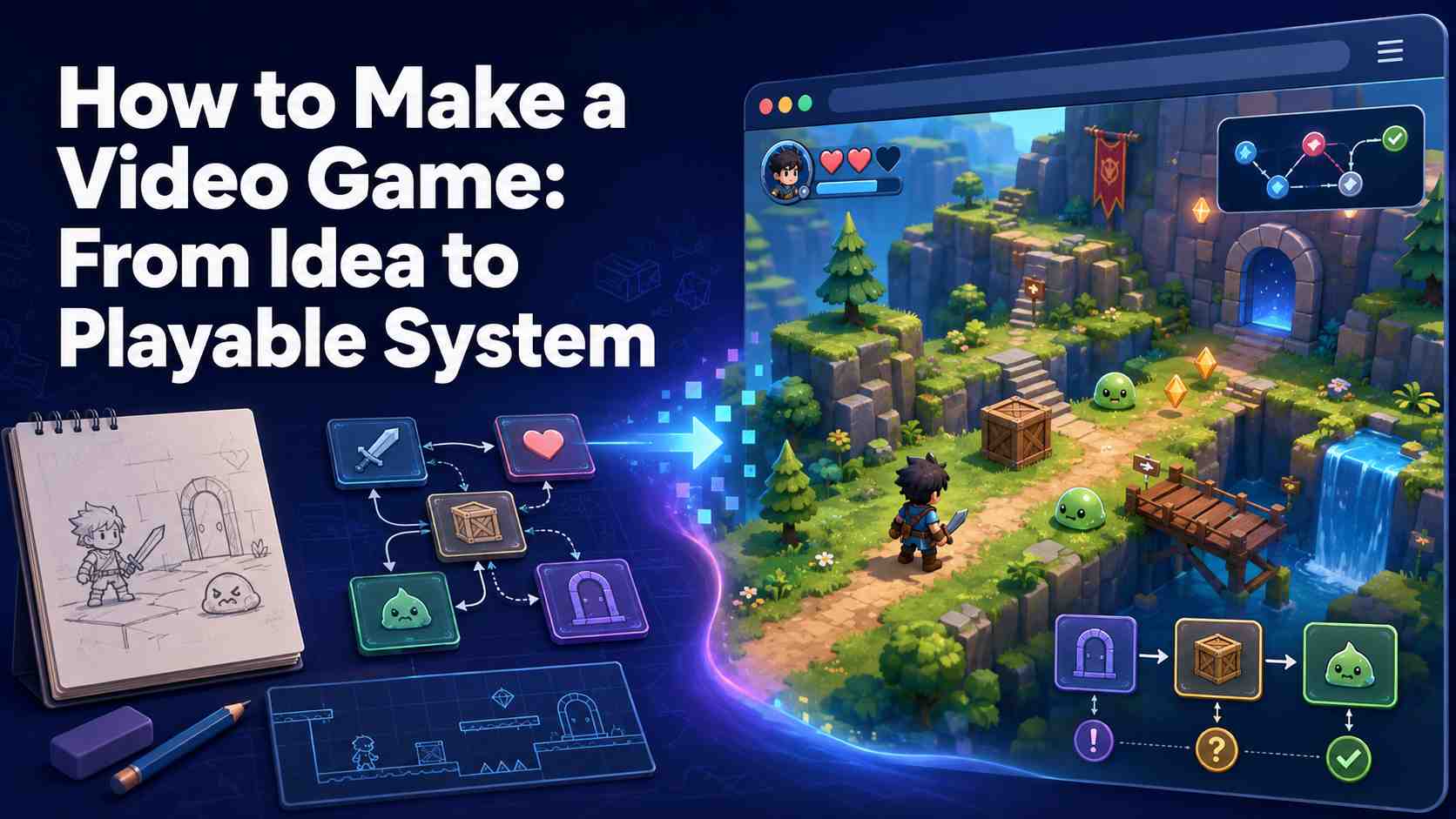
To make a video game, define what the player repeatedly does, build the smallest version that can test that experience, and watch how real players respond. Only then should you invest in more art, levels, features, or marketing.
This is why a setting is not yet a game. “A fantasy world with crafting” describes a theme and a feature. A playable system explains what the player collects, creates, risks, learns, and tries to achieve. In Minecraft, mining, crafting, building, and surviving continually change what the player can do next. The world matters because the player can act on it.
This guide follows the practical path from idea to release, but it focuses on the decisions behind the steps: how to shape a game system, control scope, research the audience, test the biggest risk, and decide what deserves full production. Let's get started!
Turn your idea into aplayable game
Describe the game you want to make, and SoonLab will help you start building it.
The Roadmap: How to Make a Video Game from Start to Finish
Most successful game-making processes share the same backbone: define, research, prototype, test, produce, and release. Each stage should answer a different question.
| Stage | Question to answer | Useful deliverable |
|---|---|---|
| 1. Define the player promise | What should the player get to feel or become? | A one-sentence promise |
| 2. Shape the game system | What does the player repeatedly do, decide, and learn? | A core-loop map |
| 3. Research the audience | Who already wants this experience, and what do they expect? | A comparable-game map |
| 4. Identify the biggest risk | What uncertain assumption could invalidate the project? | One testable hypothesis |
| 5. Build a prototype | What is the cheapest playable test of that hypothesis? | A short, rough build |
| 6. Observe players | What does their behavior reveal? | Test notes and a decision |
| 7. Produce the complete game | Can you make the experience clear, reliable, and repeatable? | A production plan and finished build |
| 8. Release and learn | Can the right people understand, find, and play it? | A store or share page and launch data |
A hobby project can move through these stages informally. A commercial project needs stronger evidence because every extra month increases the cost of being wrong.
See how It Takes Two Connects the Eight Stages
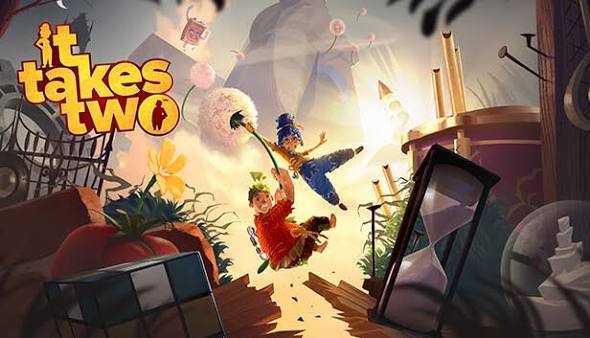
It Takes Two makes the roadmap easy to see because one promise—two people must truly cooperate—shaped the game from concept to distribution. Public sources do not reveal every internal milestone in a perfect sequence, but the visible decisions show how the stages support one another.
| Stage | It Takes Two example |
|---|---|
| Player promise | Two players become Cody and May, a couple who can move forward only by working together. |
| Game system | Each character receives different abilities. Progress depends on combining them rather than letting one player do everything. |
| Audience | Hazelight built on its experience with story-driven co-op in A Way Out instead of treating the audience as completely unknown. |
| Biggest risk | A mandatory two-player adventure had to remain varied while making both players feel necessary. |
| Prototype | An interview with Hazelight designers describes early prototypes as rough and unfinished, allowing abilities and levels to change before final art. |
| Player observation | Director Josef Fares told Wired that couples playtested the game and showed different levels of harmony. Their communication was part of what the team could observe. |
| Production | The team expanded the co-op principle across platforming, puzzles, action, and level-specific abilities while keeping story and gameplay connected—Hazelight’s stated main development priority. |
| Release | The Friend’s Pass reduced a predictable obstacle by allowing the owner to invite a second player for the full game. |
The reusable lesson is alignment, not scale. The player promise became a filter for the mechanics, playtests, content, and buying model. A five-minute browser game can use the same discipline.
Turn a Game Idea Into a Playable System
A game is a conversation between the player and a system. The player acts, the game changes, the player reads the result, and then makes another decision. If that exchange is unclear or uninteresting, a larger world will not fix it.
Tetris shows how much structure can exist inside a simple idea:
| Design element | Question | Tetris example |
|---|---|---|
| Player promise | What experience are you delivering? | Create order while pressure keeps rising. |
| Core verbs | What can the player do? | Move, rotate, and drop pieces. |
| Meaningful decision | What choice has future consequences? | Place a piece for an immediate line or preserve space for a better combination. |
| Pressure | Why can the player not wait forever? | Pieces keep falling and the stack grows. |
| Feedback | How are consequences communicated? | Completed lines disappear, the score rises, and the board opens up. |
| Progression | How does the challenge develop? | Faster pieces leave less time to inspect the board. |
| Finish line | What completes a session? | The stack reaches the top, leaving a final score to beat. |
A meaningful choice needs a tradeoff, cost, or uncertain outcome. In Tetris, filling a gap now can damage the space needed for a later piece. The same principle applies to an RPG dialogue choice, a strategy-game upgrade, or a route through a platformer. If one answer is always correct, the player is following an instruction rather than making a decision.
Write your first loop in one line:
The player [takes an action], reads [feedback], and chooses [the next action] while [pressure] moves the game toward [a clear outcome].
Prototype the Riskiest Assumption
A prototype should answer a question, not reproduce the whole game at lower quality. Identify the assumption that could make the rest of the work irrelevant, then build the cheapest test that can challenge it.
| Risk | Question illustrated by a familiar game | Useful test |
|---|---|---|
| Design | Could a new Portal player predict where an object will exit and how momentum will behave? | One greybox room with two portal surfaces and one goal. |
| Technical | Could a Minecraft-style voxel world generate, load, and save chunks fast enough? | An isolated terrain and save-load test without finished art. |
| Production | Could a small team sustain a Cuphead-like hand-drawn animation pipeline? | Finish one representative enemy and measure the real hours. |
| Market | Can the intended audience understand why an unfamiliar genre combination is appealing? | A concept page, short trailer, or focused demo shown to relevant players. |
Turn the risk into a statement that can fail:
We believe [specific players] will [observable behavior] because [design reason]. We will reconsider the design if [failure evidence].
For a Portal-style puzzle, the test might ask whether first-time players can use two linked portals to reach an elevated exit after one safe demonstration. If they repeatedly walk past valid surfaces or cannot predict where they will emerge, the next step is clearer feedback or a simpler teaching room—not another ten levels.
Use the fastest tool that preserves the behavior being tested. Paper can test turn-based resource choices. A conventional engine may be necessary for networking, physics, or performance. For a short web-game loop, SoonLab’s text-to-game AI can produce a playable browser version for early testing. This guide to video game prototyping explains how to match the prototype to the question.
Turn your idea into aplayable game
Describe the game you want to make, and SoonLab will help you start building it.
After the test, make a decision:
| Decision | Evidence | Next move |
|---|---|---|
| Continue | Players understand the main action, make the intended choices, and want another attempt. | Preserve the loop and test the next risk. |
| Iterate | Interest is present, but rules, controls, pacing, or feedback block it. | Change the clearest cause and test again. |
| Redesign | The main action feels flat or one answer always dominates. | Change the decision structure, not only the presentation. |
| Stop | The core experience remains weak while the content required to support it is expensive. | Record the lesson and redirect the time. |
Research the Market Before Full Production
Market research does not mean copying the best-selling video game or searching only for an empty niche. It means learning which players already want the experience, which patterns successful games satisfy, and where your idea can serve those players differently.
If the project is purely for learning or personal expression, a few comparable games may be enough. If you hope to attract strangers or recover development costs, market uncertainty needs its own evidence.
Define the Audience by Behavior
“Players aged 18–35” rarely helps a design decision. Describe what people choose and why: players who return to Hades to experiment with builds, players who use Minecraft as a creative space, or partners looking for a story-driven game they can complete together. Those behaviors suggest different session lengths, difficulty curves, interfaces, and marketing messages.
Study Patterns Before Gaps
Choose five to ten games that share the audience, fantasy, mechanic, presentation, price, or expected play length. For each one, record:
- the player promise and repeated loop;
- the hook shown in the first screenshots or trailer moments;
- session length, progression, and apparent production scope;
- what positive reviews repeatedly celebrate;
- which expectations negative reviews say were not met.
Start with what good games consistently do well. If several successful games reach a meaningful decision quickly, teach through safe early situations, and communicate consequences clearly, those are audience expectations worth learning from. A content gap matters only when players care about it and your team can serve it well.
Do not convert every complaint into a feature. If players say a strategy game becomes predictable, the need may be evolving decisions rather than ten more units. Reviews are evidence of expectations, not a ready-made development backlog.
Use the Language Players Recognize
Store vocabulary shows how players classify experiences. Steam says tags help customers understand a game and influence where it appears. Its guidance recommends specific descriptions of genre, perspective, visual style, theme, mechanics, and activities; the top five tags should give a clear picture. That makes Steam’s tag system useful research vocabulary even before you create a store page.
Try to describe the game with five precise terms. “Co-op,” “puzzle,” “split screen,” “story rich,” and “3D platformer” tell a player more than “indie,” “casual,” or “adventure” alone.
Test Concept Interest Separately from Gameplay
A prototype asks whether the experience works. A concept page, trailer, or store page asks whether the promise attracts attention. A compelling theme can earn clicks while hiding weak play; a good prototype can remain invisible if nobody understands its appeal from the outside.
Wishlists are one signal of potential interest, not guaranteed sales. Steam describes them as a way to gauge interest and notify players about releases, discounts, and demos. Use wishlist data alongside demo completion, playtest behavior, follows, and qualitative feedback.
Decide What You Are Actually Trying to Finish
“Finish a game” can describe very different outcomes. Choose the deliverable before the tool.
| Goal | Best first deliverable | Useful definition of success |
|---|---|---|
| Learn game design | One complete playable loop | You can explain what the test taught and what changed. |
| Build a portfolio | A polished vertical slice | It clearly demonstrates the skill you want to be hired for. |
| Share a short game | A complete browser-sized experience | Players can start, understand, finish, replay, and share it. |
| Release commercially | A validated concept, prototype, and production plan | Evidence supports demand, quality, scope, and financial viability. |
A portfolio piece does not need twenty hours of content. A learning project does not need monetization. A commercial game needs more than a fun mechanic; it also needs an audience, a sustainable pipeline, and a discoverable promise.
Read Player Behavior Instead of Asking “Is It Fun?”
“Is it fun?” encourages a polite opinion. Give the build to someone who has not watched you make it, avoid explaining the rules, and observe how the person forms a plan.
| Observe | What it can reveal |
|---|---|
| Time to first meaningful action | Whether the opening is clear and the main promise arrives quickly. |
| Repeated misunderstanding | A rule, control, symbol, or consequence is unclear. |
| Choice distribution | One option may dominate, or the choices may feel arbitrary. |
| Recovery after failure | Whether players understand what happened and can form a new plan. |
| Voluntary retry | Whether curiosity, mastery, or alternative outcomes pull them back. |
After the session, ask what the player thought the goal was, which decision required the most thought, when the plan changed, and what they would try differently next time. One person can reveal a severe usability problem; repeated behavior across several relevant players is more useful for judging the design itself.
Turn the Prototype Into a Complete Game
A prototype proves that one possibility works. A complete game supports the entire session, including the moments that are easy to ignore while testing the main mechanic.
| Production layer | What “complete” requires |
|---|---|
| Clarity | Players understand the goal, controls, state, and consequences without the creator beside them. |
| State completeness | Starting, pausing, winning, losing, restarting, settings, saving, and ending work where needed. |
| Pacing | New situations deepen the decisions instead of only increasing numbers. |
| Variation | Levels, enemies, tools, or story beats justify the intended play length without repeating solved work. |
| Reliability and access | Performance, inputs, readable text, accessibility, aspect ratios, and full playthroughs work on target platforms. |
Portal does not begin with its hardest spatial puzzles, and Tetris does not need dozens of unrelated mechanics to create progression. Completion is not the same as maximum content. Polish clarifies a working experience; content extends it. Neither repairs a weak core loop.
Choose a Production System You Can Sustain
Choose an AI game maker, visual editor, conventional engine, or code-first framework based on the project’s bottleneck—not on which tool appears most professional.
Constraints are normal. The GDC 2025 State of the Game Industry survey reported that half of developers self-funded their games and one in three used generative AI to streamline development. Time and production cost deserve the same attention as creative ambition.
| Bottleneck | Practical response |
|---|---|
| Programming | Reduce technical novelty, use visual logic or AI assistance, or work with a programmer. |
| Art and animation | Choose a sustainable style and time one representative asset before committing. |
| Content volume | Use systems that recombine well, shorten the game, or build level tools first. |
| Testing | Add repeatable test builds, external players, instrumentation, and a clear bug process. |
| Discovery | Clarify the promise, test store assets early, and give relevant players a demo. |
Estimate scope with real samples. If one finished enemy takes three days, fifty enemies are not a small plan. Measure the slowest repeatable unit—an environment, quest, animation set, puzzle, or dialogue scene—then include testing and rework.
AI can reduce the cost of reaching a playable test. It can help produce a first implementation, placeholder assets, code explanations, variations, or test cases. It cannot decide which player promise deserves pursuit, whether the result feels coherent, or which attractive feature should be removed.
Keep the design judgment human-owned: set the constraints, play every build, reject output that weakens the identity, and verify licenses, privacy, and commercial-use terms. Use AI to learn sooner, not to create so much material that the game loses its center.
A Working Brief for Your Own Video Game
Before opening an engine or prompting an AI game maker, complete this one-page brief:
Player promise: The player gets to feel or become…
Target player: People who currently enjoy… because…
Comparable games: We share… but differ by…
Core loop: The player repeatedly…
Meaningful decision: The player must choose between…
Pressure and feedback: The game creates pressure through… and shows consequences through…
Biggest risk: We do not yet know whether…
Prototype: The smallest test includes… and excludes…
Success and stop evidence: We will continue if… and reconsider if…
Finish line: This project is complete when…
A blank field is useful. It identifies the next question that research or a prototype should answer.
FAQs
Should story or gameplay come first?
Start with whichever creates the player promise, then translate it into action. A story-first game still needs participation; a mechanics-first game still benefits from context that explains why the action matters. It Takes Two works because the relationship story and forced cooperation support the same experience.
Do I need coding skills to make a video game?
No. You can use an AI game maker, no-code editor, templates, or collaborators. Coding becomes more important when the project needs custom systems, performance optimization, complex integrations, or complete technical control. Without coding, you still need to define rules, judge the result, test it, and control scope.
Can AI make a complete video game?
AI can create complete small games and accelerate parts of larger projects. As complexity grows, more human work is required to maintain coherent design, reliable systems, consistent assets, rights compliance, and production control. Treat AI as leverage inside the process, not a replacement for it.
How long does it take to make a video game?
A focused prototype can take hours or days; a polished short game may take weeks or months; a larger commercial game can take years. Genre labels are poor estimates. Count the real units of work, measure one representative sample, and include time for testing, rework, and release.
Conclusion
When you make your own video game, the hardest work is deciding what the player should repeatedly experience and what evidence would prove it works. Begin with one promise, turn it into actions and consequences, research the expectations around it, and build one test that can prove you wrong.
If players understand the system, make meaningful choices, and want another attempt, the idea has earned more time. Build the world after the experience gives you a reason to.