
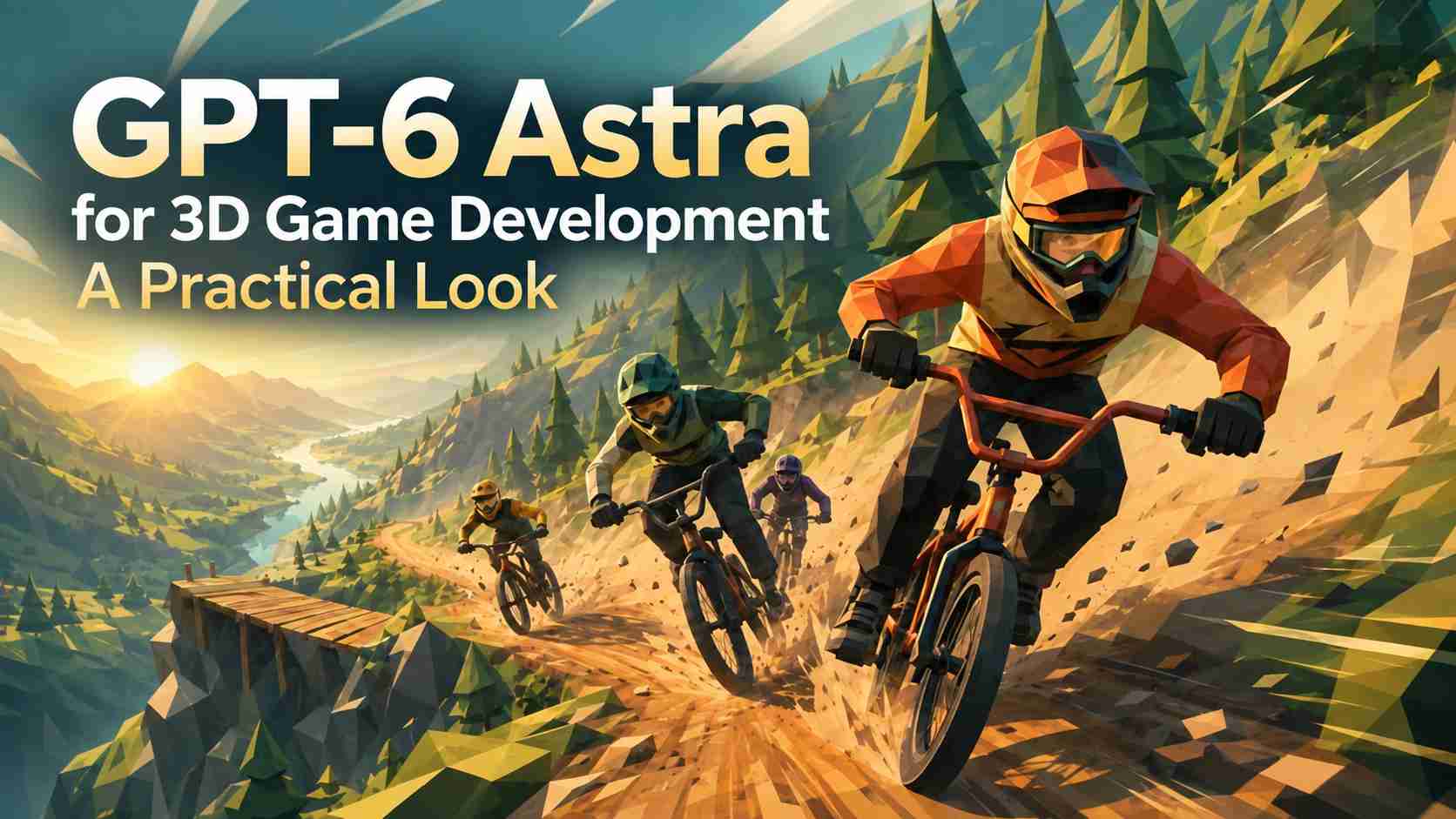
GPT-6 Astra is most useful in 3D game development when the work becomes iterative. I would use it to take a focused mechanic to a playable build. From there, I would ask it to inspect specific problems across controls, camera behavior, level layout, UI, and performance.
For professional use, code generation is already table stakes. What matters is whether the model can keep a project coherent while it builds, runs, evaluates, and revises the game. That is where Astra becomes relevant—and where its limits become easier to see.
Where GPT-6 Astra Changes the 3D Iteration Loop
Most 3D prototypes do not fail because one script is missing. They fail where systems meet. A faster movement controller changes the camera distance. A wider field of view changes how players read hazards. More detailed terrain can disrupt frame time. Fixing one problem can quietly create another.
I see Astra's main advantage in its ability to work across these dependencies. It can read the brief, inspect project context, make a change, launch the build, and use visible or instrumented feedback to decide what needs attention next. That is more valuable than generating a large block of code that has never been played.
OpenAI developer Thomas Ricouard used this approach while building Void Explorer with GPT-6 Astra. The project exposed repeatable test scenes, screenshots, game-state data, and performance counters. Astra could investigate a specific transition or terrain problem instead of trying to infer the entire game state from source files alone.
I would apply the same principle to a smaller prototype. Give the model a reproducible state, the expected result, and a way to inspect the outcome. The quality of that feedback loop matters more than the length of the initial prompt.
Sunbreak Downhill: A Playable GPT-6 Astra 3D Game
Sunbreak Downhill was created with GPT-6 Astra inside SoonLab. It is a cel-shaded BMX game built around a procedural mountain descent. The player races AI riders, chooses lines through the course, jumps across gaps, performs tricks, manages boost, and adapts to changing weather.
I find this example useful because it has more than a 3D environment and a movement controller. Its systems depend on one another:
- The course has to support racing lines, jumps, slides, and different speeds.
- The camera has to keep the rider and upcoming terrain readable.
- Tricks need input states, airborne detection, landing checks, scoring, and feedback.
- Boost affects speed, course timing, cornering, and difficulty.
- AI riders need to move through the same space without making the race feel arbitrary.
That makes Sunbreak a better case for GPT-6 Astra 3D game development than a static scene or short visual demo. It shows that the output can include a defined game loop, several control states, competing agents, and a complete route with an end goal.
For developers comparing production scope before starting, the practical differences between 2D and 3D game development remain important. Astra may reduce iteration time, but it does not remove the extra camera, navigation, animation, physics, and performance work that comes with 3D.
How I Would Brief GPT-6 Astra for a 3D Prototype
I would not begin with a genre label such as “make an open-world racing game.” I would describe one playable slice and define the decisions that matter inside it.
A useful first brief for a downhill game could specify:
- Player experience: maintain speed while choosing between safe and risky routes.
- Playable space: one compact mountain course with clear landmarks and three route splits.
- Controller: steering, braking, jumping, landing, and one limited boost action.
- Camera: third-person follow camera that looks ahead on descents and remains stable during jumps.
- Game state: countdown, checkpoint progress, race position, finish, and clean restart.
- Performance target: a declared frame-rate target on the intended browser or device class.
This gives Astra a bounded system it can build and verify. I would add tricks, weather, rival behavior, and visual polish only after the basic descent works. That sequence protects the core loop from being buried under features.
The follow-up prompts should also stay diagnostic. “Make it feel better” gives the model no reliable target. I would use requests such as:
- Move the camera farther forward as speed increases, but keep the rider in the lower third of the frame.
- Reduce lateral drift after landing without changing steering response on the ground.
- Profile the next section of the course and identify why frame time rises near the bridge.
- Add a repeatable test state that starts the rider five seconds before the largest jump.
If you need a starting structure for other genres, SoonLab's AI game prompt examples can help turn a loose concept into a more testable brief. I would still adapt every prompt to the project's mechanics and acceptance checks.
Using GPT-6 Astra With Unity and Godot
For an existing Unity or Godot project, I would judge Astra by how well the agent environment exposes the engine—not by the model name alone. The model needs access to the project structure, editor state, logs, scenes, tests, and a running build. It also needs clear limits on which files and systems it can change.
Playco's Playbot demonstrates this setup. It connects Astra to Unity and Godot so the model can edit scenes, play the game, validate changes, and find bugs. In the published Playco case study, the team reported 50% fewer manual fixes than with the previous model while producing three themed prototypes from one grey-box foundation. One prototype still needed a performance fix.
That result matches how I would use Astra in a professional engine:
- Work in a separate branch or controlled workspace.
- Give it one feature or failure state at a time.
- Provide a repeatable scene and acceptance checks.
- Require the model to run the relevant test after each change.
- Review architecture, game feel, and performance before merging.
A game prototype maker serves a different stage. I would use SoonLab when I want to validate a mechanic or creative direction before committing it to a larger engine project. I would use an engine-connected Astra workflow when the project already depends on Unity or Godot systems and needs changes inside that environment.
Does the AGI Discussion Matter to Game Developers?

GPT-6 Astra's 99.9% result on ARC-AGI-3 will naturally pull game-development discussions toward AGI. I would not use that score as proof that Astra can design or ship a complete game on its own. ARC-AGI-3 measures adaptation to unfamiliar interactive problems. It does not measure production architecture, multiplayer stability, animation quality, performance across target hardware, or whether a game remains interesting after an hour.
The result is still relevant in a narrower way. Game development constantly introduces unfamiliar states. A model may need to infer why an interaction failed, learn how a project exposes its systems, and adjust its plan after observing the build. Better adaptation can make the agent more useful during those tasks.
I care less about whether that qualifies as AGI and more about whether the model stays oriented through a long revision. Can it preserve the movement constraints while changing the camera? Can it repair a loading problem without breaking save data? Can it explain what it changed and reproduce the failure? Those questions are much closer to daily development work.
Where I Would Still Keep Human Control
I would not delegate the final judgment of game feel. Astra can compare a build against explicit checks, but many design decisions are not binary. A jump can be technically correct and still feel flat. An enemy can follow its behavior tree and still create a dull encounter.
I would also review these areas closely:
- Architecture: a fast prototype can accumulate systems that become difficult to extend.
- Performance: visual correctness does not guarantee stable frame pacing on target hardware.
- State integrity: fixes must hold across saving, loading, restarting, and unusual action sequences.
- Content ownership: generated code, names, assets, and visual references still require review.
- Player experience: automated tests cannot replace observation of real players.
For a broader review of Astra's benchmarks, 3D reasoning, coding performance, and current limitations, see my GPT-6 game development analysis. I would keep that model-level evaluation separate from the project-focused workflow discussed here.
Final Verdict
I would use GPT-6 Astra to shorten the distance between a design decision and a playable answer. Its strongest role is not replacing the developer. It is carrying more of the work between a clear brief, a running build, an observed problem, and the next revision.
For professional Unity or Godot teams, that means giving Astra controlled engine access and strong observability. For early concepts, a 3D game maker such as SoonLab offers a faster way to test whether the mechanic, camera, and world direction work together. Sunbreak Downhill shows the kind of playable scope this workflow can reach.
I would start with one complete loop, make every important state reproducible, and expand only after the first build earns it. GPT-6 Astra can accelerate that process. The developer still decides what is worth building.