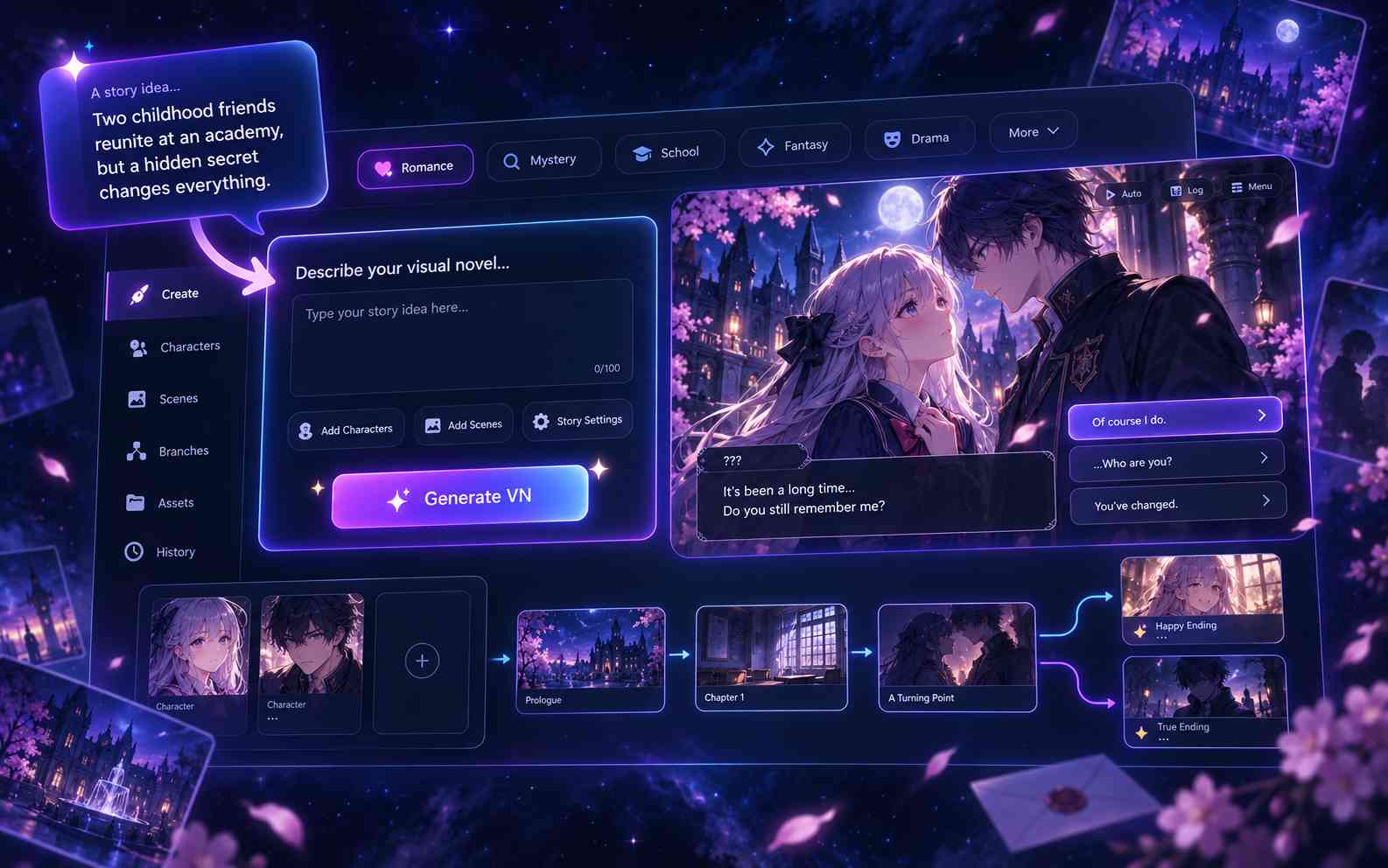
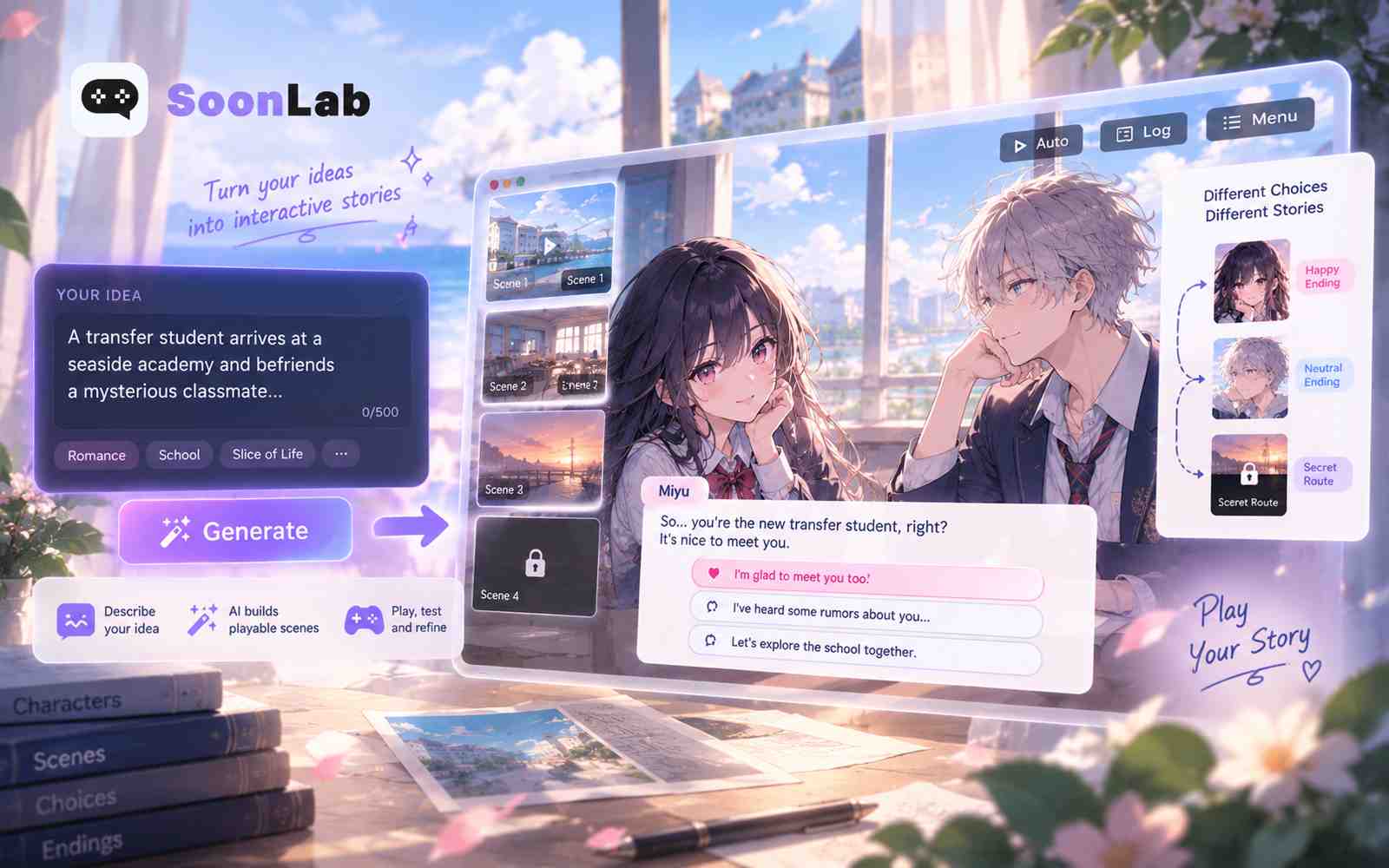
Turn a story idea into a playable visual novel with SoonLab. Describe your characters, setting, dialogue choices, scene changes, and endings in plain English. SoonLab builds a browser-playable first version that you can test, revise, publish, and share—without learning code before you begin.
0/10000
Points based on the model's starting price will be deducted before each creation. (Actual deducted points may vary depending on generation difficulty.)
Why Use SoonLab as Your Visual Novel Maker?
Go from Story Idea to Playable Scenes
A story outline is not yet a game. SoonLab helps turn your premise into scenes with characters, dialogue, player choices, visible consequences, and endings. You can play the result in your browser and judge whether the story works as an interactive experience.
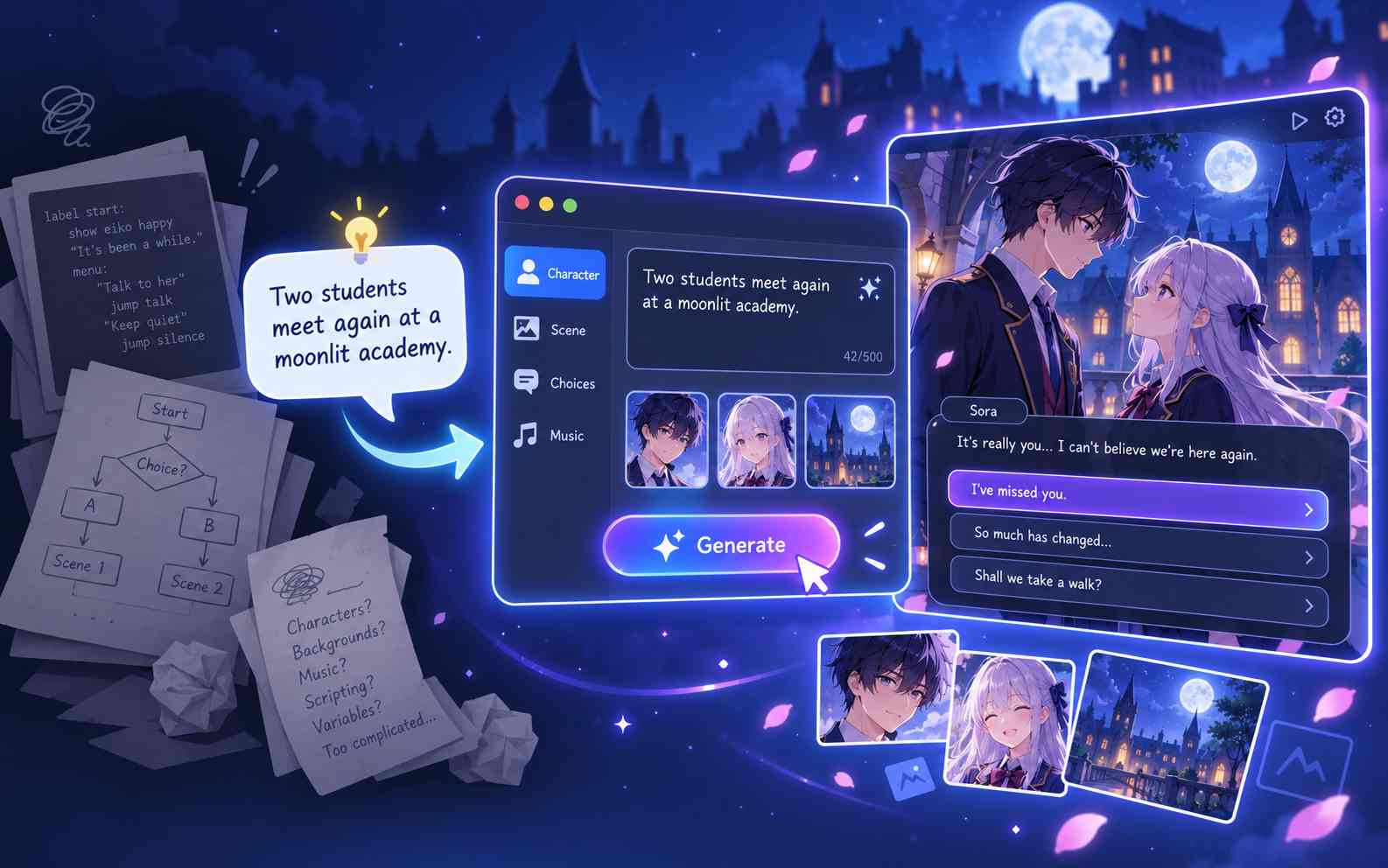
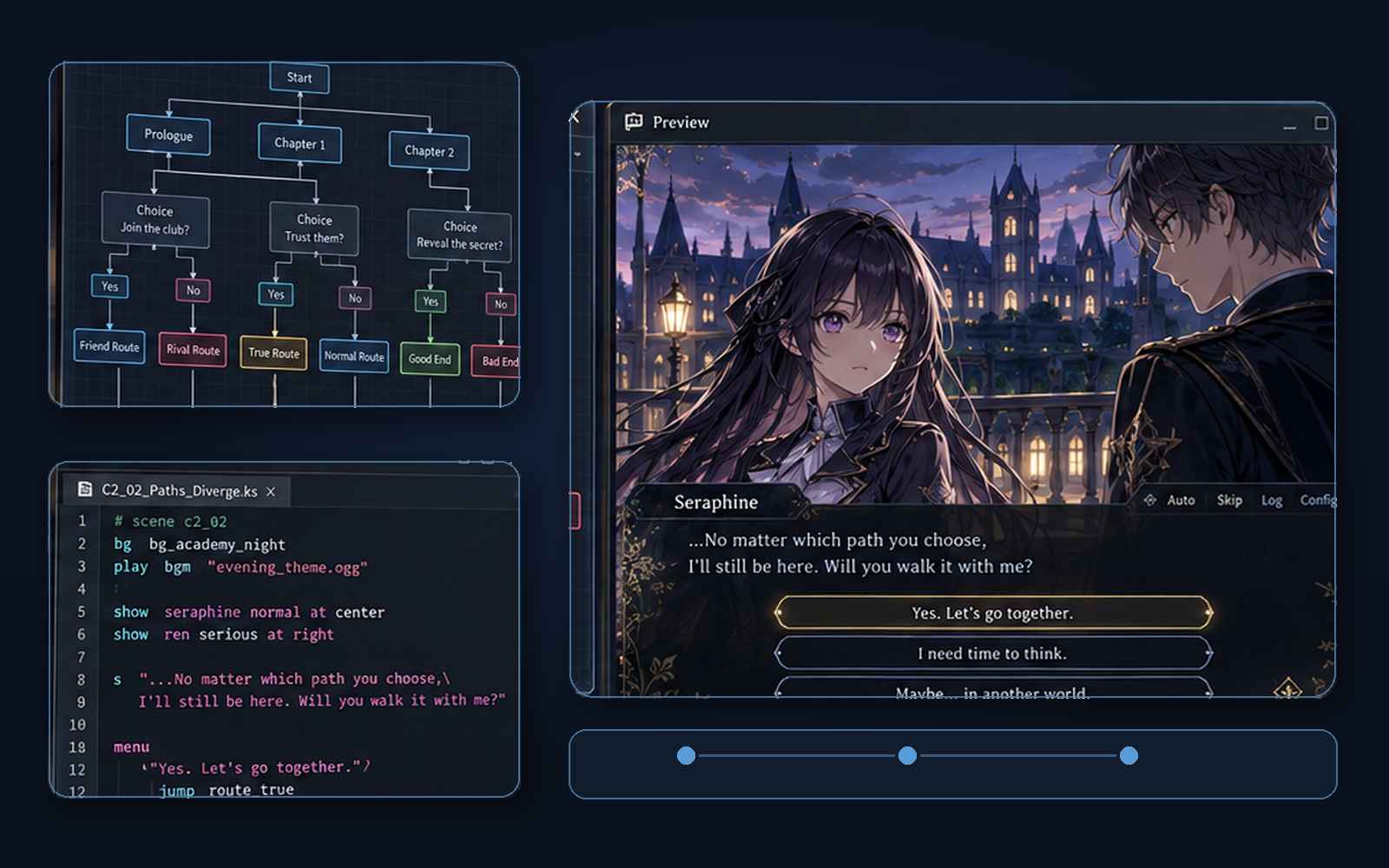
Traditional visual novel engines often ask you to prepare scripts, import assets, connect labels, and manage variables yourself. With SoonLab, you can explain those ideas in normal language. This makes it easier to test a concept before deciding whether it needs a more advanced production workflow.
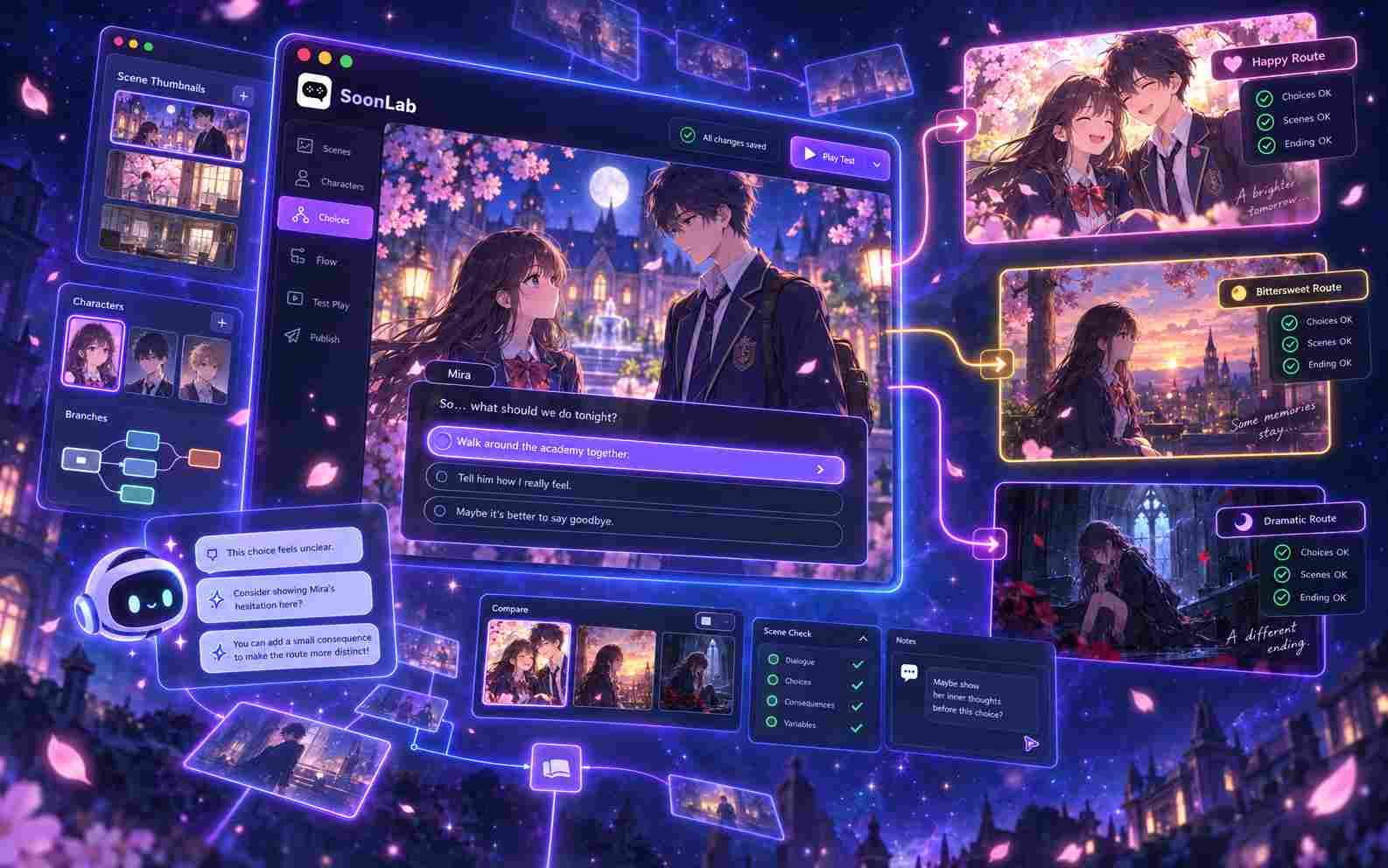
A choice only matters when the player can notice its effect. Play each route, check that the correct scenes appear, and confirm that every ending makes sense. Then, chat with SoonLab AI Game Agent to repair unclear dialogue, missing consequences, abrupt scene changes, or routes that feel too similar.
Your first visual novel does not need a huge cast or dozens of endings. Build one short, complete story first, then expand only after every route works.
Step1.Define the Story and Its Main Choice
Start with one sentence that names the player, the situation, and the decision that changes the story. Add two or three important characters, one central conflict, a small number of locations, and two or three endings. Planning a clear main route first keeps the project manageable.
Step2.Generate and Play Every Route
Enter your idea in SoonLab and generate a playable browser version. Read every conversation, select every major choice, and reach every ending. Look for choices that lead to the same result, character reactions that do not match earlier events, and scenes where the player does not know what to do next.
Step3.Refine One Scene or Branch at a Time
Give SoonLab focused revision instructions. Ask it to shorten a slow conversation, make a secret choice affect a later scene, keep a character portrait consistent, add a clearer route indicator, or strengthen an ending. Test the changed branch again before editing another part of the game.
Choose a visual novel maker idea, copy it, and open SoonLab to generate a playable story with characters, dialogue choices, branching scenes, endings, and visual direction already defined.
Prompt idea
Prompt
Difficulty
Best for
Style
Copy
The Last Train from Aster Bay
PromptCreate a short mystery visual novel set on the last train leaving a flooded coastal town. The player is a student searching for a missing brother. Include three suspects, five scenes, a notebook that records clues, and three major choices. Earlier choices should change which character tells the truth in the final carriage. Add one hopeful ending, one unresolved ending, and one bad ending. Use atmospheric illustrated backgrounds, readable dialogue boxes, and character portraits with consistent clothing and expressions.
DifficultyBeginner
Best forMystery stories
StyleAtmospheric mystery
Copy failed. Try again.
Letters Under the Café Door
PromptCreate a cozy romance visual novel about a baker who receives anonymous letters before the town's winter festival. Include two possible relationship routes, four locations, a Trust meter, and three choices that change later dialogue. Let the player discover the writer's identity, choose whether to forgive a past mistake, and reach friendship, romance, or independent endings. Use a warm hand-painted style, gentle background music, and a simple route summary after each ending.
DifficultyBeginner
Best forRomance and otome fans
StyleCozy romance
Copy failed. Try again.
The Voice Beyond Deck Seven
PromptCreate a sci-fi horror visual novel on an abandoned research station. The player wakes with a damaged memory and receives instructions from an unknown voice. Include six short scenes, a Stability meter, two key items, and choices about whether to trust the voice, repair the station, or escape. Make two earlier decisions unlock or block later options. Add three distinct endings and show a clear explanation of the choices that led to each ending. Use a dark illustrated style with restrained sound effects.
DifficultyIntermediate
Best forHorror story prototypes
StyleSci-fi horror
Copy failed. Try again.
After-School Observatory
PromptCreate a school-life visual novel where the player joins a struggling astronomy club before a rare meteor shower. Include three club members with different goals, four after-school scenes, dialogue choices that affect friendship, and a small telescope-repair mini-game. The final choice should determine whether the player stays with the club, helps one character pursue a scholarship, or leaves to follow a different dream. Use soft anime-inspired backgrounds, expressive portraits, and three meaningful endings.
The hardest part of making a good visual novel game is usually not displaying dialogue. It is keeping the story small enough to finish, while making each choice feel worth selecting.
Visual Novel Design Tips
Write the main route first. Once the beginning, turning point, and ending work, add alternative branches around that path.
Give every important choice a visible consequence: new dialogue, a changed relationship, a blocked option, a discovered clue, or a different ending.
Keep the first cast small. Two or three well-defined characters are easier to remember and write consistently than ten shallow ones.
Reuse locations when possible. A café at morning, closing time, and during a storm can support different moods without requiring a completely new background for every scene.
Track only variables the player can understand, such as Trust, Suspicion, Courage, clues found, or promises kept.
Break long conversations with choices, expressions, scene changes, sound cues, or short actions that change the rhythm.
Make each ending resolve the central conflict. A bad ending should still explain what the player's decisions caused.
Play every route from the beginning after a major edit. A change in one branch can create contradictions later.
Common Visual Novel Maker Mistakes
Planning too many routes before finishing one complete path.
Adding choices that change one line but lead immediately back to the same result.
Writing large blocks of exposition before the player has a reason to care.
Changing a character's personality only to force the plot toward an ending.
Using too many locations, outfits, and expressions for a first project.
Hiding route requirements so completely that players cannot understand why an ending happened.
Testing only the preferred route and missing broken choices elsewhere.
Treating AI output as final instead of checking tone, continuity, originality, and asset rights.
Choose SoonLab or a Traditional Visual Novel Engine?
Choose SoonLab for Fast, Playable Prototypes
SoonLab is a good fit when you want to turn a prompt into a playable browser story quickly, test a narrative idea without coding, or share an early version for feedback. It shortens the path from premise to playtest, especially for beginners and small experimental projects.
Choose a Dedicated Engine for Deeper Production Control
A dedicated visual novel engine such as Ren'Py is usually more suitable when you need detailed scripting, custom interfaces, precise asset control, large route structures, advanced save systems, or distribution across several platforms. You can still use SoonLab first to test whether the story and choices are strong enough to justify a larger build.
The best visual novel maker depends on your goal. SoonLab is suitable for beginners who want to turn a text prompt into a playable browser game without coding. Ren'Py offers more scripting and production control, while tools such as TyranoBuilder provide a visual editor for building scenes manually.
Create Your First Visual Novel
Start with one setting, two or three important characters, one central choice, and a few endings. Turn the idea into a playable browser story, test every route, and improve the scenes that need more impact.