After eight years in game development, I have found that coming up with ideas does not necessarily get easier. You simply become more skeptical of them.
When I was less experienced, I could get excited about an idea because I could imagine everything it might eventually become. Now I usually ask much less exciting questions first: What will the player actually spend most of their time doing? What happens in the first five minutes? And if I remove the rewards, upgrades, pets, currencies, and polished map, is there still something I want to play?
I think those questions are especially useful when looking for Roblox game ideas. There is already no shortage of obbies, simulators, tycoons, survival games, and horror games. Giving you another list of "make a pet simulator" or "build a zombie survival game" would not help much.
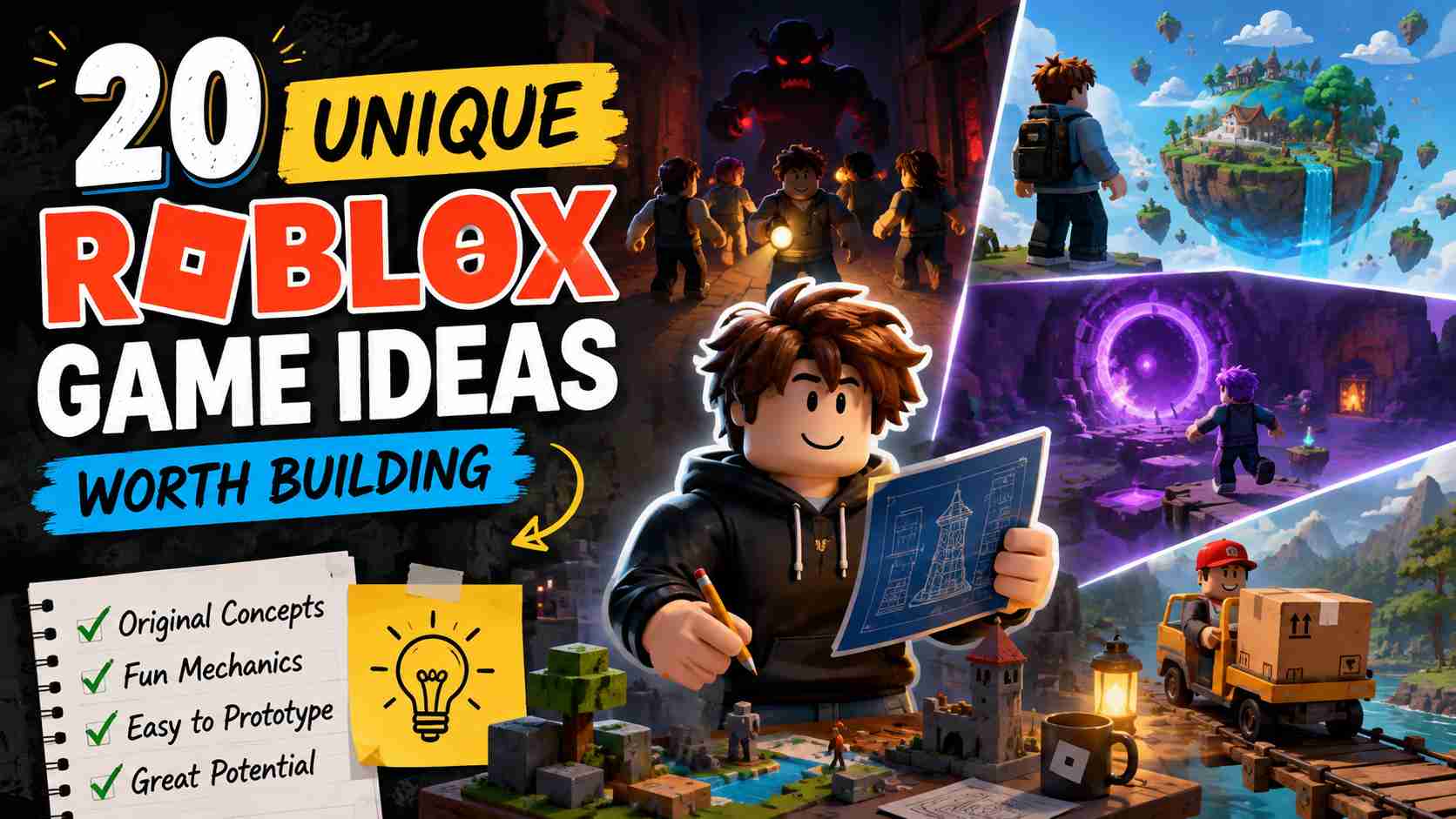
So I picked 20 ideas where I can already picture the game, not just the genre. Some are relatively easy to prototype, while others would take much more work. I would not build all of them myself, but every idea here contains at least one mechanic I would genuinely want to test.
What Is a Roblox Game Idea?
A Roblox game idea is the core concept behind the experience you want to build: what the player does, what makes that interaction interesting, and what gives the game its own identity.
"Make a horror game" is still too broad. "Four players search a building where every loud action helps a monster locate them" is much closer to an actual game idea because I can already imagine how a round would play.
A game idea is also different from a Roblox script. The idea describes the design; the script is part of how you implement that design in Roblox Studio. For example, the idea might be an obby that changes based on the player's previous mistakes, while the scripts would handle things such as tracking those mistakes, changing obstacles, updating the round, and responding to player input.
I would normally settle the gameplay idea first and only then think about how to script it. A clever script can make a mechanic work, but it cannot tell you whether the mechanic was worth building in the first place.
 Also Read
20 Roblox Game Ideas at a Glance
| Game Idea | Genre | Main Mechanic | Scope |
|---|---|---|---|
| Borrowed Body | Puzzle / Adventure | Possess different NPCs to use their abilities | Medium |
| Don't Wake the Monster | Co-op Horror | Player actions create noise the monster can track | Medium |
| Tiny World Survival | Survival | Survive ordinary environments at insect scale | Medium |
| The Wrong Floor | Social / Horror | Players must decide whether an elevator floor is safe | Medium |
| Monster Cleanup Crew | Co-op / Comedy | Clean up locations after monster attacks | Medium |
| Reverse Obby | Obby | Completed obstacles transform behind the player | Easy |
| Everyone Has One Secret Power | Social | Each player hides a different ability | Medium |
| Delivery Disaster | Co-op / Party | Every package has different handling rules | Easy |
| NPC Detective | Mystery | NPC stories change and contradict each other | Medium |
| Grow a Tiny Planet | Simulation | Your actions physically transform a small planet | Medium |
| Your Shadow Is the Enemy | Puzzle / Horror | A delayed copy repeats your previous movements | Medium |
| Help Your Future Self | Puzzle | Actions in one run create tools for the next | Hard |
| Weather Is the Enemy | Survival | Weather changes which parts of the map are safe | Medium |
| Become the Boss | Action / Multiplayer | The best player becomes the next boss | Medium |
| Time Loop School | Story / Mystery | Knowledge from repeated days unlocks new choices | Hard |
| Pet With a Personality | Simulation | One pet develops behavior from how you play | Medium |
| Build Your Own Hiding Spot | Social | Players modify the map before hide and seek begins | Medium |
| The Map Remembers You | Adventure | The world permanently reacts to previous player actions | Hard |
| One Player Is Already Dead | Co-op Puzzle | One player interacts with a different version of the map | Medium |
| The Game Learns Your Mistakes | Adaptive Obby | Challenges change according to how you fail | Hard |
1. Borrowed Body
You begin as a small ghost that cannot fight, open doors, or even pick things up. To move through the world, you temporarily possess the NPCs around you.
A security guard can enter restricted rooms. A child fits through a narrow passage. A maintenance worker can repair a broken elevator, while possessing a dog lets you follow scents that human characters cannot see.
I like this idea because the NPC is effectively your equipment. Instead of finding a better sword or unlocking another skill, you look around the room and ask which character can solve the problem in front of you. I would keep the first prototype to four or five very different NPCs; if switching bodies already makes players experiment, there is plenty of room to expand later.
2. Don't Wake the Monster
Four players enter an abandoned building to recover several objects, but the creature inside does not patrol in a predictable path. It follows sound.
Running, slamming doors, dropping equipment, or dragging a heavy object across the floor can reveal your position. Some valuable objects might require two people to carry, forcing the group to choose between moving slowly together or taking a louder shortcut.
I would pay close attention to how players blame and warn each other during testing. If the group starts whispering about who should move first or gets angry because somebody panicked and ran, the noise system is doing much more for the horror than another jumpscare would.
3. Tiny World Survival
You wake up the size of an insect inside an ordinary house. The first objective might simply be reaching the kitchen table, but at this scale a puddle blocks the floor, a drawer becomes a climbing route, and turning on a fan can make an entire area impossible to cross.
I would design the world around familiar objects rather than filling it with generic survival resources. A bottle cap can become a shield, thread can work as climbing equipment, and a toy car might eventually become transportation.
The scale already gives this idea its identity. I would build one detailed room before attempting the whole house.
4. The Wrong Floor
You and several other players are trapped inside an elevator. At every stop, the doors open onto what appears to be a normal place: a hotel hallway, supermarket, office, playground, or apartment.
The group has about 20 seconds to decide whether to leave the elevator. The problem is that something on the floor may be wrong. Perhaps every clock shows a different time, an NPC has no reflection, or a door that was open five seconds ago has disappeared. Some floors are completely safe, so refusing to leave every time will not work either.
I would make observation and disagreement the real game here. Watching six players argue about whether a perfectly normal-looking room is safe sounds more interesting to me than simply putting a monster behind every door.
5. Monster Cleanup Crew
The monster fight is already over when the game begins. You are the badly paid cleanup crew sent in afterward.
One job might involve cleaning glowing slime out of a restaurant while another asks you to recover furniture from a house damaged by something enormous. The catch is that the mess is not always harmless. A garbage bag may move, an egg may hatch halfway back to the truck, or the "dead" monster part your teammate picked up may not actually be dead.
I would keep the early jobs funny and mundane, then gradually make players less confident about what is safe to touch. That contrast is more interesting to me than starting with obvious horror.
6. Reverse Obby
You complete what initially looks like a normal obby, but every obstacle changes after you pass it. Platforms collapse, walls begin moving, and previously safe paths become dangerous.
Halfway through the level, the game tells you to return to the starting point.
Now you have to cross the same course again, except you are dealing with the consequences of your first run. I would prototype only a few obstacles and spend time making their second state genuinely different rather than building a long course immediately.
7. Everyone Has One Secret Power
Every player enters the same social survival round but receives one hidden ability. You might be able to swap positions with another player, briefly stop time, see footprints through walls, or create a fake copy of yourself.
Nobody knows what the others received.
The round should create situations where using your power helps you but also gives other players clues about what you can do. I would design abilities around deception and observation rather than raw strength, because the interesting part is figuring out what everyone else is hiding.
8. Delivery Disaster
You and your friends run a delivery company where the packages are much harder to transport than the destinations are to reach.
A wedding cake has to remain upright. An aquarium slowly loses water when tilted. A sleeping creature wakes if the vehicle hits too many objects. Another customer might ask you to deliver something enormous through a building that clearly was not designed for it.
I would make the package change how players approach the route. If every mission can be solved by driving faster, the idea loses most of what makes it funny.
9. NPC Detective
Ten NPCs are staying in a small hotel, and one of them is lying about what happened the previous night.
You can talk to them, enter their rooms, inspect objects, and compare their stories. One NPC says they never left their room, but somebody remembers seeing them downstairs. Another claims they lost their key, yet you find it somewhere they should never have visited.
The liar, evidence, and relationships change between rounds. I would rather spend time making ten characters worth investigating than build a large city filled with NPCs who have nothing useful to say.
10. Grow a Tiny Planet
You start with a small grey planet that can almost fit on the screen. Instead of buying increasingly expensive machines, most upgrades physically change the world.
Water creates rivers, plants change the surface, animals appear when the environment supports them, and settlements slowly grow around the areas you developed. Two players who make different choices should eventually have visibly different planets.
I like progression that you can see without opening a stats menu. If players occasionally stop what they are doing just to rotate the planet and look at it, I would consider that a good sign.
11. Your Shadow Is the Enemy
You enter a maze alone, but after 30 seconds a shadow appears and begins repeating everything you did exactly 30 seconds earlier.
If you walked through a doorway, the shadow will eventually walk through it. If you waited beside a switch, it will wait there too. Touching your shadow sends you back to the start.
The interesting part is that your own earlier decisions gradually reshape where it is safe to move. Later puzzles could even require you to deliberately record a useful path for your shadow so that it activates something for you.
12. Help Your Future Self
Every attempt lasts five minutes. When time runs out, the world resets, but one thing you changed remains for the next version of yourself.
You might spend one run repairing a bridge that you will cross in the next. Another attempt could be used to move a heavy object into position or leave an item somewhere you know you will need later.
I would design this around planning rather than reflexes. The satisfying moment should come when something that seemed pointless two runs ago finally makes the current route possible.
13. Weather Is the Enemy
There are no zombies or hostile NPCs. Players are given a forecast and a short amount of time to prepare for whatever the environment is about to do.
A flood makes low ground dangerous, while a tornado punishes exposed structures. The shelter that saved you during one event might become exactly the wrong place to be during the next.
I would avoid turning weather into different-colored damage effects. Each event should make players reconsider where they go, what they build, or what they decide to carry with them.
14. Become the Boss
Everyone starts by fighting the same boss together. When it is defeated, the player who contributed the most becomes the boss for the next round.
That player gets a different movement style and a small set of powerful abilities, while everybody else suddenly has to fight the person who was helping them moments earlier.
I would keep the boss kit simple and make the role change happen quickly. The part worth testing is not how elaborate the combat system can become; it is whether players genuinely look forward to taking their turn on the other side.
15. Time Loop School
The same school day repeats from morning to afternoon, but being in one place means missing what happened somewhere else.
Following one student might reveal a locked classroom at noon. During the next loop, you can arrive there earlier. A conversation near the end of the day may give you information that changes what you say to someone the next morning.
This is one of the harder ideas on the list because the events have to fit together properly. I like it because progress comes from understanding the day rather than simply increasing the player's stats.
16. Pet With a Personality
Instead of collecting dozens of pets, you get one creature and live with the consequences of how you raise it.
Take it into dangerous places often and it may become brave. Give it everything immediately and it might become demanding. A curious pet could wander away to investigate objects, while a nervous one stays close when unfamiliar players approach.
I would make those traits visible through behavior rather than another menu of numbers. The goal is for two players with the same species of pet to end up telling completely different stories about them.
17. Build Your Own Hiding Spot
Before each hide-and-seek round, players get two minutes to modify part of the map. They can move furniture, create small passages, place decoys, or build limited hiding structures.
Then one player enters as the seeker.
The building rules would need careful limits because players will find impossible hiding spots much faster than you expect. I actually like that problem, though. The players are not only using the map; they are helping create the puzzle the seeker has to solve.
18. The Map Remembers You
Every time you return to the same town, it remembers small things you did there.
Break a window and it may still be boarded up tomorrow. Help an NPC repair a shop and that shop later opens a new route. Keep stealing from the same area and residents start locking doors when they see you coming.
I would not try to make every object persistent. A carefully chosen set of visible consequences is enough to make the world feel unusually attentive to the player.
19. One Player Is Already Dead
Four players enter the same haunted building, but one is randomly chosen as a ghost at the beginning of the round.
The ghost still appears to the group, but sees a different version of the environment. A collapsed staircase might be intact for them, hidden writing may appear on walls, and certain doors can only be opened from their side of the world.
The group therefore needs the ghost rather than simply trying to revive them. I would design puzzles around incomplete information so that both sides have something the other cannot see.
20. The Game Learns Your Mistakes
This is the idea I would be most curious to prototype, although I would not recommend it as a first Roblox project.
The game records a few simple habits while you play. If you rush into every room, later traps begin reacting to speed. If you repeatedly choose the same side of a fork, that preference eventually becomes dangerous. Struggle with one kind of obstacle and the game quietly starts using it more often.
You do not need sophisticated AI to create the effect. A few tracked behaviors are enough. I would know the prototype is working the first time a player stops and wonders whether the game deliberately used something against them.
Which Roblox Game Idea Should You Actually Choose?
I would not choose from this list based on which idea sounds the most impressive. I would choose based on which mechanic I am most curious to see working.
If you are still learning Roblox development, I would start with Reverse Obby or Delivery Disaster. Both can become playable before they become large projects.
If multiplayer interaction interests you more, Don't Wake the Monster, Everyone Has One Secret Power, and One Player Is Already Dead give the players themselves a large role in creating what happens during a round.
For developers who enjoy systems and narrative, I think Time Loop School, The Map Remembers You, and Help Your Future Self have more unusual possibilities, but I would go into all three expecting considerably more design work.
Personally, The Game Learns Your Mistakes is the one I would be most interested in experimenting with. I can already imagine several versions of it, but I would still begin with a very small prototype rather than assuming the larger idea works.
What I Look for in a Good Roblox Game Idea
When I look at a game idea now, I care less about how many features I can imagine adding to it. I want to understand what situation the game can create for the player.
Take Don't Wake the Monster. "A multiplayer horror game with a monster" tells me very little. What interests me is the situation where one player wants to run back to the group, everyone else knows running will make noise, and nobody agrees on what to do.
For One Player Is Already Dead, I can picture a player insisting that there is a door directly in front of them while the rest of the team sees nothing but a wall. That is already a situation I want to test.
Those moments matter to me because they tell me more about the game than a feature list does. If I can imagine players arguing, laughing, hesitating, experimenting, or surprising each other because of the mechanic, the idea has given me something useful to work with.
Test Your Roblox Game Idea Before You Build It
Before I spend much time developing a game idea, I want to know whether the part I find interesting still works once it becomes playable. A concept can sound great when I describe it, but that does not mean the mechanic will feel good in practice.
For example, if I wanted to make Don't Wake the Monster, I would not start by building the full abandoned building, progression system, and finished monster. I would first make a small space with a basic noise mechanic and see whether players actually change how they move and communicate because of it. For Grow a Tiny Planet, I would test whether watching the planet change is satisfying before designing a larger economy around it.
This is where I think AI game maker SoonLab can be useful. You can describe the game you have in mind and use SoonLab to turn it into a playable browser prototype without coding.
Turn your idea into aplayable game
Describe the game you want to make, and SoonLab will help you start building it.
I would treat that prototype as a test rather than a finished game. Play it yourself, let someone else try it, and pay attention to the part you were originally excited about. If that mechanic is already fun in a rough version, the idea is probably worth developing further. If it still needs a long list of extra features before it becomes interesting, I would rethink the idea before investing more time in it.
SoonLab does not generate native Roblox experiences or replace Roblox Studio. I see it as an earlier step in the process: a quick way to move from "this sounds interesting" to "I have actually played a version of it."
FAQs About Roblox Game Ideas
What are some good Roblox game ideas?
Good Roblox game ideas give players a clear situation rather than only a genre. Ideas such as Don't Wake the Monster, One Player Is Already Dead, Borrowed Body, or Your Shadow Is the Enemy all start from mechanics that can change how the player thinks or behaves rather than simply adding another theme to a familiar game.
What are some unique Roblox game ideas for 2026?
Some less conventional ideas I would consider include a game where you possess NPCs to use their abilities, a co-op game where one player exists in a different version of the world, an adaptive obby that responds to how you fail, or a town that remembers selected actions from previous visits. I would still prototype the central mechanic before building any of these into a large game.
What Roblox game should a beginner make?
I would choose an idea that can become playable with one map and a small number of mechanics. Reverse Obby and Delivery Disaster are good examples from this list. They leave plenty of room to expand later without requiring a large progression system before you can test whether the game is enjoyable.
How do I come up with original Roblox game ideas?
I usually start with a familiar game type and question one assumption inside it. What if dying gives the player a new role instead of removing them from the round? What if the obstacle course remembers what you did? What if collecting more pets is removed from a pet game? You do not need to make everything unfamiliar; changing one important rule can be enough to give the game its own identity.
What are some Roblox game ideas with no scripting?
Simple obbies, exploration experiences, and projects based largely on existing Roblox Studio tools are easier to begin with when you have limited scripting experience. I would not make avoiding scripting the main design goal, though. Keeping the first version small is usually more useful than trying to build a complicated idea without code.
Can AI generate Roblox game ideas?
Yes, but I would give AI constraints rather than asking it for hundreds of random ideas. Tell it what kind of game you enjoy, whether you are working alone, how experienced you are, how many players the game should support, and how quickly you want to finish the first prototype. Then look for the few suggestions that make you want to test the mechanic rather than the ones with the longest feature lists.
Final Thoughts
After looking through these Roblox game ideas, I would not spend too much time trying to decide which one has the biggest potential. Pick the one that makes you curious enough to want to play it yourself. Maybe you want to see what happens when a monster can hear every mistake your team makes, or whether an obby that remembers how you failed is actually as interesting to play as it sounds.
That curiosity is enough to start. Keep the first version small, test the mechanic you care about, and let what you learn from playing it shape what comes next. Some ideas will become much better once they are playable, while others will quickly show you why they should stay ideas. Finding that out early is part of game development.
If you have found an idea here that you want to try, you can start with SoonLab. Describe the game you have in mind, turn it into a playable prototype without coding, and see what your idea feels like when you can actually play it. You do not need to know everything the game will eventually become. You just need something worth testing first.