

Pac-Man is the best arcade game of all time for most players. Its controls take seconds to learn, every maze creates clear pressure, and chasing a better score remains satisfying decades later. Street Fighter II is the stronger choice for competitive play, while Galaga offers the best introduction to classic arcade shooting.
The greatest arcade games do more than trigger nostalgia. They give you an interesting decision almost immediately, respond clearly to your input, and make another attempt feel worthwhile. This list covers the games that preserve that appeal, along with the control issues, difficulty spikes, and repetition that modern players may notice.
What Is an Arcade Game?
An arcade game originally meant a coin-operated video game played on a dedicated cabinet in an arcade, restaurant, bar, or another public space. These games usually needed to capture attention quickly, so they used clear goals, focused controls, short rounds, visible scores, and difficulty that increased as the player progressed.
Today, “arcade game” also describes a style of play rather than only a type of machine. An arcade-style game may run on a console, phone, computer, or web browser, but it still emphasizes immediate action, fast restarts, simple rules, and replaying to improve a score or performance.
Arcade games are not limited to pixel graphics or one video game genre. Pac-Man is a maze game, Street Fighter II is a fighting game, Daytona USA is a racing game, and Dance Dance Revolution is a rhythm game. What connects them is that players can understand the main goal quickly, while mastering the controls and challenge takes much longer.
The Best Arcade Games of All Time
1. Pac-Man
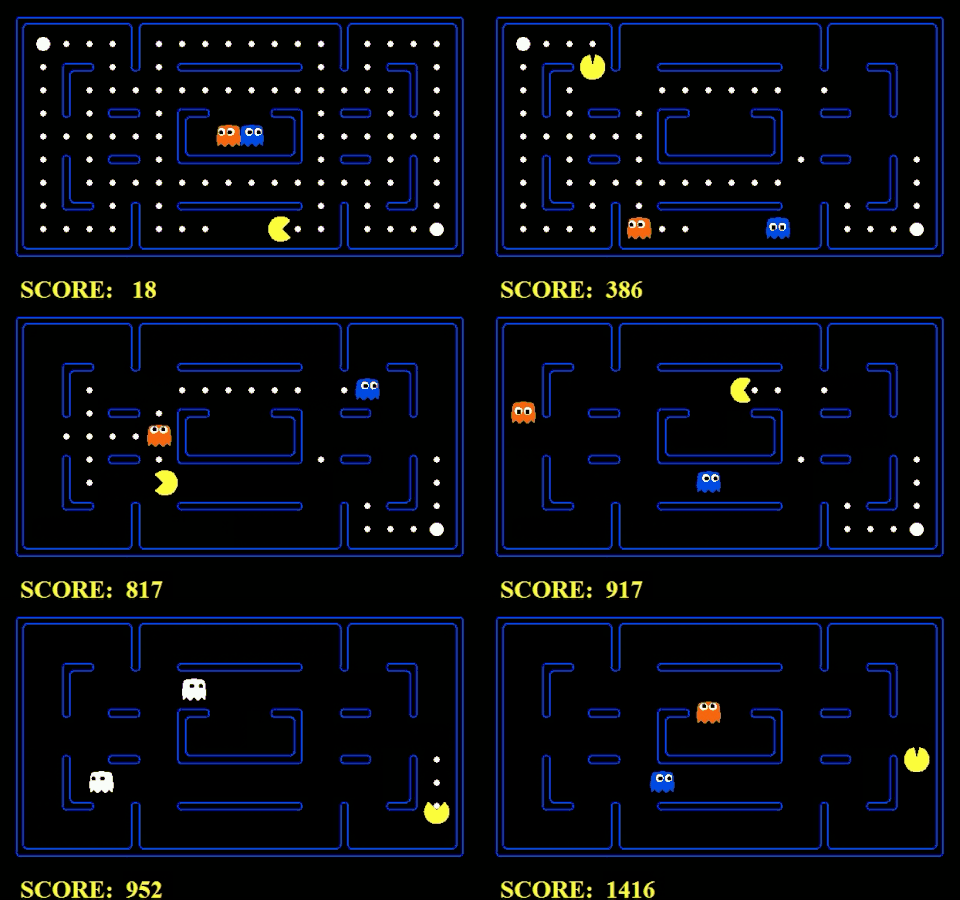
Best for: Almost anyone trying a classic arcade game for the first time
Pac-Man turns four-direction movement into a constant series of small decisions. Do you clear a dangerous corner now, save a power pellet for later, or lure the ghosts into a better position? The rules are visible from the first life, but strong play depends on route planning, timing, and understanding how the ghosts move.
That balance between clarity and depth is why it remains my best overall pick. The Strong National Museum of Play describes Pac-Man as the best-selling arcade video game ever, but its ranking here is not based on sales alone. The responsive controls and fast restarts still create a strong score-chasing loop today.
The limitation: The original game uses one maze. Later stages become faster rather than structurally different, so players who want constant visual variety may prefer Ms. Pac-Man.
2. Street Fighter II
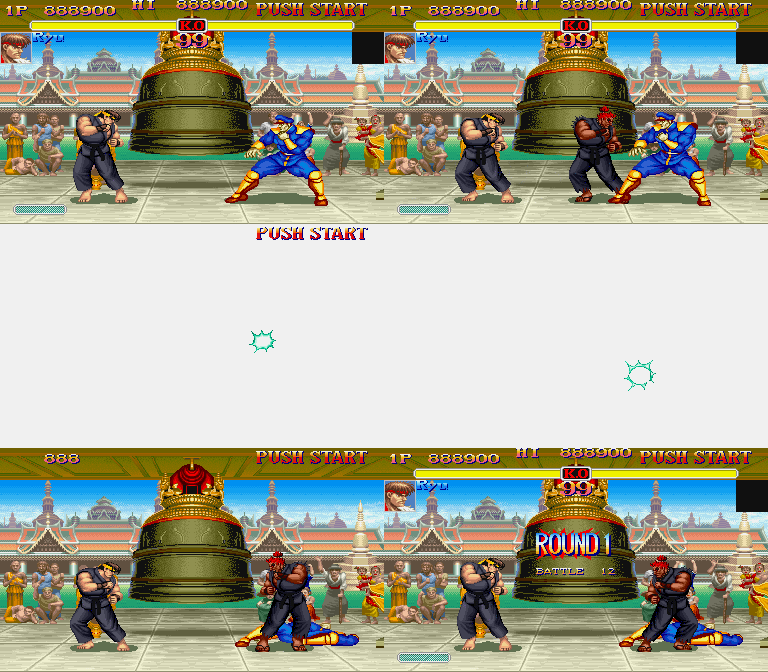
Best for: Head-to-head competition
Street Fighter II made the person beside the cabinet more interesting than the computer inside it. Its distinct fighters, spacing, blocking, throws, special moves, and matchup differences give each round a clear strategic shape. A beginner can enjoy landing a heavy attack, while an experienced player can read habits and control the pace of a match.
The game helped popularize the fighting game genre, and its basic language still appears in modern fighters. It also remains enjoyable because wins feel connected to decisions rather than long-term upgrades or random rewards.
The limitation: Six attack buttons and motion-based special moves create a steeper first hour than Pac-Man or Galaga. Some computer opponents can also feel unfair rather than intelligent.
3. Galaga
Best for: Players who want a classic arcade shooter that is easy to understand
Galaga gives you only movement and fire, then finds depth through enemy formations, diving attack patterns, challenge stages, and the decision to risk a captured ship. Recovering that ship doubles your firepower but also gives enemies a wider target. That single gamble makes the game more interesting than a basic left-to-right shooter.
The controls remain crisp, the enemy sprites are easy to read, and each short attempt teaches you something. If that immediate action appeals to you, a shooter game maker can help you test an original wave pattern, scoring rule, or power-up idea of your own.
The limitation: The opening waves lose some surprise after repeated runs. Most of the long-term appeal comes from score improvement rather than new stages or abilities.
4. Donkey Kong
Best for: Deliberate platforming and high-score routes
Donkey Kong is less about fast running than committing to the right movement at the right moment. Ladders, barrels, gaps, elevators, and moving hazards create compact stages where position matters. A good jump clears danger; a careless one locks you into an animation while the next threat approaches.
Its influence is obvious, but the tighter reason to return is its scoring system. Players can take a safer route or stay near danger to earn more points. That risk-reward structure still offers a useful lesson for modern arcade platform games.
The limitation: Jumping feels rigid beside modern platformers, and small falls can be fatal. New players must accept the rules of the original movement system rather than expect mid-air control.
5. Ms. Pac-Man
Best for: Players who want the strongest pure maze-chase design
Ms. Pac-Man keeps the readable movement of Pac-Man but adds four mazes, moving bonus fruit, and more variation in ghost behavior. These changes make repeated runs less dependent on following one memorized route. Corners, escape lanes, and power-pellet timing feel different from board to board.
The Strong argues that these changes made Ms. Pac-Man more varied and less predictable than its predecessor. I still rank Pac-Man higher overall because its identity and original design are impossible to separate from arcade history, but Ms. Pac-Man may be the better game to play for a full evening.
The limitation: Less predictable ghost movement increases replay value, but it can also frustrate players who enjoy learning a perfectly repeatable route.
6. Tetris
Best for: Puzzle players and long score-focused sessions
Tetris is built on one of gaming's cleanest loops: place falling pieces, complete lines, and keep the board from filling. Every piece solves one problem while potentially creating another. Speed raises the pressure without changing the rules, so improvement comes from seeing shapes earlier and leaving the board flexible.
The core design still feels modern because it needs no story, tutorial sequence, or unlock system. Arcade editions helped turn that design into a public score challenge, although different cabinets use different rotation behavior, speed curves, and scoring rules.
The limitation: There is no single definitive arcade version. Players used to modern Tetris may find older rotation systems less forgiving and the controls harder to recover from mistakes.
You can try out a Tetris-like game I made using SoonLab.
7. Space Invaders
Best for: Understanding the foundation of arcade shooters
Space Invaders creates pressure with very little on screen. The alien formation moves lower as you clear it, the remaining enemies speed up, and four shields slowly disappear under fire. Shooting is not enough; you must manage space and decide when it is safe to leave cover.
The controls are still immediately understandable, and the accelerating end of each wave remains effective. Its importance to arcade history is enormous, but the game also earns a place here because its rhythm of control, threat, and release still works without explanation.
The limitation: Movement is slow, the presentation is sparse, and later shooters offer much more enemy variety. Historical importance will carry more weight than replay value for some players.
8. Asteroids
Best for: Movement mastery and open-ended score chasing
Asteroids does not lock your ship to the bottom of the screen. You rotate, thrust, drift, fire, and wrap around the playfield while rocks break into smaller, faster pieces. Momentum makes every correction meaningful, and there is rarely one correct place to stand.
The original vector display remains striking, while the physics give skilled players room to develop their own survival style. The Strong notes that Asteroids became Atari's best-selling arcade game, but its lasting strength is the freedom inside its simple arena.
The limitation: The five-button control panel is demanding, especially without an original cabinet. New players may spend several attempts fighting the ship before they start reading the rocks.
9. Robotron: 2084
Best for: Intense twin-stick action
Robotron: 2084 separates movement from aiming, allowing you to run in one direction and fire in another. That now-familiar control idea turns a crowded screen into a fast test of target priority. You can chase points by rescuing humans, but every detour gives the enemy swarm more time to close in.
The game remains unusually direct. There is no reload, cover system, or long transition between waves. You move, shoot, rescue, and make rapid decisions until the arena overwhelms you.
The limitation: The difficulty is severe from the beginning. The visual noise and constant pressure can feel exhausting, and the game gives new players very little space to learn.
10. OutRun
Best for: Relaxed arcade racing with style
OutRun is a race against the clock rather than a realistic motorsport simulation. The road flows through bright landscapes, traffic creates quick passing decisions, and branching routes let you choose a new path during a run. The steering is forgiving enough to enjoy immediately but still rewards smooth cornering.
Its music, roadside scenery, and sit-down cabinet make the drive feel like a short road trip instead of a sequence of laps. It remains one of the best arcade racing games for players who value flow over aggressive competition.
The limitation: The route choices create variety, but the basic action changes little. Players looking for deep car handling, upgrades, or close multiplayer battles should choose Daytona USA.
11. Daytona USA
Best for: Loud, social multiplayer racing
Daytona USA is at its best when several cabinets are linked together. The handling is easy to grasp, crashes are dramatic without ending the race, and familiar tracks quickly turn into contests over racing lines and small mistakes. Catchy music and large cabinets make the surrounding room part of the experience.
The game favors readable speed and competition over simulation. That focus is also a useful starting point if you want to make an arcade racing game: one clear track, responsive steering, visible checkpoints, and a reason to replay can be enough for a strong first version.
The limitation: The solo experience is much less special than a linked race. Track variety is limited, and the artificial intelligence cannot recreate the unpredictability of nearby players.
12. NBA Jam
Best for: Fast two-on-two sports competition
NBA Jam removes most of basketball's slower structure and keeps steals, blocks, long shots, exaggerated dunks, and rapid changes of possession. Two-button controls make it easy to join, while team selection, positioning, and shot timing give regular players room to improve.
It still works because a full match produces constant momentum shifts and shared reactions. Few arcade sports games make a newcomer feel useful this quickly, especially with a more experienced teammate beside them.
The limitation: The simplified rules and exaggerated shooting create spectacle at the cost of basketball realism. Solo matches also lack the unpredictability that makes multiplayer games memorable.
13. Mortal Kombat II
Best for: Spectacle, secrets, and local fighting-game rivalries
Mortal Kombat II expanded the original with a stronger roster, more confident arenas, hidden fights, and memorable finishing moves. Its digitized characters still give it a distinct identity, while blocking, projectiles, sweeps, and character-specific attacks create enough depth for repeated matches.
Street Fighter II has smoother competitive fundamentals, but Mortal Kombat II makes every round feel like an event. The original Mortal Kombat also had a wider effect beyond the arcade: its violence became part of the debate that led the US game industry to establish a ratings system.
The limitation: Movement and attack animation can feel stiff. The computer also reads inputs aggressively, making solo play less fair than fighting another person.
14. Metal Slug
Best for: Run-and-gun action with expressive animation
Metal Slug combines simple movement and shooting with detailed animation, destructible scenery, rescued prisoners, temporary weapons, and vehicles. Enemies telegraph many attacks clearly, and the screen constantly rewards attention with alternate routes, hidden items, or a new visual joke.
The game is immediately readable but difficult to master without losing lives. Cooperative play makes the chaos more enjoyable because two players can cover different parts of the screen and recover from mistakes together.
The limitation: Later sections become sharply harder and can drain lives quickly. Beautiful animation cannot hide every surprise attack, so a first run can feel expensive and unfair on original coin-operated hardware.
15. Time Crisis II
Best for: Two-player light-gun action
Time Crisis II gives the player a gun and a foot pedal. Pressing the pedal lets you attack; releasing it puts you behind cover to reload and avoid fire. That physical rhythm turns a simple rail shooter into a game about timing, target order, and knowing when to take a risk.
Two-player stages show each character moving through the same scene from different angles, making cooperation visible instead of merely doubling the number of bullets. The game remains fast, readable, and satisfying when played on working hardware.
The limitation: The cabinet is essential. A normal controller or mouse can reproduce the targets, but not the weight of the gun, the pedal rhythm, or the side-by-side arcade experience.
16. Dance Dance Revolution
Best for: Rhythm, movement, and public performance
Dance Dance Revolution turns four directional inputs into a full-body challenge. The screen tells you exactly what to do, but accurate timing, balance, stamina, and reading speed separate a completed song from a failed one. Multiple difficulty levels let beginners and expert players use the same cabinet.
DDR reached Japanese arcades in 1998 and became one of the most recognizable rhythm games. It still feels distinctive because watching, playing, and exercising happen in the same public space.
The limitation: The real experience depends on a responsive dance platform and enough physical space. Accessibility, stamina, and worn cabinet sensors can all affect play.
17. The Simpsons Arcade Game
Best for: Accessible four-player cooperation
The Simpsons Arcade Game lets four people walk in and understand their roles almost immediately. Each family member has a distinctive weapon, players can combine attacks, and familiar locations keep the journey moving. It is one of the easiest classic beat 'em ups to enjoy with people who rarely play arcade games.
The appeal comes from sharing the screen, reacting to bosses, and making progress as a group. Mechanical depth is limited, but the short campaign suits a casual arcade visit better than a complicated character-building system would.
The limitation: Combat becomes repetitive, especially with fewer than four players. Much of its charm also depends on affection for the characters and presentation.
18. Defender
Best for: Expert players who want speed and control complexity
Defender gives you an entire horizontal world to patrol instead of a single fixed screen. You must shoot enemies, watch a radar, reverse direction, protect humans, and decide when to use limited smart bombs or hyperspace. The game demands both local reactions and awareness of threats elsewhere on the map.
That combination still feels ambitious. Saving a human while enemies attack from both directions produces a kind of pressure that simpler wave shooters cannot match.
The limitation: The controls are famously difficult. Several buttons, rapid reversals, and a busy first wave make Defender a poor introduction to classic arcade games, even though mastery is deeply rewarding.
19. Arkanoid
Best for: Players who want action and puzzles in the same cabinet
Arkanoid expands the Breakout formula with patterned stages, unusual bricks, enemies, a boss, and power-ups that change the paddle or ball. The dial controller gives fine control over paddle position, while each level asks you to find useful angles rather than simply react.
It remains one of the strongest arcade puzzle games because power-ups create short tactical choices without obscuring the main rule. If you enjoy this formula, SoonLab's guide to the best block breaker games covers both classic and newer variations.
The limitation: Some late brick arrangements take too long to finish or depend heavily on receiving the right power-up. Losing the ball can also remove an upgrade and create a harsh downward spiral.
20. Frogger
Best for: Short attempts and pure timing
Frogger divides one screen into two kinds of danger. First, you cross traffic by reading gaps; then you use moving logs and turtles to reach safe homes across the river. Four-direction controls make the goal obvious, while changing speeds force you to plan more than one move ahead.
A failed crossing is usually easy to understand, which makes the restart button tempting. The game also remains visually clear despite its age: safe spaces, moving hazards, and the destination are all visible at once.
The limitation: Collision boundaries can feel stricter than the sprites suggest. Waiting for the right opening may also feel slow to players used to constant action.
Which Classic Arcade Game Should You Play First?
Start with Pac-Man for the clearest introduction to classic arcade design. Choose Galaga for shooting, Tetris for puzzles, or Ms. Pac-Man for more varied maze layouts.
For multiplayer, try Street Fighter II for competition, Daytona USA for linked racing, or The Simpsons Arcade Game for simple co-op. In a Reddit discussion about party-friendly arcade games, commenters recommended familiar games with simple controls and goals that new players can understand quickly.
Whenever possible, use the original controls. Asteroids benefits from its five-button panel, Arkanoid from its dial, Time Crisis II from its gun and pedal, and Dance Dance Revolution from its dance platform. For standard controllers, Pac-Man, Galaga, and Tetris translate more naturally. A separate Reddit discussion about replay value also highlights games such as Ms. Pac-Man, Galaga, Joust, and Street Fighter II—good starting choices that are easy to learn but difficult to master.
Why the Best Arcade Games Still Feel Good Today
The best arcade games reach the main action quickly. Their goals are visible, controls are focused, and feedback is immediate. Short rounds make failure less frustrating, while fast restarts turn each mistake into a reason to try again.
Long-term popularity is more than nostalgia. The World Video Game Hall of Fame uses longevity as one of its main selection criteria, recognizing games that remained popular rather than becoming a passing fad. Classics such as Pac-Man, Street Fighter II, and Asteroids still work because their core rules remain easy to understand.
Simple rules also leave room for mastery. In The Strong’s history of Asteroids, game designer Tim Skelly explained: “Its strength was that it allowed you to work out your own ways to win the game.” The same principle applies to finding better routes in Pac-Man, improving lap times in Daytona USA, or learning matchups in Street Fighter II. Modern progression systems can add variety, but they cannot replace a core loop that feels worth repeating.
How to Make Your Own Arcade Game with SoonLab
You do not need a large world or complex story to create an arcade game. Start with one action that feels satisfying to repeat, such as shooting targets, avoiding obstacles, collecting items, or chasing a high score. Keep the first version small and use classic games as design references without copying their characters, artwork, or levels.
1. Describe the Core Game Loop
Explain what the player controls, what they repeatedly do, how they score, what makes the game harder, and how a round ends. For example: “Create a top-down space shooter with arrow-key movement, automatic firing, enemy waves, score multipliers, three lives, and a boss after five rounds.”
2. Generate and Play the First Version
Enter your prompt into SoonLab’s Arcade game maker to generate a playable browser game. Complete a full round and check whether the controls respond quickly, the score updates correctly, hazards are easy to read, and the restart flow works.
Turn your idea into aplayable game
Describe the game you want to make, and SoonLab will help you start building it.
3. Improve, Share, or Download the Game
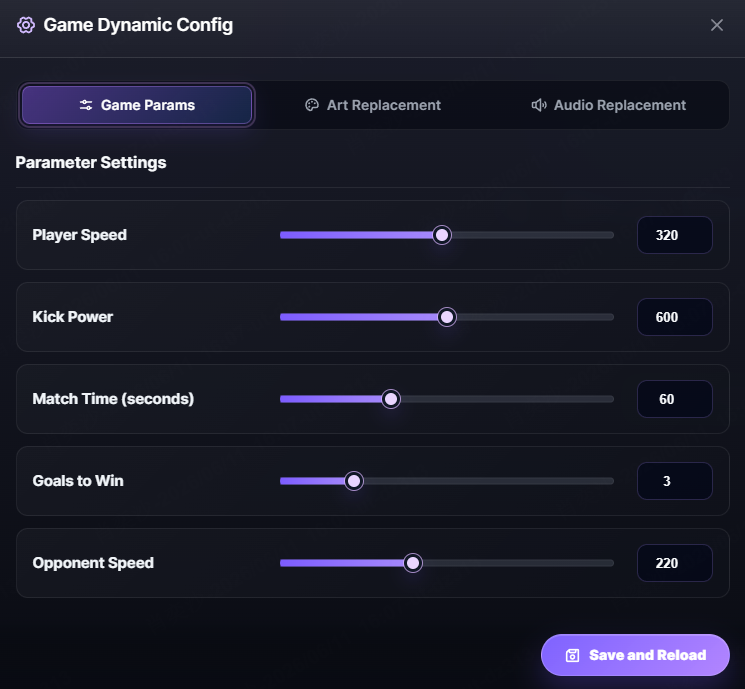
Use follow-up prompts to adjust one element at a time. You can increase the speed, add enemy patterns, improve hit feedback, change the scoring system, or create a smoother difficulty curve. Once the game feels ready, publish and share its online page or download it as an HTML file.
FAQs About Best Arcade Games
What is the best arcade game of all time?
Pac-Man is the best overall arcade game because it combines simple controls, strategic movement, increasing difficulty, high replay value, and exceptional historical influence. Ms. Pac-Man is arguably stronger as a pure maze game, while Street Fighter II is the better choice for competitive play.
What are the best 1980s arcade games?
Pac-Man, Ms. Pac-Man, Galaga, Donkey Kong, Tetris, Asteroids, Robotron: 2084, Defender, OutRun, Arkanoid, and Frogger are among the best 1980s arcade games. Together, they cover maze games, platformers, shooters, puzzles, racing, and high-score challenges.
What are the best 1990s arcade games?
Street Fighter II, Mortal Kombat II, NBA Jam, Daytona USA, Metal Slug, Time Crisis II, Dance Dance Revolution, and The Simpsons Arcade Game are excellent 1990s arcade games. This era was especially strong for fighting, racing, light-gun, rhythm, and multiplayer games.
Are old arcade games still worth playing?
Yes. The best old arcade games remain enjoyable because their goals are clear, controls are focused, sessions are short, and improvement is easy to feel. However, some games depend heavily on their original cabinet controls, and others use difficulty designed to encourage players to insert another coin.
Can I create my own arcade game without coding?
Yes. Start with one repeated action, simple controls, a scoring rule, increasing difficulty, and a clear game-over condition. With AI game maker SoonLab, you can describe that idea in a prompt, generate a playable browser version, test it, and improve it without writing code.
Final Thoughts
The best arcade games of all time are not valuable only because they are old. Pac-Man still creates tension with four directions and one maze. Street Fighter II still turns two players into rivals. Galaga, Tetris, Daytona USA, and the other games on this list still make one more attempt feel reasonable.
If you want to create something inspired by that design philosophy, keep the first version small. Choose one main action, make the controls responsive, show the score clearly, and give the player a fast restart. SoonLab can turn that focused idea into a short playable game, leaving you to decide what makes each round worth repeating.