
If you want to learn how to make a hide and seek game, you are picking a game idea with surprisingly strong legs. The basic rules are simple: one side hides, the other side searches. But the best digital versions add tension, misdirection, map design, time pressure, and small mechanical twists that make every round feel different.
That is why hide-and-seek style games keep coming back. Classic playground rules became online prop hunt modes. Stealth games turned hiding into level design. More recently, MECCHA CHAMELEON showed how a simple idea can become a viral multiplayer hit. PC Gamer reported in late June 2026 that the game had sold more than 10 million copies less than a month after release, helped by its playful body-paint camouflage and streamer-friendly moments.
The lesson is not that every creator should copy MECCHA CHAMELEON. The better lesson is that hide-and-seek games are easy to understand, fun to watch, and flexible enough for new mechanics. With an AI game maker like SoonLab, beginners can use prompts to prototype a hide-and-seek browser game before investing weeks into code, art, or complex multiplayer systems.
Why Hide-and-Seek Games Are Popular Again
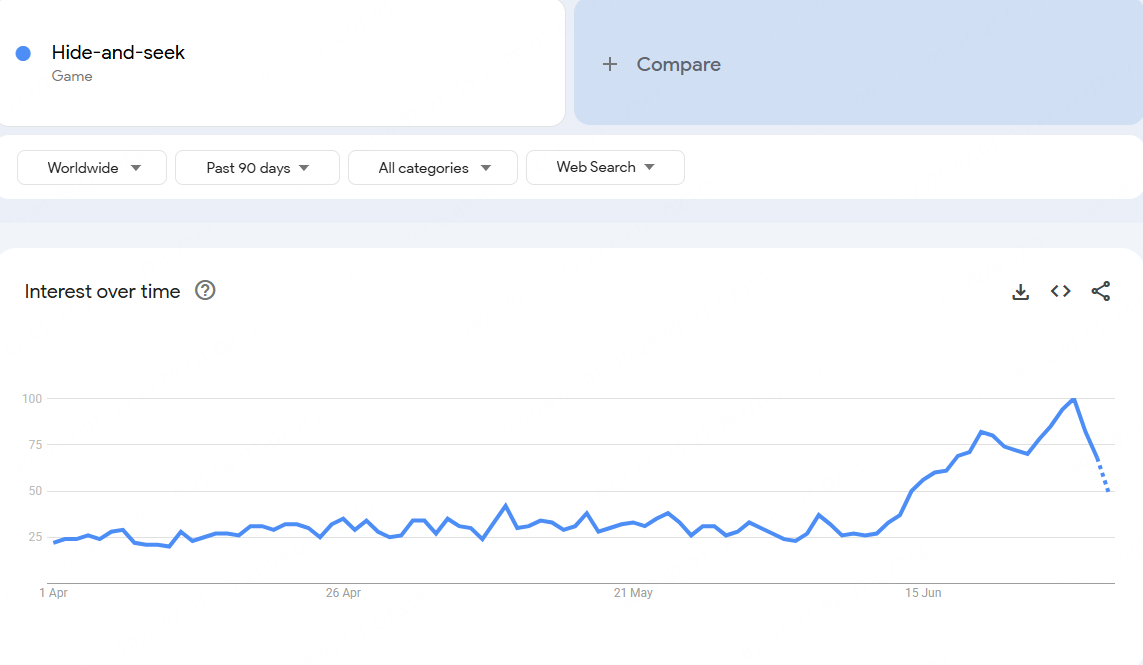
Hide-and-seek games work because they create instant drama. The hider feels clever when a seeker walks past. The seeker feels powerful when they spot one tiny mistake. Spectators enjoy both sides because the tension is easy to read.
Prop Hunt helped modernize the format by letting hiders disguise themselves as objects in the map. Garry's Mod popularized the mode, and similar ideas later appeared across games such as Fortnite and other custom-game platforms. MECCHA CHAMELEON adds another twist: instead of turning into a prop, players paint themselves to blend into the environment. That makes the game about observation, color, pose, and psychology.
For beginner creators, this trend is useful because the core design is small. You do not need a huge RPG world. You need a readable map, two roles, a timer, a few hiding systems, and a clear win condition.
What Makes a Hide and Seek Game Work?
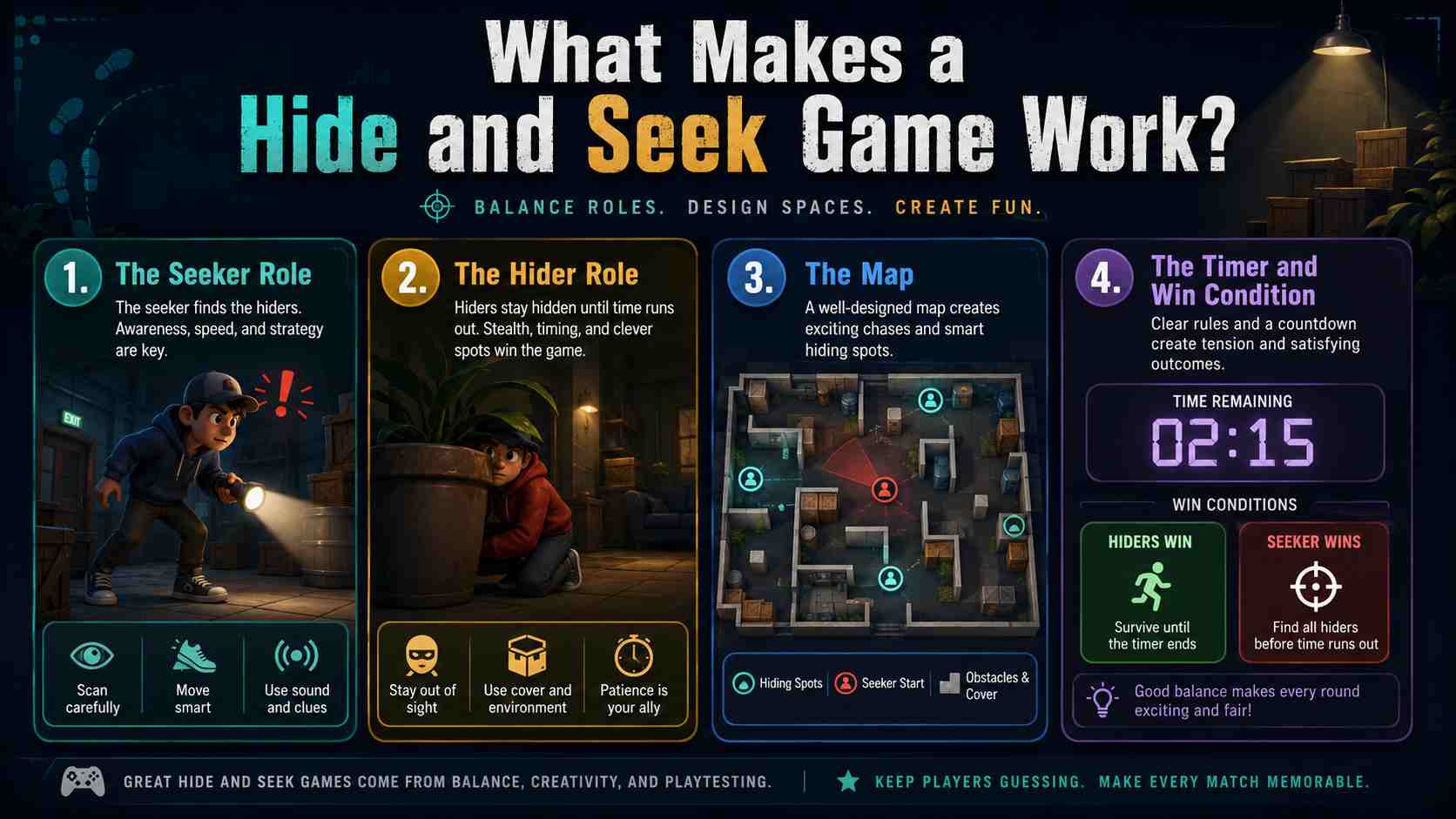
Good hide and seek games depends on four parts: seeker rules, hider rules, map design, and round structure.
1. The Seeker Role
The seeker needs a clear job: find hiders before time runs out. In a digital game, the seeker can have simple tools such as a flashlight, scan pulse, sound clue, limited reveal, or short speed boost.
Do not make the seeker too strong. If the seeker can instantly reveal every hiding spot, the game becomes a chore for hiders. But do not make the seeker too weak either. If they have no clues, the round becomes random wandering.
A good beginner rule is: seekers should get information, not guaranteed answers.
2. The Hider Role
The hider needs a way to feel clever. That might mean choosing a dark corner, turning into a prop, blending with a wall, leaving a decoy, or moving only when the seeker looks away.
Hiders should have tradeoffs. If disguise is too perfect, the seeker has no chance. If movement is too loud, hiders never take risks. If hiding spots are too obvious, every round feels the same.
Useful hider mechanics include limited disguise time, fake props, crouching, sound reduction, decoy placement, or a short dash with a cooldown.
3. The Map
Map design matters more than most beginners expect. A hide-and-seek map should be small enough to search, but complex enough to create choices.
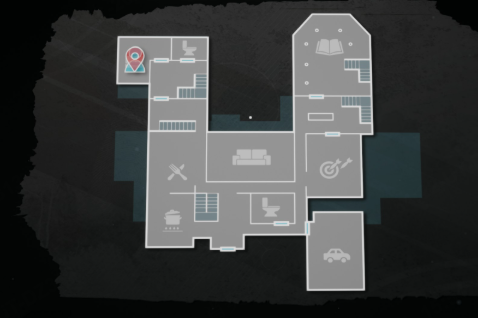
Add a mix of hiding zones:
- Obvious spots for beginners.
- Risky spots near seeker paths.
- High-value spots with limited escape routes.
- Fake-safe spots that are easy to check.
- Open areas where bold players can hide in plain sight.
The best maps make both sides think. Hiders ask, "Will they check here?" Seekers ask, "Where would I hide if I had only ten seconds?"
4. The Timer and Win Condition
Most hide-and-seek games need a timer. Without a timer, hiders can wait forever and seekers lose urgency.
A simple round structure looks like this:
- Hiders get 20 to 30 seconds to hide.
- Seekers are locked or blinded during the hiding phase.
- The search phase lasts 2 to 4 minutes.
- Hiders win if at least one hider survives.
- Seekers win if all hiders are found.
- Players swap roles next round.
For a first prototype, this is enough. You can add scoring later. The goal is to test whether the timer, hiding phase, and win condition create a playable loop before adding more systems. For a broader workflow, see our guide on how to build a playable game prototype.
Hide and Seek Game Rules and Ideas for a Beginner Prototype
Here is a beginner-friendly ruleset you can use as your starting point:
- Players are split into seekers and hiders.
- Hiders choose hiding spots before the seeker is released.
- Hiders can move, but moving creates risk.
- Seekers can tag or reveal hiders within a short range.
- The map includes obstacles, rooms, props, and shadows.
- The round ends when time runs out or all hiders are found.
- Hiders score points for surviving.
- Seekers score points for finding hiders quickly.
This ruleset can become a classic hide-and-seek game, an online hide and seek game, a prop hunt game, or a stealth puzzle depending on the mechanics you add.
If you want your hide-and-seek game to feel more modern, add one twist. Do not add five twists at once. One strong mechanic is easier to understand and easier to prototype.
| Game Idea | Core Twist | Why It Works |
|---|---|---|
| Prop Hunt Room | Hiders disguise as chairs, boxes, plants, or lamps | Players enjoy spotting what looks slightly wrong |
| Chameleon Wall | Hiders copy the color of nearby surfaces | Encourages observation and visual tricks |
| Haunted Library | Hiders are ghosts who freeze near bookshelves | Gives the map a strong theme |
| Museum After Dark | Hiders disguise as statues or paintings | Makes hiding spots part of the story |
| Tiny Robot Escape | Hiders collect batteries while avoiding a seeker drone | Adds a goal beyond survival |
| Schoolyard Browser Game | A classic playground version with lockers, trees, and benches | Easy for beginners to understand |
| Stealth Puzzle Hideout | One player avoids AI guards instead of human seekers | Good for a single-player prototype |
For an AI game maker workflow, the best first version is usually small: one map, one seeker, one or more hiders, a timer, and one special mechanic.
How to Make a Hide and Seek Game With AI
AI works best when you turn a loose idea into clear game rules. Instead of asking for "a fun hide and seek game," describe the roles, map, hiding spots, timer, win conditions, and one special mechanic. This helps an AI game maker SoonLab generate a playable first version instead of a vague concept.
Turn your idea into aplayable game
Describe the game you want to make, and SoonLab will help you start building it.
Step 1: Start With One Clear Game Concept
Begin with a simple one-sentence idea. Do not design ten maps or fifty props at the start. Your first goal is to make one round feel fun.
A prop hunt game in a tiny museum where the player hides as statues and paintings while an AI guard searches the room.Step 2: Define the Player Roles
Decide who the player controls and who is searching. For a beginner prototype, use one main player role and one simple seeker or AI guard.
- Hider: avoids being found until the timer ends.
- Seeker: finds and tags hiders within a short range.
- AI guard: patrols the map and reacts to movement, noise, or suspicious props.
Step 3: Design a Small Map
Keep the first map compact and easy to understand. A small schoolyard, storage room, library, museum, or hallway is enough for a first hide-and-seek game prototype.
Describe important map objects such as rooms, walls, doors, benches, lockers, trees, props, shadows, escape paths, and hiding zones.
Step 4: Add One Special Mechanic
A modern hide-and-seek game usually needs one memorable twist. Choose one mechanic first, then test whether it makes the round more fun.
- Disguise: the hider can turn into a chair, box, plant, barrel, or lamp.
- Camouflage: the hider changes color to match nearby walls or objects.
- Sound: running creates noise that attracts the seeker.
- Flashlight: the seeker reveals hidden players with a limited beam.
- Decoy: the hider can place a fake object to distract the seeker.
Step 5: Set the Timer and Win Conditions
Clear win conditions make the game easier to build and easier to play. For a beginner version, use a short round with simple scoring.
- The hider wins by surviving for 2 minutes.
- The seeker wins by finding or tagging the hider.
- Bonus points can reward fast hiding, smart movement, or quick detection.
Step 6: Use a Specific AI Game Prompt
Once the rules are clear, combine them into a detailed prompt. Here are three copy-ready game prompts you can adapt for SoonLab or another AI game maker.
Prompt 1: Classic Seeker vs HiderCreate a simple browser hide-and-seek game prototype. The player controls a hider in a small schoolyard map with trees, benches, lockers, and walls. An AI seeker starts after a 20-second hiding phase. The hider wins by surviving for 2 minutes. The seeker wins if it gets close enough to tag the hider. Add simple movement controls, a countdown timer, hiding zones, and a clear win/lose screen.Create a prop hunt style browser game prototype. The player is a hider who can disguise as one of five props: chair, box, plant, barrel, or lamp. The map is a small storage room with matching objects. An AI seeker patrols and checks suspicious props. The hider wins by staying hidden until the timer ends. Add a disguise button, limited movement while disguised, and simple seeker detection.Create a single-player stealth hide-and-seek game. The player must collect three keys while avoiding a seeker guard. The map has shadows, doors, tables, and hiding spots. The guard has a cone of vision and follows noise if the player runs. The player wins by collecting all keys and reaching the exit. Add simple stealth rules, a restart button, and clear instructions.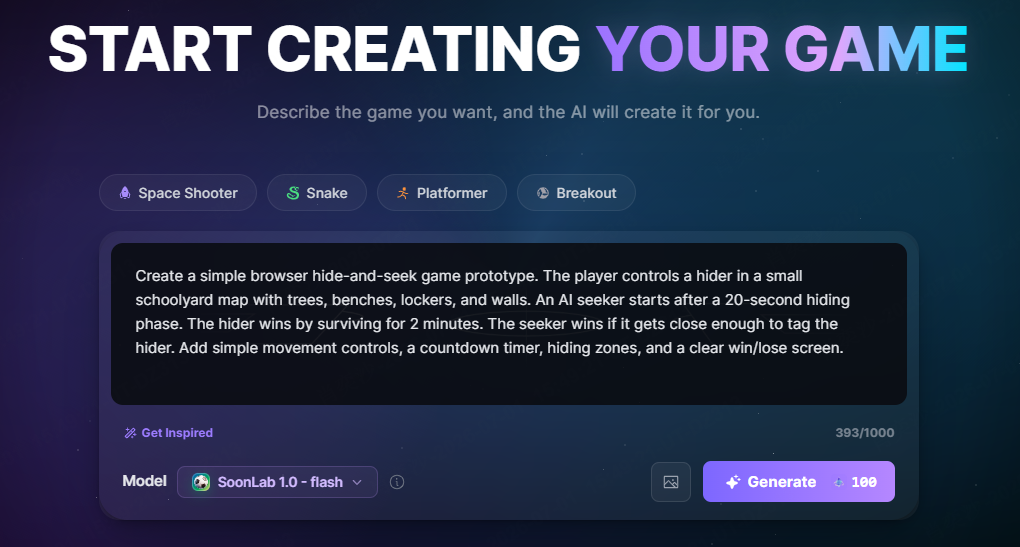
Step 7: Generate, Test, and Improve the Prototype
After generating the first version, play one full round and check whether the core loop works. Can the hider escape? Can the seeker find the player? Does the timer feel fair? Is the map too empty or too confusing?
SoonLab is useful here because it helps beginners move from idea to playable browser prototype without starting from a blank code editor. You can describe the roles, map, hiding spots, time limit, win conditions, and special mechanic in plain language, then test the result directly in the browser.
For beginners, the best workflow is simple: create one small round, test whether it is fun, improve the prompt, and only then add more maps, props, characters, or multiplayer-style ideas.
SoonLab vs Other Game Makers for Hide-and-Seek Games
Different tools fit different creators. Here is a fair way to think about the options.
| Tool | Best For | Tradeoff |
|---|---|---|
| SoonLab | Prompt-led browser game prototypes and fast iteration for beginners | Best framed as early prototyping unless specific advanced features are confirmed |
| Roblox Studio | Social multiplayer games and Roblox-native audiences | Requires learning Roblox systems and platform rules |
| Fortnite Creative / UEFN | Large 3D islands, creator economy, and Fortnite-style multiplayer experiences | More complex and tied to the Fortnite ecosystem |
| GDevelop | No-code 2D and HTML5 games with event-based logic | More manual setup than prompt-first AI workflows |
| Construct | Polished 2D browser games with visual event sheets | Strong for 2D logic, but still requires hands-on system design |
If you want a polished multiplayer game inside an existing platform, Roblox Studio or UEFN may be better long-term. If you want a 2D no-code engine, GDevelop or Construct are strong options. If you want to quickly test rules, prompts, map ideas, and a playable browser game concept, SoonLab is a natural fit.
FAQs
What are the basic rules of a hide and seek game?
One player or team acts as the seeker while the others hide. The seeker waits during a short hiding phase, then searches the map. Hiders win if they survive until the timer ends. Seekers win if they find or tag every hider before time runs out.
How do you make a hide and seek game fun online?
Use a small but interesting map, clear roles, a timer, strong hiding spots, and simple tools for both sides. Hiders need ways to feel clever, while seekers need clues or abilities that reward observation without making hiding impossible.
What is a prop hunt game?
A prop hunt game is a hide-and-seek variation where hiders disguise themselves as objects in the map, such as chairs, boxes, plants, or barrels. Seekers must identify which objects are real and which are players.
Can I make a hide and seek game without coding?
Yes, depending on the tool and scope. No-code game makers and AI game makers can help beginners create simple prototypes. For a first version, focus on one map, one timer, one seeker, and one hider mechanic.
How can AI help me make a hide and seek game?
AI can help turn your concept into rules, map ideas, prompts, win conditions, and playable prototypes. The best results come from specific prompts that describe roles, controls, hiding spots, timers, and mechanics.
What is a good first hide and seek game idea?
A simple prop hunt room is a strong first idea. Create one room with everyday objects, let the hider disguise as one prop, and give the seeker a timer and short detection range. This keeps the prototype focused and testable.
How does SoonLab fit into hide-and-seek game creation?
SoonLab can help beginners prototype hide-and-seek style browser games from prompts. It is useful for testing rules, map ideas, disguises, timers, and win conditions before investing time in advanced art, code, or platform-specific systems.
Final Thoughts
A great hide and seek game is not just about hiding. It is about readable tension: the hider knows the seeker is close, the seeker knows something is off, and the map gives both sides enough information to make clever choices.
To make your first hide and seek game, keep the scope small. Use one map, one timer, one seeker rule, one hider ability, and one win condition. Add a prop hunt or camouflage twist only after the basic round works.
The popularity of MECCHA CHAMELEON shows that players still love simple social games when they create funny, surprising moments. With SoonLab, you can use that insight to prototype your own hide-and-seek style browser game from prompts, then test whether your rules are actually fun before building anything bigger.