
World models will matter to game development, but probably not in the way the most exciting demos suggest. Working at the intersection of game creation and AI, I am less interested in whether a model can produce an impressive world demo than whether that world can support reliable player decisions. I do not think the first major contribution of world models will be generating complete games at runtime. Their near-term value is more practical: turning visual references into coherent space, helping developers explore environments much faster, and creating a spatial layer that existing game systems can use.
That distinction matters. A model may generate a beautiful world that I can move through, yet still know nothing about why a locked door should stay locked, whether a jump is fair, or what makes a combat encounter interesting. A world is a place. A game is a designed system of actions, rules, feedback, and consequences.
World Labs' new Atlas world model makes the boundary between those two things easier to see. It also gives us a useful picture of how the boundary may eventually disappear.
What World Model Atlas Changes for Game Development
Atlas is a multimodal model built to work across text, images, video, camera poses, and 3D depth. Instead of treating an image as a flat picture, it grounds images at positions in 3D space and builds a shared spatial context. It can then generate a new view from a specified camera, reconstruct a scene from a small number of images, or infer the parts of a place the camera never saw.
For game developers, its most important output is not the polished video. Atlas can also produce explicit 3D representations such as point clouds and Gaussian splats. That makes the result transferable. It can become an asset in a wider toolchain rather than remain a video that only looks interactive.
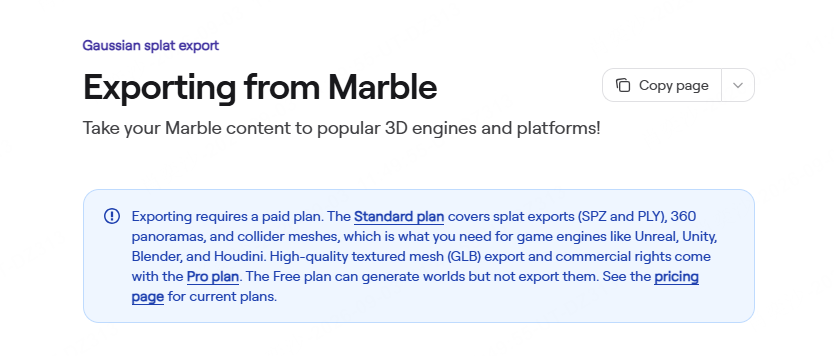
Atlas is still entering early access, so it would be premature to treat it as a production-ready game pipeline. World Labs has, however, already shown the practical direction with Marble. Marble worlds can be exported as splats, meshes, panoramas, and collider meshes for tools including Unity, Unreal Engine, Blender, and Houdini, according to the official export documentation.
That is the real development signal. The world model is becoming less like a media generator and more like a spatial compiler: it takes an incomplete description of a place and produces a representation another system can render, inspect, and build upon.
The First Breakthrough Will Be Pre-Production, Not Runtime Generation
If I were deciding where to use a world model today, I would start before production. Environment development has a costly gap between imagining a place and experiencing its scale. Concept art communicates mood, while a greybox communicates distance, sightlines, and movement. Developers usually need both, and moving between them takes time. This is the same reason a playable game prototype is often more useful than a long design document: movement exposes spatial problems that an image or description cannot.
A spatial model could compress that loop. A developer could provide a sketch, a location photo, and a rough camera plan, then walk through several plausible versions of the environment before committing to a level. The model would not replace level design. It would make spatial questions answerable earlier:
- Does this corridor make the reveal feel dramatic or predictable?
- Can the player read the destination from the starting point?
- Does the room feel tense at gameplay speed rather than only in a still image?
- Which camera path best introduces the scale of the world?
Atlas is particularly relevant here because camera geometry is a native input, not a loose instruction written into a prompt. A cinematic designer could explore framing and movement while keeping the surrounding space consistent. An environment artist could reconstruct a reference location from a few photographs, then test viewpoints that were never captured.
This is more valuable than producing another mood board. It creates a place that can be questioned.
World Generation and Game Generation Are Different Problems
One of the easiest mistakes in this discussion is to use “interactive world” and “game” as if they mean the same thing. They do not.
A generated scene needs at least two kinds of truth. The first is visual truth: the wall remains where the player saw it, lighting stays coherent, and a room still looks like the same room from another angle. The second is gameplay truth: the wall blocks movement, the doorway has a known width, enemies can navigate around the table, and the key reliably changes the door from locked to unlocked.
Atlas makes a significant advance in visual and spatial truth. It does not, based on the capabilities World Labs has announced, automatically provide the complete gameplay truth required by a shippable game.
A previous World Labs game experiment shows exactly where the seam sits. Marble generated the visible 3D environment, but the team still had to export a collider mesh and use a separate game platform to add controls, triggers, objectives, effects, and multiplayer logic. The published workflow demonstrates that the generated world became playable only after another system supplied rules and interactions.
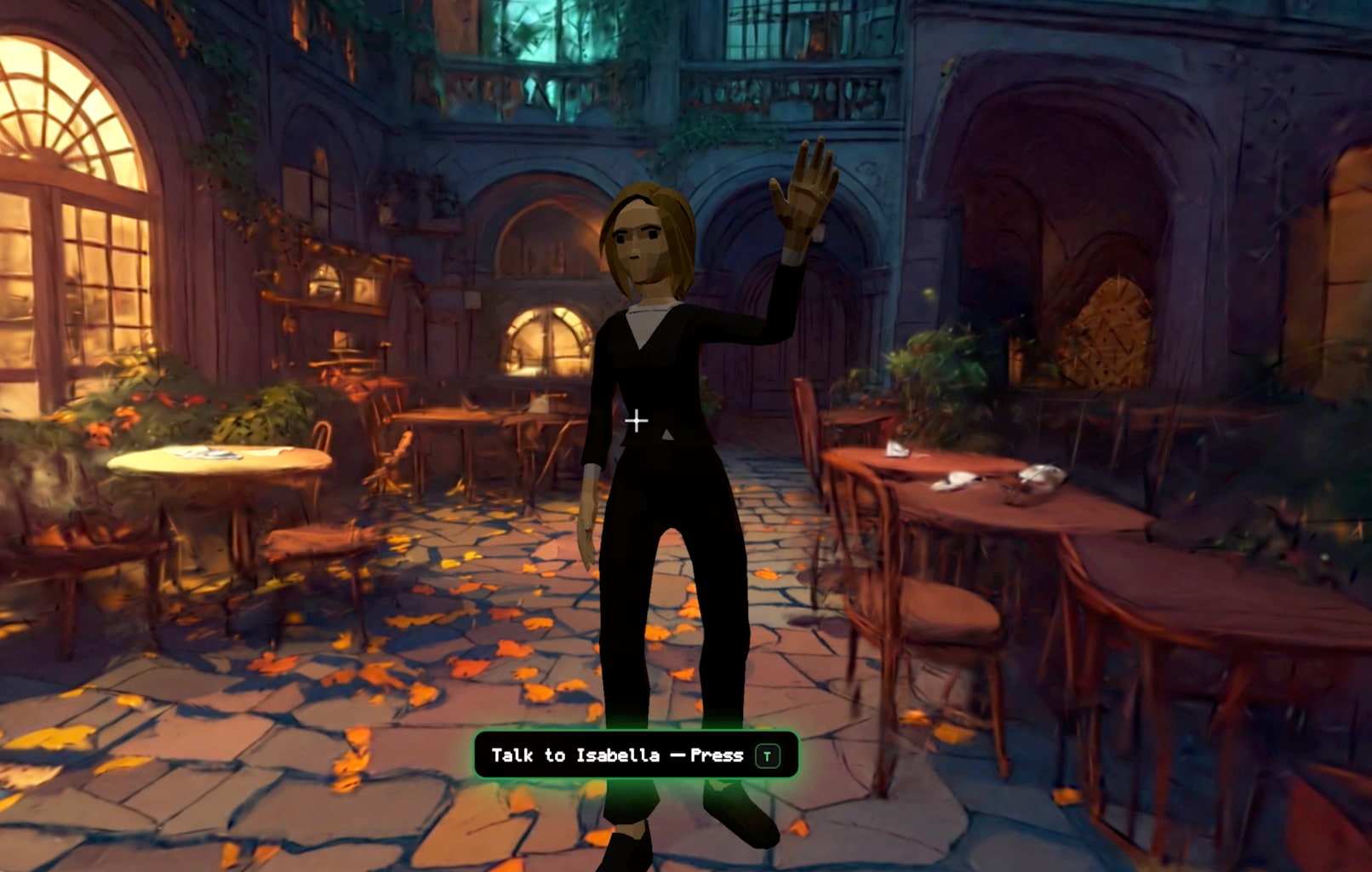
I expect this two-layer design to become the standard architecture for AI-generated games:
- The world layer generates appearance, atmosphere, spatial continuity, and plausible expansion.
- The game layer owns collision, navigation, object identity, state, rules, balance, and save data.
Prompt-to-play tools already approach the other side of this problem. SoonLab's text-to-game AI, for example, turns a description into a browser game with controls, rules, objectives, and a playable loop. A world model adds a different capability: it turns intent and visual evidence into coherent space.
These systems therefore solve complementary problems. One turns intent into mechanics; the other turns intent into space. The important product opportunity is not choosing between them. It is creating a reliable interface between them.
Turn your idea into aplayable game
Describe the game you want to make, and SoonLab will help you start building it.
The Missing Interface Is a Gameplay Contract
To move from a convincing world to a dependable game, a world model needs to return more than pixels and approximate geometry. It needs a structured gameplay contract.
That contract could describe which surfaces are walkable, which objects are persistent, where traversal is possible, what can be moved or destroyed, and which areas must never change. It should also preserve stable IDs. If a player leaves a sword on a table and returns later, the game cannot accept a visually similar sword in a plausible location. It needs the same object, with the same state.
This is where I see the most important technical work ahead. Generative models are rewarded for plausibility. Games depend on repeatability. A model may think three versions of a staircase are equally reasonable; a platforming game may only be fair with one exact riser height.
The solution is unlikely to be a single model improvising everything. A stronger system would let the developer declare invariants:
- This path must remain open.
- This platform must be reachable with a 2.4-meter jump.
- This landmark must be visible from the spawn point.
- This object must retain its identity across every generated view.
- Everything outside these constraints may be reimagined.
That final line is crucial. Good generative game tools will not remove control; they will let creators decide where uncertainty is useful.
Game Developers Will Need an Uncertainty Budget
Atlas offers a useful design clue: when it receives fewer reference images, it fills unseen space with plausible content. As more views are supplied, the reconstruction becomes more faithful and the model needs to imagine less.
I think game teams will treat this tradeoff as an uncertainty budget. Not every part of a game world needs the same level of control.
A distant street seen through a window can tolerate a large uncertainty budget. A side room in an exploration game may vary between playthroughs. The route used for a speedrun, the cover layout in a competitive shooter, or the spacing in a precision platformer cannot.
This creates a more useful authoring model than a simple “generate” button. Developers could lock the critical path, traversal metrics, quest objects, and combat spaces, while allowing the model to interpret transitional areas, scenery, weather, and nonessential detail. The creative skill shifts from specifying every asset to deciding what must be exact and what may remain fluid.
Which Games Will Benefit First?
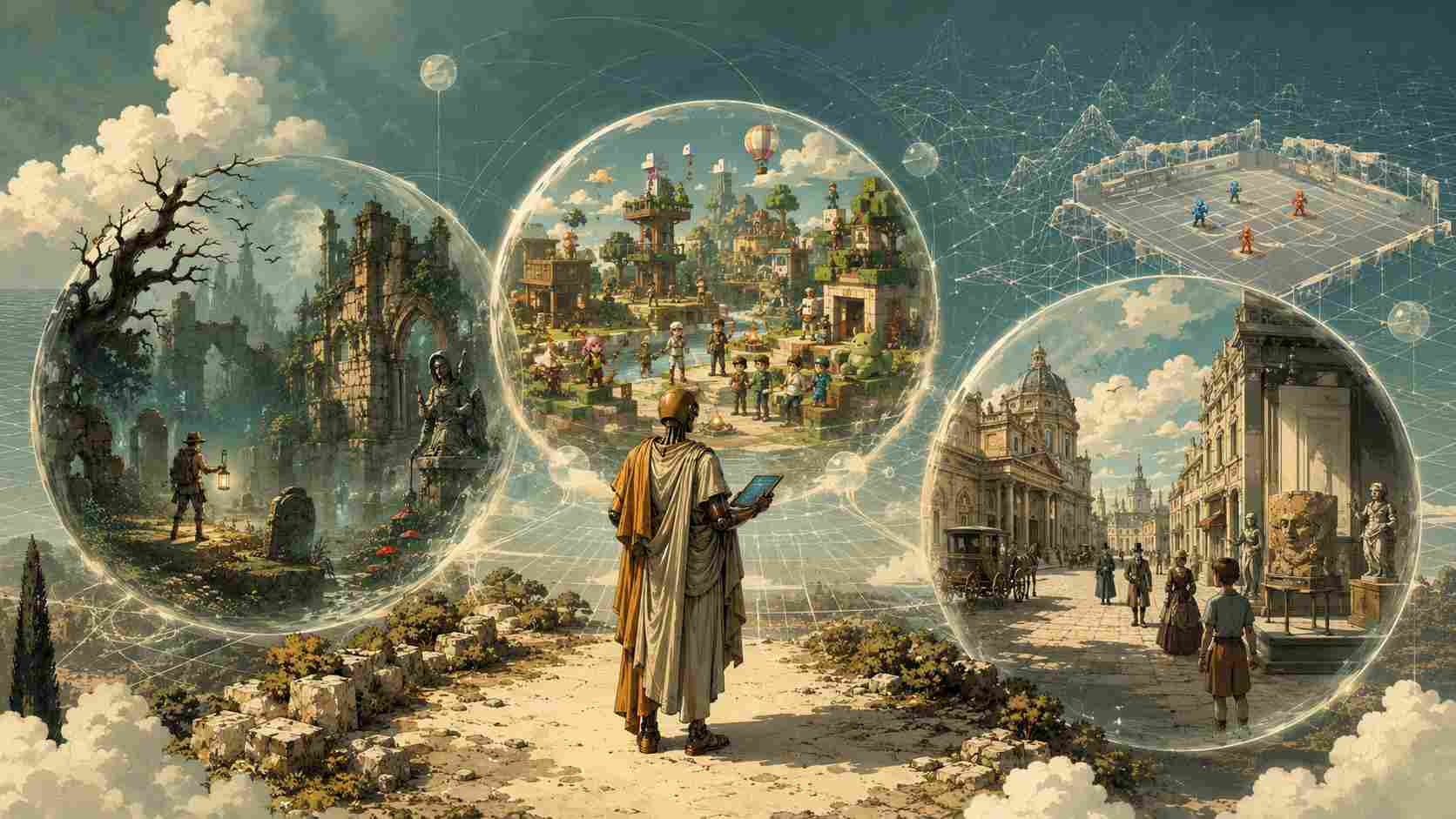
The impact will not be equal across genres. Games with high environmental value and relatively loose spatial tolerances are the most natural early adopters.
Exploration, Horror, and Narrative Games
These games can gain a great deal from rapid atmosphere and location generation. A designer could build several versions of an abandoned hotel, preserve the story-critical rooms, and vary the spaces between them. Slight uncertainty may even improve the experience by making a familiar place feel unstable.
UGC and Social Worlds
World models can lower the cost of giving every creator a distinctive space. The World Labs and Rosebud experiment already points toward generated environments used as shared multiplayer stages. Templates can handle networking and rules while the world model supplies visual identity.
Location-Based and Educational Games
Sparse reconstruction could turn a small set of photographs or an ordinary phone video into a navigable starting point. Museums, historical settings, training spaces, and local stories become more practical to prototype without a full scanning crew.
Precision and Competitive Games Will Move More Slowly
Platformers, fighting games, tactical shooters, and heavily systemic simulations need exact geometry, stable timing, predictable visibility, and reproducible interactions. World models may still accelerate concepting and asset creation for these genres, but putting open-ended generation inside the core match creates design and testing problems that visual quality cannot solve. Even when using an AI 3D game maker for an early prototype, camera behavior, collision, movement, level boundaries, and win conditions still need to be tested as separate systems.
World Models Could Also Change Game Testing
The less visible opportunity is simulation. Once a model understands how a space changes over time, it can produce variations that expose a game or agent to situations the team did not manually author.
This does not mean replacing deterministic tests. If a door must open after a switch is pressed, a normal automated test should still verify that rule. A world model is better suited to broad, messy questions: Can an agent navigate when lighting changes? Does a landmark remain readable in fog? Does an interaction survive when objects appear in unfamiliar arrangements?
Microsoft's Muse research approaches the problem from another direction by modeling game visuals together with controller actions. Google DeepMind's Genie 3 generates environments that can be explored in real time. Atlas is differentiated by putting explicit camera geometry, sparse reconstruction, and exportable 3D representations at the center.
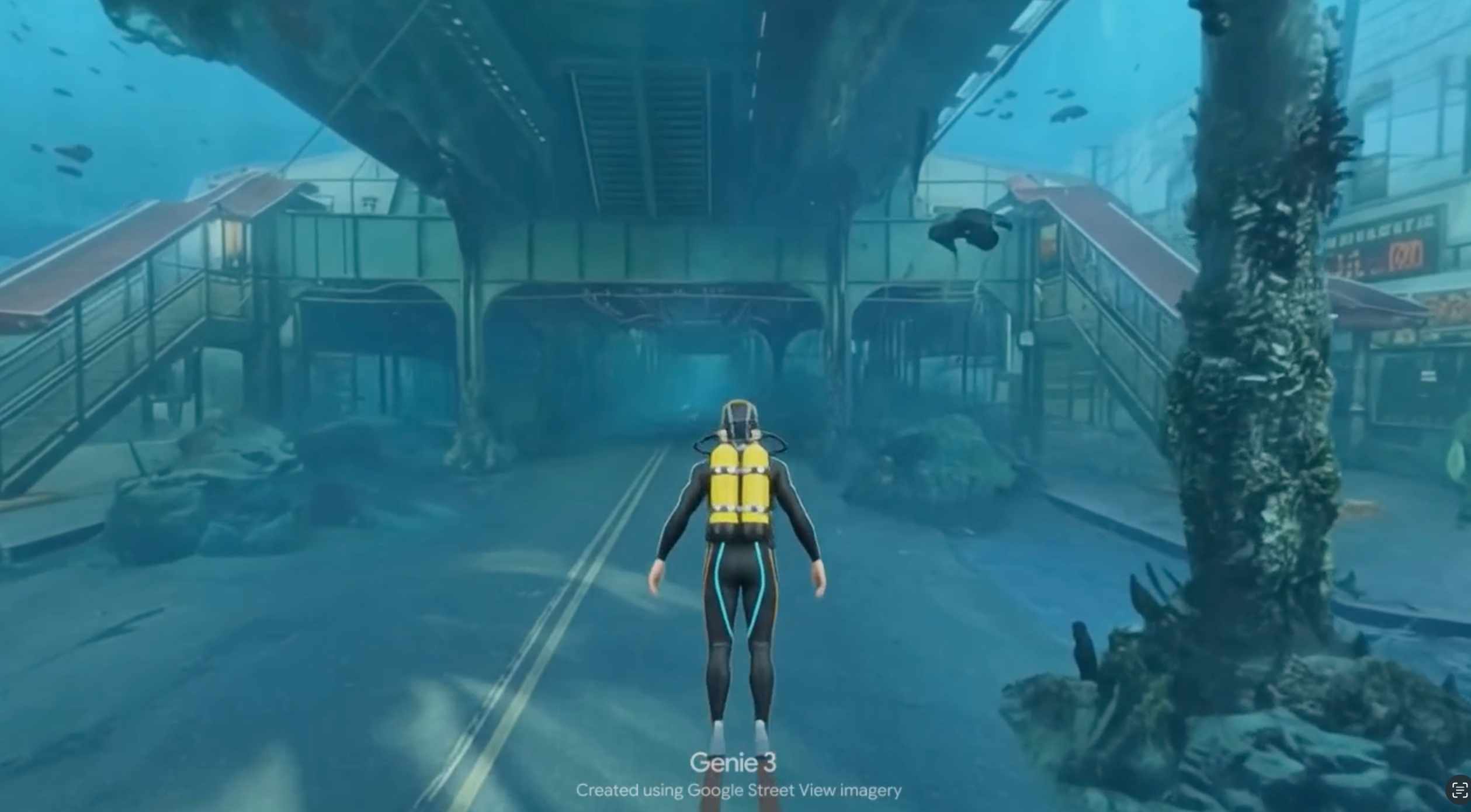
Together, these projects suggest three distinct uses of world models in games: generating spaces, predicting play, and creating environments in which people or AI agents can be tested. The long-term change may be larger in development infrastructure than in what players see on screen.
Why I Would Not Build a Fully Generated Game Yet
The idea is attractive: generate each new view as the player moves and let the world continue forever. For most games, I would resist it today.
Runtime generation makes several production problems harder at once. The team must control latency and compute cost, reproduce bugs, moderate unexpected content, preserve state, keep multiplayer clients synchronized, and guarantee that generated geometry remains playable. Art direction also becomes statistical rather than absolute. “Usually correct” is not enough when a quest item disappears or a doorway changes shape.
Exportable worlds offer a better near-term compromise. Generate first, inspect the result, derive or edit collision, add semantic labels, run validation, and then ship a fixed or bounded version. This keeps the speed of generation without giving up the debuggability of a game engine.
Runtime world models may arrive first in deliberately dreamlike experiences, temporary social spaces, and games built around surprise. In those cases, inconsistency can be part of the fiction. Most other games will adopt generation gradually, outside the player's immediate view and inside constraints set by designers.
The Role of the Game Developer Is Not Getting Smaller
World models reduce the cost of producing plausible space. That does not reduce the importance of design. It raises the value of judgment.
When it becomes easy to create ten environments, the difficult question is no longer “Can we build this room?” It is “Which room creates the right decision?” Developers will spend less time translating references into raw assets and more time defining invariants, testing affordances, controlling variation, and connecting space to mechanics.
I expect environment artists to work more like world directors, combining authored geometry, generated detail, reference images, and semantic constraints. Level designers will still own pacing and traversal. Technical artists will become essential at the boundary between neural representations and engine-ready assets. AI will make these roles more interconnected, not obsolete.
My Take: The Future Is Prompt to World to Play
Atlas is important for games because it makes spatial intelligence more programmable. It can infer a coherent place from incomplete inputs and express that place in forms other tools can use. But the next real milestone is not an endless generated landscape. It is a generated world that understands what the game must preserve.
The most credible path is a hybrid pipeline: a world model produces and expands space; an AI game maker or traditional engine turns that space into rules, interactions, and goals; a human creator decides where the system may improvise and where it must obey. This also changes how I evaluate AI tools for game development. The useful question is not which tool claims to make everything. It is which part of the creative pipeline each tool can make faster without taking control away from the developer.
Creators do not need to wait for that complete pipeline before experimenting. They can already turn a focused idea into a small playable game, test the core loop, and learn which parts of the experience actually require a richer generated world. That is a better starting point than trying to generate an unlimited world before proving that the player has a meaningful reason to move through it.
When the spatial and gameplay layers finally connect, “prompt to game” will mean more than assembling assets around a template. The prompt will define a world, the world will expose structured possibilities, and the game system will turn those possibilities into play.
I would not call Atlas a game generator. I would call it an early version of something game development has never had before: a model that can reason in the same medium that level designers use—space. Once that spatial layer can communicate reliably with mechanics, world models will not just help us build game environments faster. They may change what a game environment is allowed to become.