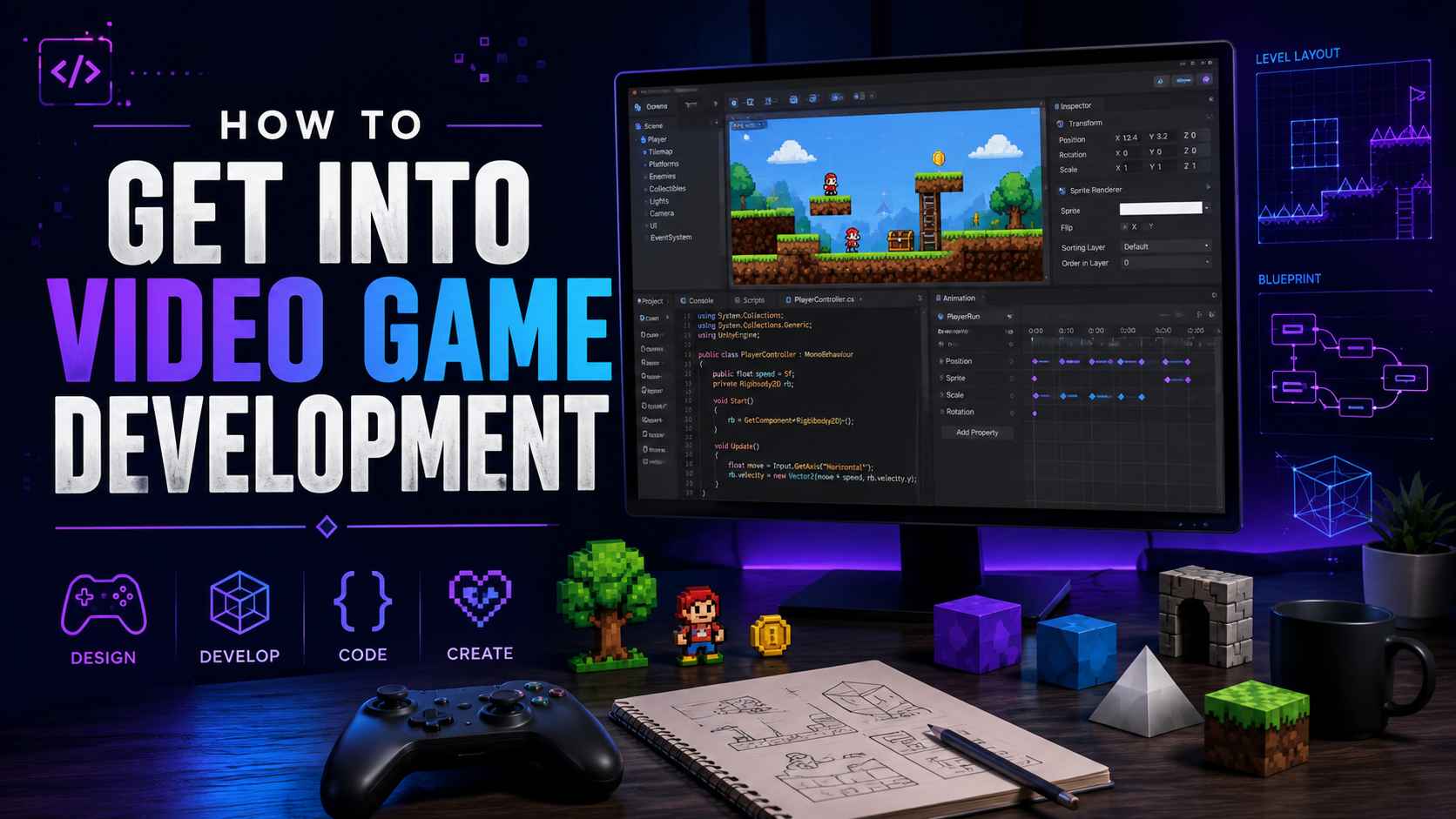
I understand why many beginners feel overwhelmed when they first search how to get into video game development.
You may start with a simple feeling: "I love games, and I want to make one." Maybe you already have a dream idea in your head, like an open-world RPG, a cozy farming game, a multiplayer survival game, or a story-driven adventure with choices that matter.
Then you begin researching. Suddenly, you find yourself surrounded by Unity tutorials, Unreal Engine guides, Godot recommendations, C# vs. C++ debates, pixel art tools, Steam publishing advice, and AI tools for game development. Before you even make your first character move, game development already feels too big.
That is why I think the real beginner question is not only "how do I become a game developer?" The better question is: how do I finish something playable before tools, tutorials, and my dream game make me give up?
My answer is simple: start small, build one playable loop, finish it, and repeat. Game development is not learned by collecting tutorials. It is learned by finishing small games.
What It Really Means to Become a Game Developer
When I talk about becoming a game developer, I do not only mean becoming someone who can write code.
Coding is important, but game development is bigger than programming. Even a small game may involve design, movement, UI, art, sound, level layout, testing, debugging, balancing, and sometimes publishing or marketing.
That is why I see a game developer as someone who can turn an idea into a playable experience. The game does not have to be beautiful at first. It can use placeholder art. It can be short. It can be rough. But if another person can play it, understand what to do, and feel some kind of interaction, then you are already practicing real game development.
It also helps to know which path you are aiming for. These paths are different, but they all start in the same place: you need to prove that you can finish something small before you try to build something large.
Why Beginners Get Stuck So Easily
I do not think we help beginners by pretending game development is easy.
At first, the idea in your head feels exciting. But once you start building, the first version often feels disappointing. The movement feels wrong. The camera is awkward. The enemy gets stuck. The UI is ugly. The game does not feel fun yet.
That moment is normal. The hard part of game development is not only learning how to make things. It is learning how to continue when the first version looks worse than the version in your imagination.
The biggest mistake I see is starting with a dream game too early. Dream games are motivating, but they are dangerous as first projects. Open-world RPGs, multiplayer survival games, complex roguelikes, farming sims, and story-heavy adventures are not single beginner projects. They are collections of many systems.
I do not think beginners should abandon their dream game. I think they should shrink it. If your dream is a farming RPG, start with one crop, one field, one NPC, and one shop. If your dream is a roguelike, start with one room, one enemy, one weapon, and one upgrade. The dream can stay. The first version just needs to be small enough to finish.
How to Start in Game Development: Build One Tiny Playable Loop
When someone asks me how to start in game development, I usually do not tell them to compare game engines for weeks. I tell them to choose one tiny game and finish it.
Your first game does not need to be original, beautiful, or marketable. Its job is to teach you the full process of making something playable.

A playable loop is the basic action cycle of the game. The player jumps over obstacles and reaches the end. The player clicks to earn coins and buy upgrades. The player collects items before time runs out. The player survives waves of enemies.
This is one of the most practical ways to answer how to learn video game development. You learn faster from five finished tiny games than from one giant unfinished project.
How to Learn Video Game Development Without Tutorial Hell
Tutorials are useful, but tutorial hell is real. I think many beginners know this pattern: you watch one tutorial, then another, then another. You feel like you are learning, but when you try to build something without the video, you feel stuck.
The problem is not tutorials. The problem is using tutorials as a replacement for making decisions. First, choose one tool and stay with it long enough to finish a few small projects.
If you are unsure whether your first project should use a flat 2D play area or a world with depth, this guide to choosing between 2D and 3D games compares the development difficulty, art requirements, cameras, physics, controls, and performance of both formats.
 Tip
TipWe compare Unity vs Unreal Engine and Godot vs Unity to help you choose the best engine for your needs.
I would not frame this as "which engine is best?" For a beginner, the better question is: which tool helps me finish my first playable loop?
After choosing a tool, learn only what your current game needs. If you are making a simple platformer, learn movement, jumping, collision, checkpoints, UI, and restart logic. Do not start with multiplayer netcode.
How to Develop an Indie Game Without Letting Scope Destroy It
If you want to know how to develop an indie game, I think the most useful idea is the vertical slice.
A vertical slice is a small but playable version of the full game experience. It is not the whole game. It is one focused piece that shows what the game might feel like when the main parts work together.
For example, if you want to make a farming game, your vertical slice might include one crop, one field, one NPC, one shop, and one day-night cycle. If you want to make a dungeon crawler, it might include one room, one enemy, one attack, one item, and one exit.
This helps you test the most important question early: is the small version fun enough to expand? You are not giving up on the big idea. You are building it in pieces.
Can AI Help You Start Game Development in 2026?
I think AI can help beginners, but only if we are honest about its role.
AI can help you brainstorm ideas, break a large concept into smaller systems, explain code, generate starter scripts, write placeholder dialogue, debug errors, create design checklists, or suggest balance ideas.
For beginners, one of the biggest benefits is that AI can reduce the fear of the blank page. Instead of staring at a huge idea and not knowing where to begin, you can ask AI to shrink it into something you can actually build.
But AI cannot reliably decide whether your game is fun. It cannot replace playtesting. It cannot create a strong creative identity by itself. It cannot understand every detail of your project without context. And it cannot make finishing emotionally easy.
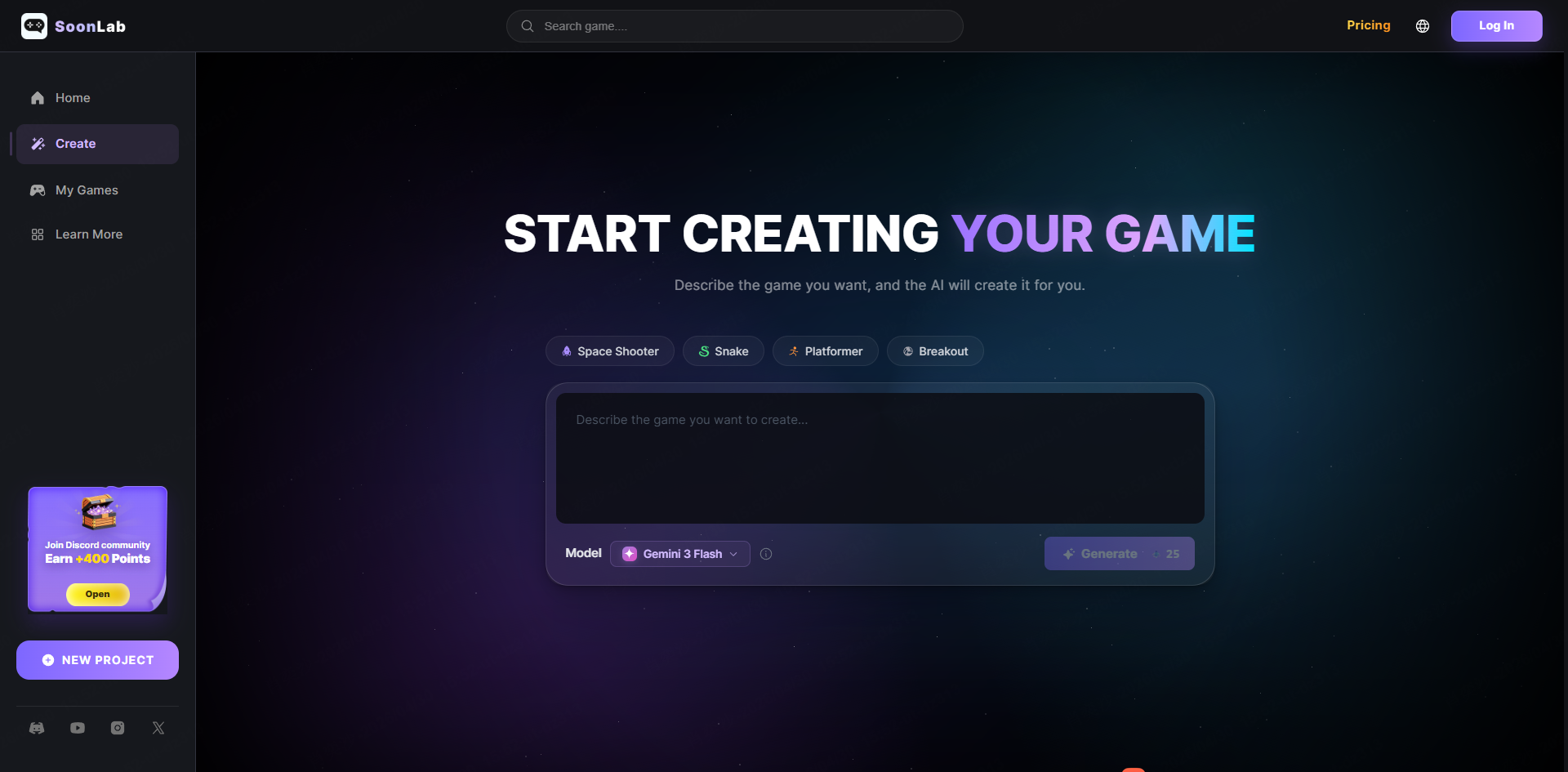
This is where a tool like SoonLab can fit naturally. For beginners who have ideas but are not ready for a full engine workflow, SoonLab can help turn early concepts into small playable prototypes. It does not replace learning game development, but it can help with one of the hardest early steps: moving from "I have an idea" to "I can test a small version of this idea."
A Simple Beginner Roadmap: From Zero to First Playable Game
If I were starting from zero, I would not try to become a professional game developer in 30 days. That is too much pressure. Instead, I would use the first month to build the habit of finishing.
Week 1: Choose One Tool and Build a Tiny Clone
In week one, I would follow one beginner tutorial, finish the basic project, and change at least one thing myself. The change could be small: speed, score, level layout, color, sound, or difficulty.
Week 2: Make a Small Original Game
In week two, I would make a small original game using one mechanic from the clone. The goal is not to be revolutionary. The goal is to make something that feels like mine.
Week 3: Polish and Share It
In week three, I would stop adding new systems and polish what already exists. I would add sound, improve the UI, fix obvious bugs, make the goal clearer, and let someone else play it.
Week 4: Start the Next Game Smarter
In week four, I would write down what I learned and start the next game smarter. The goal is not to master game development in one month. The goal is to prove to yourself that you can finish a small playable game.
Common Beginner Mistakes I Would Avoid
Most beginners do not fail because they lack ideas. They fail because every idea becomes ten systems before the first system is fun.
FAQs
How do I become a game developer with no experience?
I would start with tiny projects. Choose one engine or tool, learn only the skills needed for your current project, and finish several small games before chasing a large one.
How long does it take to learn video game development?
You can make a tiny game in days or weeks, but becoming job-ready or commercially capable usually takes months or years of repeated practice. The fastest path is not one huge project. It is many small finished projects.
What is the best engine for beginners?
I do not think there is one universal best engine. Unity, Godot, GameMaker, Roblox Studio, and Unreal Engine can all work. The best beginner engine is the one that helps you finish your first playable game.
Should I learn coding before game development?
You do not need to master coding before starting, but programming basics will help. I would focus on variables, conditions, loops, functions, events, and debugging, then practice them inside small games.
Should my first game be my dream game?
Not directly. I would keep the dream game as motivation, but shrink it into a playable slice first. Your first project should teach you how to finish.
Can AI make me a game developer faster?
AI can help with ideas, code explanations, debugging, and prototype planning. But it cannot replace practice, playtesting, design judgment, or finishing projects.
How do I develop an indie game by myself?
Start with a small scope, build a vertical slice, use placeholder assets, test early, polish the core loop, and only expand once the small version feels fun.
Conclusion
Game development is hard, but I believe it is learnable.
The biggest beginner problem is usually not a lack of ideas. It is too many ideas, too many tools, too many tutorials, and too much pressure to build the dream game immediately.
You do not need to choose the perfect engine before you start. You do not need to master every programming concept. You do not need to build a commercial game on your first try.
Start smaller. Build one playable loop. Test it. Fix it. Share it. Then build another one.
AI tools can help you brainstorm, prototype, and understand code faster, but they cannot replace your taste, judgment, or willingness to finish.
So if you want to know how to get into video game development, I would not begin by asking which engine can build your dream game. I would begin with a smaller and more useful question: what tiny game can I finish this month? That first finished project is the real doorway.