
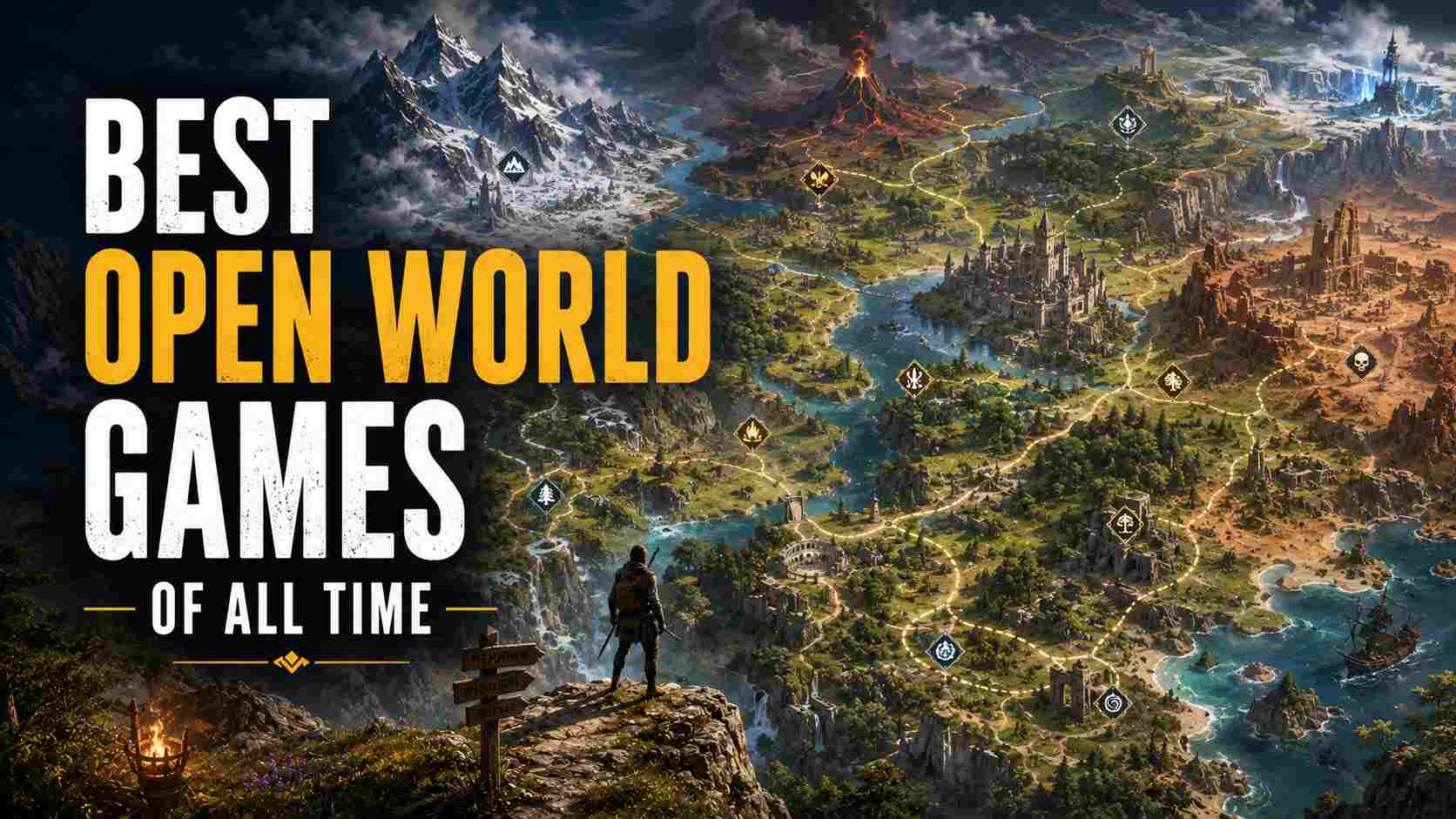
The best open world games of all time do more than give players a huge map. They create the feeling that anything could be waiting beyond the next hill, alley, cave, island, or ruined tower.
That feeling is hard to fake. A large world can still feel empty if every activity is predictable. A smaller world can feel unforgettable if every location has a purpose, every detour has a reward, and every system gives players a new way to tell their own story.
This guide is written for players looking for their next great open world game, but also for creators who want to understand why these games work. If you are experimenting with AI game creation, the best open world games below offer practical lessons you can apply to browser games, adventure games, survival games, and small open-ended worlds made with tools like SoonLab.
Quick Picks: Best Open World Games of All Time
| Game | Best For | Why? |
|---|---|---|
| Elden Ring | Mystery and discovery | A dangerous world that rewards curiosity without over-explaining. |
| Red Dead Redemption 2 | Immersion | One of the most believable open worlds ever built. |
| The Witcher 3: Wild Hunt | Story-driven exploration | Side quests often feel as rich as main story chapters. |
| The Legend of Zelda: Tears of the Kingdom | Creative freedom | Physics, building, and traversal make exploration personal. |
| The Elder Scrolls V: Skyrim | Roleplay and wandering | A fantasy world where detours become the main event. |
| Minecraft | Creative survival | The player turns the world into a personal project. |
| Grand Theft Auto V | Urban sandbox play | A modern city full of systems, chaos, and player-made moments. |
| Cyberpunk 2077 | Dense city atmosphere | Night City is stylish, vertical, and packed with stories. |
| No Man's Sky | Endless exploration | Procedural planets make discovery feel almost infinite. |
| Subnautica | Survival tension | Exploration becomes thrilling because the ocean is beautiful and dangerous. |
| Ghost of Tsushima | Cinematic adventure | A focused open world with elegant visual guidance. |
| Outer Wilds | Knowledge-based discovery | Progress comes from understanding the world, not grinding levels. |
How We Chose the Best Open World Games?
For this list, "best" does not simply mean biggest. The strongest open world games usually succeed in five areas: player freedom, meaningful exploration, atmosphere, replay value, and design influence.
They give players freedom without leaving them lost. They reward curiosity with discoveries that feel worthwhile. They make the world feel alive through detail, systems, or story. They support different play styles. And they leave creators with something worth studying.
That last point is important for readers. A great open world is not only entertainment. It is a design lesson in how to create goals, secrets, movement, risk, surprise, and player choice.
1. Elden Ring
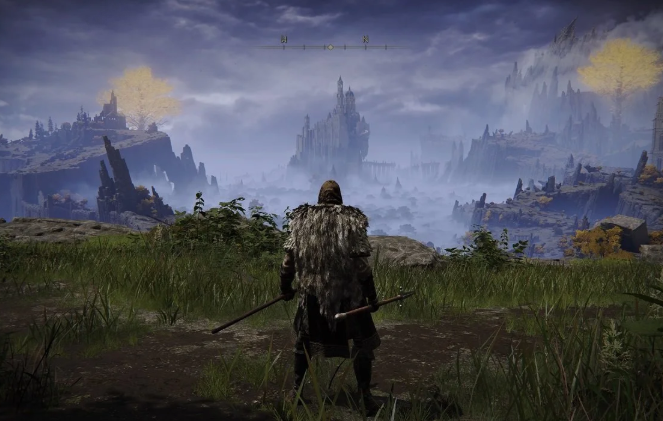
Elden Ring is one of the clearest examples of how powerful open world design can be when it trusts the player. The Lands Between is beautiful, hostile, strange, and rarely interested in explaining itself too neatly.
Instead of pushing players through a checklist, Elden Ring invites them to notice. A glowing tree in the distance, a broken bridge, a hidden cave, a suspicious elevator, or an enemy that seems far too strong can all become reasons to explore. The game understands that discovery feels better when players believe they found something themselves.
It also uses danger brilliantly. You can wander into areas you are not ready for, retreat, return later, and feel your own growth. That freedom makes the world feel less like a theme park and more like a place with its own rules. If demanding combat matters as much as exploration, compare Elden Ring with other Soulslike games worth playing.
Mystery is one of the cheapest and strongest tools in game design. If you are making an AI adventure game, include optional ruins, hidden paths, strange landmarks, and clues that do not reveal everything immediately. Let the player wonder before you answer.
2. Red Dead Redemption 2
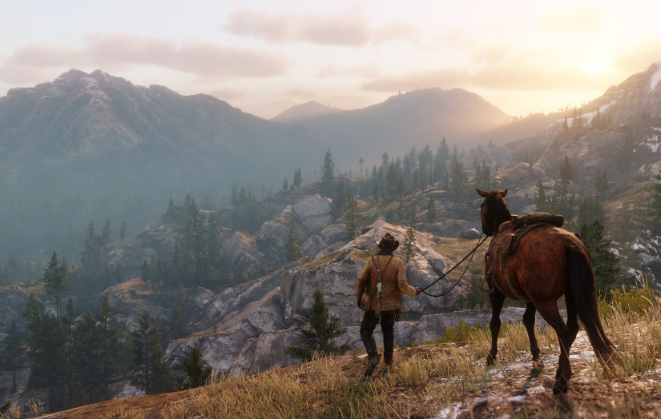
Red Dead Redemption 2 is a masterclass in immersion. Its world feels like it continues even when the player is not looking. Animals hunt, people travel, towns change mood, and random encounters make a simple ride across the map feel unpredictable.
What makes the game remarkable is its patience. It is not afraid to let players slow down. Fishing, camping, hunting, talking, riding, and observing all contribute to the fantasy of living inside the American frontier.
The result is one of the most believable open worlds ever made. It is not just full of things to do. It is full of texture.
Small details create trust. In a browser game, that could mean changing weather, NPCs who remember your choices, shops that open at different times, or travelers who share rumors about hidden places.
3. The Witcher 3: Wild Hunt
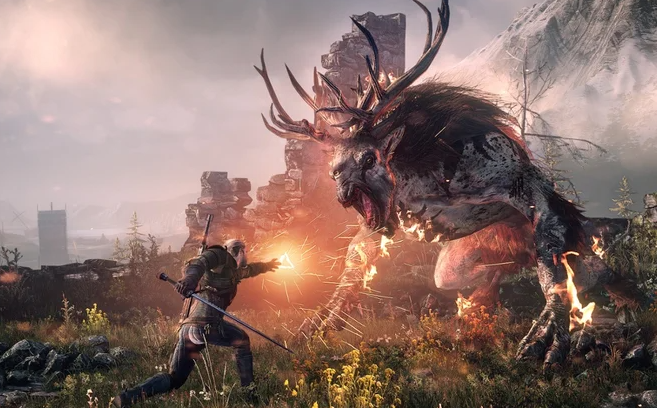
The Witcher 3 remains one of the best open world games because its world is full of stories that feel worth finding. A notice board contract might begin as a monster hunt and end as a moral dilemma. A village rumor might reveal grief, greed, fear, or a local legend that changes how you see the place.
Many open world games fill maps with icons. The Witcher 3 gives those icons narrative weight. Players keep exploring because the next side quest might be funny, tragic, disturbing, or surprisingly tender.
Its world is also imperfect in a way that feels human. War, poverty, superstition, politics, and monsters all shape the land. Exploration is not just about loot; it is about uncovering what happened here.
Give every location a story reason to exist. If you are learning how to make an adventure game, start by giving each area a rumor, conflict, secret, or character motivation.
4. The Legend of Zelda: Tears of the Kingdom
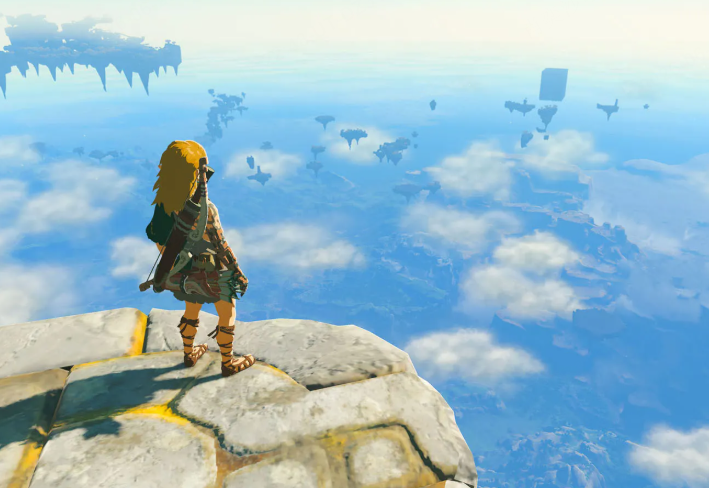
Tears of the Kingdom turns open world exploration into playful problem-solving. Hyrule is not only a map; it is a physics sandbox full of tools, materials, vertical spaces, caves, islands, machines, and unexpected solutions.
The best part is that the game rarely insists on one correct answer. Players build strange vehicles, improvise bridges, launch themselves into the sky, fuse weapons, and solve puzzles in ways that feel personal.
That makes exploration feel creative. The player is not just asking, “Where should I go?” They are also asking, “What can I make happen?” It is also my strongest overall pick in our wider Nintendo Switch game recommendations, where I compare it with Mario, Animal Crossing, Metroid, and current Switch 2 exclusives.
Tools are more exciting when they have multiple uses. In an AI-made game, a rope, wind spell, block, lantern, or magnet can become a puzzle item, traversal tool, combat option, and secret finder.
5. The Elder Scrolls V: Skyrim
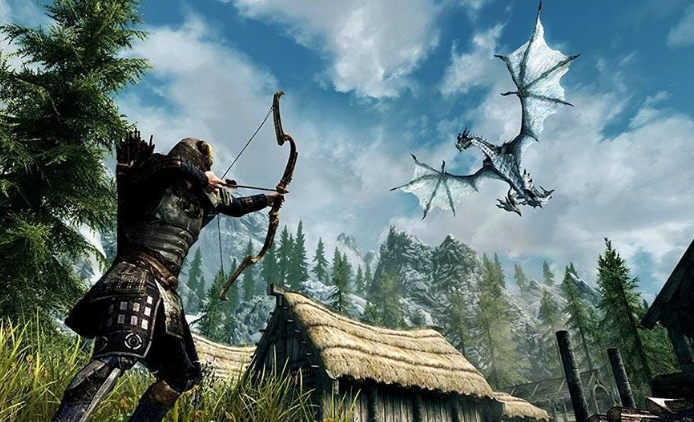
Skyrim's staying power comes from how naturally it creates personal stories. You can follow the main quest, ignore it completely, join factions, explore caves, collect books, chase dragons, buy a house, become a thief, or walk toward a mountain because it looks interesting.
The game is especially good at detours. A player may start with one mission and end up in a forgotten ruin, a faction storyline, or a random fight with a dragon. That kind of interruption is what many players want from an open world.
Skyrim is not the most technically modern game on this list, but it remains one of the most influential because it understands roleplay and wandering.
Design for detours. Add optional NPC requests, roadside events, hidden shrines, treasure maps, and small discoveries that can pull players away from the main path without punishing them.
6. Minecraft
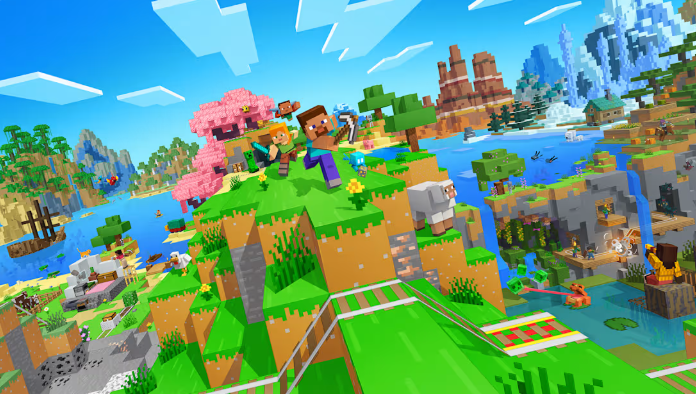
Minecraft is the ultimate example of player-defined goals. It gives players a world, a few clear rules, and the freedom to decide what matters. Survive the night. Build a house. Dig deeper. Explore a cave. Cross the ocean. Farm. Fight. Create a city. Start over with a new idea.
Its genius is that the environment is useful. Trees, stone, water, animals, caves, lava, mountains, and villages are not decoration. They are materials, threats, resources, and opportunities.
That is why Minecraft still feels fresh after so many years. The world becomes a canvas for the player's imagination. If you want more games built around this mix of freedom, building, survival, and exploration, discover the best games like Minecraft.
Make the world interactive. If your game includes a forest, let players gather wood, find herbs, unlock paths, meet creatures, or craft tools. Useful environments feel bigger than decorative ones.
7. Grand Theft Auto V
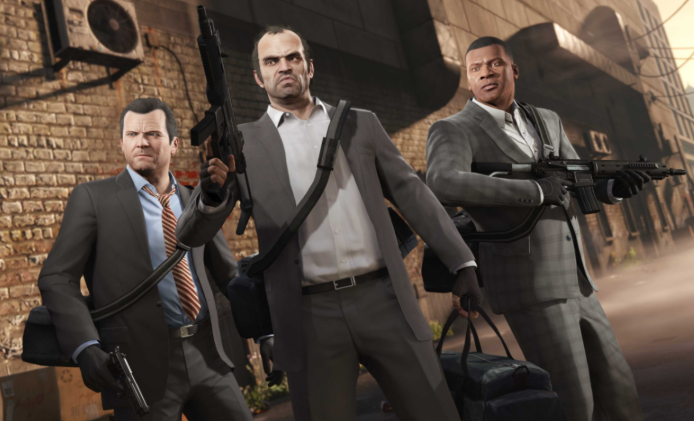
Grand Theft Auto V remains one of the strongest urban open world games because Los Santos is built for both story missions and unscripted chaos. Players can drive, fly, race, shop, explore, escape police, play side activities, or simply test what the world allows.
Its relevance is even stronger now as excitement around Grand Theft Auto VI continues to grow. GTA 6 is currently scheduled to launch on November 19, 2026, with pre-orders beginning on June 25, 2026. Rockstar and Take-Two have described it as a single-player experience set in Vice City and the wider state of Leonida, following Jason and Lucia in a crime story built around one of the series' most ambitious worlds yet.
That makes GTA V worth revisiting as the blueprint for Rockstar's modern open world design. Los Santos works because its systems constantly collide. Traffic, pedestrians, police, vehicles, weapons, terrain, radio, shops, side missions, and player choices can all create unpredictable moments. Even when players ignore the main story, the city can still generate its own entertainment.
Open world games become memorable when systems interact. A small AI browser game does not need a massive city like Los Santos or Vice City, but it can still include guards, vehicles, shops, alarms, factions, NPC reactions, and simple wanted-level mechanics that combine in surprising ways. The lesson from GTA V, and the reason players are watching GTA 6 so closely, is that a great sandbox gives players tools, rules, and consequences—then lets chaos happen naturally.
 Related Blog
8. Cyberpunk 2077
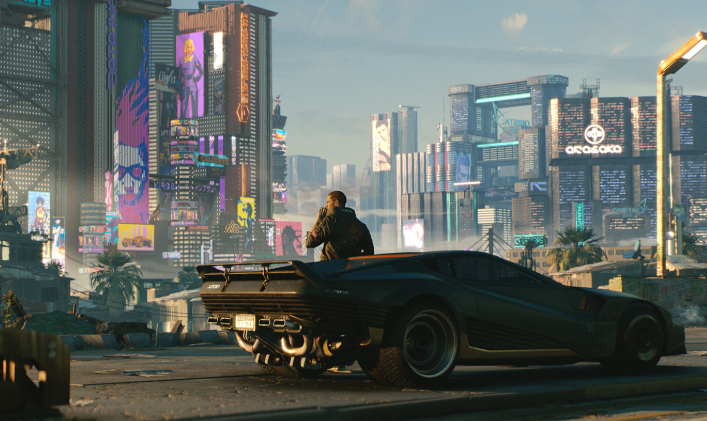
Cyberpunk 2077's Night City is a dense, stylish, vertical open world built on atmosphere. It is not just the size of the city that matters. It is the mood: neon streets, corporate towers, crowded markets, rainy highways, hidden apartments, back-alley deals, and districts with distinct identities.
After major updates and the Phantom Liberty expansion, Cyberpunk 2077 became a much stronger open world experience. Its best moments often come from moving through the city and feeling how much history, inequality, ambition, and danger are packed into every block.
Atmosphere is part of gameplay. When writing AI game prompts, describe lighting, sound, architecture, weather, culture, and social tension. "Cyberpunk city" is fine. "Rainy neon city with rooftop gardens, surveillance drones, and black-market clinics" is much better.
9. No Man's Sky
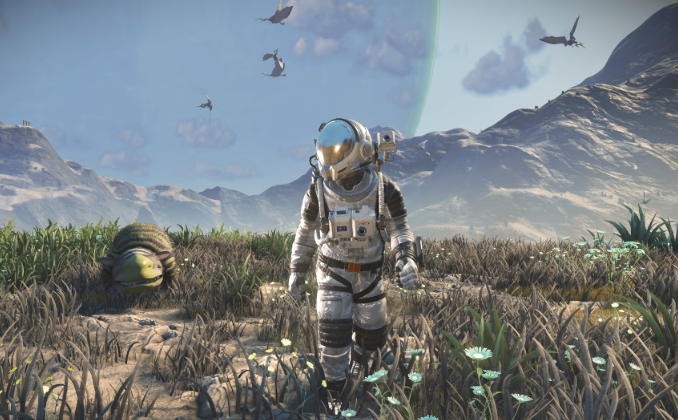
No Man's Sky is built around the fantasy of endless discovery. You can leave a planet, fly into space, land somewhere completely different, scan alien life, gather resources, upgrade equipment, and continue into another system.
Its journey is also a useful lesson in long-term game improvement. Over time, updates expanded the experience with more story, base building, multiplayer features, vehicles, settlements, and new reasons to explore.
For players who want scale, No Man's Sky offers something few games can match: the feeling of being a small traveler in a huge universe.
Procedural variety can make a small game feel larger. For AI game creation, try randomized islands, shifting dungeons, changing weather, different creature behaviors, or worlds that generate new resource layouts each session.
10. Subnautica
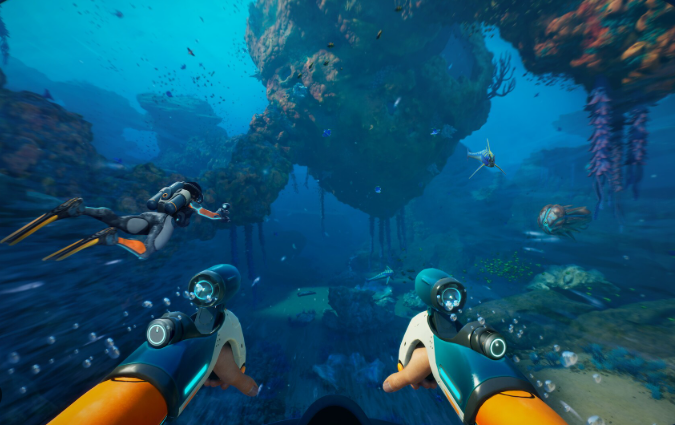
Subnautica is one of the best open world survival games because exploration creates emotion. The ocean is beautiful, but it is also frightening. Every deeper biome feels like an invitation and a warning.
The game’s systems all support that feeling. Oxygen, depth, resources, vehicles, darkness, and dangerous creatures make every trip meaningful. Going deeper is not just progress. It is a decision.
Subnautica also proves that fear and wonder can exist together. That combination makes its world unforgettable.
Use limits to create tension. If you want to make a survival game, add oxygen, hunger, battery power, nightfall, temperature, or limited inventory. Good constraints make exploration more dramatic.
11. Ghost of Tsushima
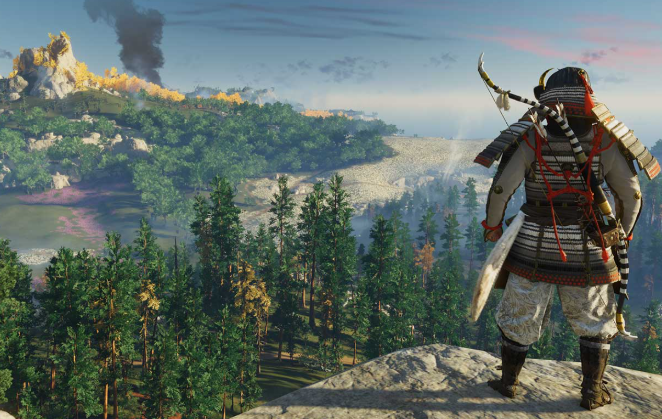
Ghost of Tsushima is a more focused open world, and that is part of its strength. Instead of overwhelming players with noisy UI, it uses wind, smoke, birds, foxes, and visual landmarks to guide attention.
The island of Tsushima feels cinematic because the world is readable. Players can follow natural signals instead of staring at a minimap. That makes exploration feel graceful and intentional.
It is also a reminder that open world games do not always need endless systems. Sometimes a clear mood, strong movement, beautiful landscapes, and elegant guidance are enough.
Guide players through the world itself. Use lights, sounds, moving objects, weather, paths, and landmarks instead of relying only on arrows or quest markers.
12. Outer Wilds
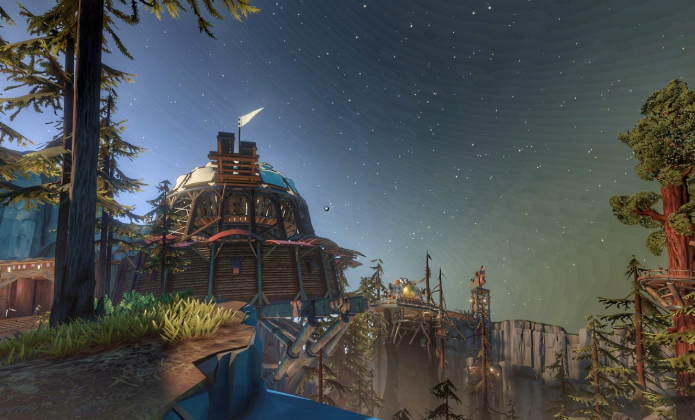
Outer Wilds is smaller than many games on this list, but it is one of the smartest exploration games ever made. Progress is not based on grinding levels or collecting better weapons. Progress is knowledge.
You explore a strange solar system, learn how its planets behave, connect clues, and slowly understand what is happening. Once you know something, the world changes because your understanding changes.
That makes Outer Wilds especially valuable for creators. It shows that discovery can be intellectual, emotional, and mechanical at the same time.
Information can be the reward. Give players clues, myths, passwords, maps, symbols, and patterns that help them unlock new meaning in places they have already visited.
What These Best Open World Games Teach Game Creators?
The biggest lesson from the best open world games of all time is this: do not start with size. Start with a loop.
A good open world loop might be explore, discover, upgrade, return. Or investigate, learn, unlock, reveal. Or gather, craft, survive, travel farther. Once the loop is fun, the world can grow around it.
For AI game creators, that means your prompt should not simply say, "Create a huge open world game." A stronger prompt defines the player role, world theme, core activities, rewards, risks, and secrets.
If you are new to this, SoonLab can help you move from idea to playable game without coding. Start with how to make a browser game, compare options in best AI game makers, or jump straight into SoonLab's create page when you have a game concept ready.
AI Open World Game Prompt Examples
Use these open world game prompts as starting points. Copy one into SoonLab, adjust the setting or gameplay details, and turn the idea into a playable browser game.
Turn your idea into aplayable game
Describe the game you want to make, and SoonLab will help you start building it.
How to Make an Open World Game with SoonLab?
You do not need to build a massive world from the beginning. With SoonLab, you can start with one clear open world game idea, turn it into a playable browser game, and improve it after testing.
STEP 1 Write Your Open World Game Prompt
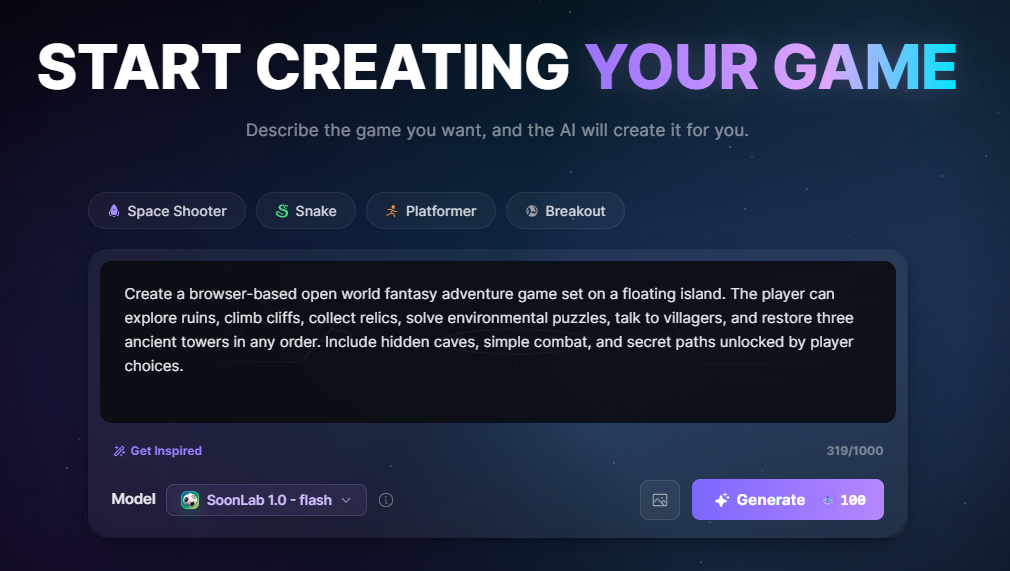
Start with a focused prompt. Describe the player role, world setting, core gameplay loop, rewards, risks, and secrets. For example, instead of saying “create a huge open world game,” describe a forest adventure where the player explores ruins, collects relics, avoids enemies, and unlocks hidden paths.
STEP 2 Create Your Game with SoonLab
Paste your prompt into SoonLab's create page and generate a playable browser game. Test the first version and check whether the player can explore, discover, face challenges, and move toward a clear goal.
STEP 3 Share and Publish Your Game
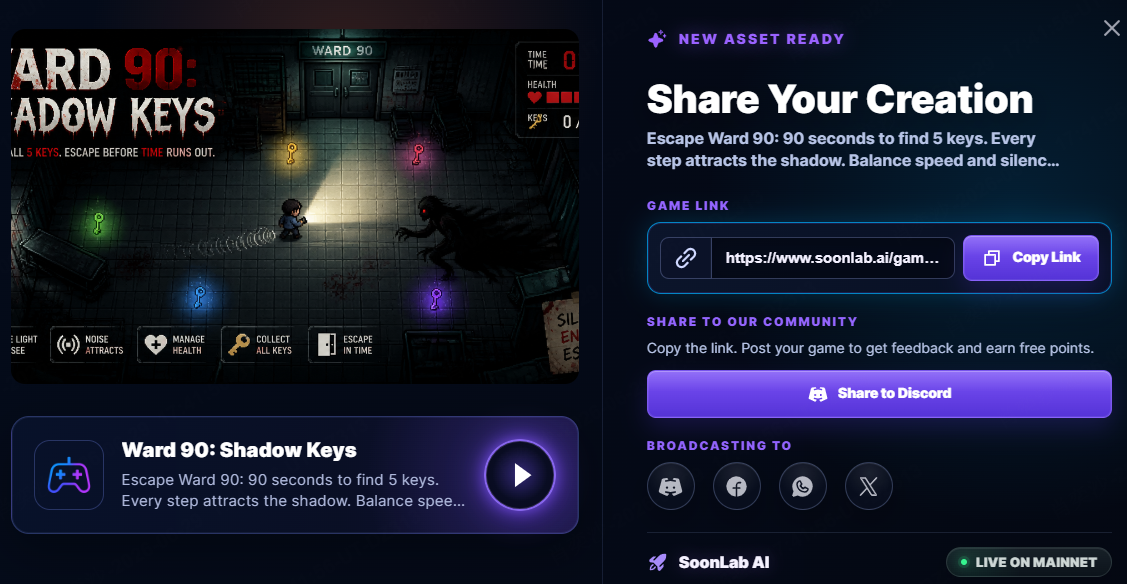
Once your game feels playable, publish it and share it with others. You can collect feedback, improve the prompt, add new areas or secrets, and keep refining your open world game over time.
FAQs
What is the best open world game of all time?
There is no single answer, but Elden Ring, Red Dead Redemption 2, The Witcher 3, Skyrim, Minecraft, and Tears of the Kingdom are among the strongest candidates. Each represents a different strength: mystery, immersion, storytelling, roleplay, creativity, and experimentation.
What open world game has the most freedom?
Minecraft offers the most creative freedom because players can build, destroy, craft, survive, explore, and set their own goals. Tears of the Kingdom is also excellent for freedom because it lets players solve problems with physics, building, and movement.
What is the best open world game for exploration?
Elden Ring is one of the best for mystery-driven exploration. Subnautica is one of the best for survival exploration. Tears of the Kingdom is ideal for players who enjoy movement, puzzles, and creative experimentation.
What open world game should beginners play first?
Skyrim, Ghost of Tsushima, and Minecraft are good starting points for different reasons. Skyrim is approachable for fantasy roleplay, Ghost of Tsushima has clear visual guidance, and Minecraft lets players set their own pace.
Can I make an open world game with AI?
Yes. With an AI game maker like SoonLab or Rosebud, you can create small open-ended browser games from prompts. The best approach is to begin with a focused world, a simple exploration loop, and a few meaningful systems instead of trying to generate a massive AAA-style game immediately.
What is a good open world game idea for beginners?
A small island adventure is a great beginner idea. It can include movement, resource collection, hidden caves, friendly NPCs, crafting, weather, and one central mystery without becoming too complex.
Final Thoughts
The best open world games of all time are not remembered because they are large. They are remembered because they make players curious.
Elden Ring makes mystery feel dangerous. Red Dead Redemption 2 makes the world feel alive. The Witcher 3 makes side stories matter. Minecraft turns the world into a creative tool. Subnautica makes exploration beautiful and frightening at the same time.
For players, these are worlds worth getting lost in. For creators, they are design textbooks hiding inside great games.
And if you want to build your own version of that feeling, start small: one world, one strong loop, a handful of secrets, and a reason for players to ask, "What's over there?"