
Maybe this is where AI games begin: not with a boss fight, not with a polished quest marker blinking like a tiny corporate lighthouse, but with a strange little browser window that behaves like a half-remembered dream.
That is the first punch of Mirage 2. It feels unreal in the old sense of the word. You type, move, poke, drift, and the world answers back in images that seem to be inventing themselves one breath at a time.
A forest can become a ruin. A room can become a mood.
And yet. The spell thins when the question changes from "Can this exist?" to "Why would I keep playing?"
Mirage 2 is dazzling technology, but dazzling technology is not the same as durable desire.
What Makes Mirage 2 So Impressive?
Before taking a scalpel to Mirage 2, it deserves its flowers.
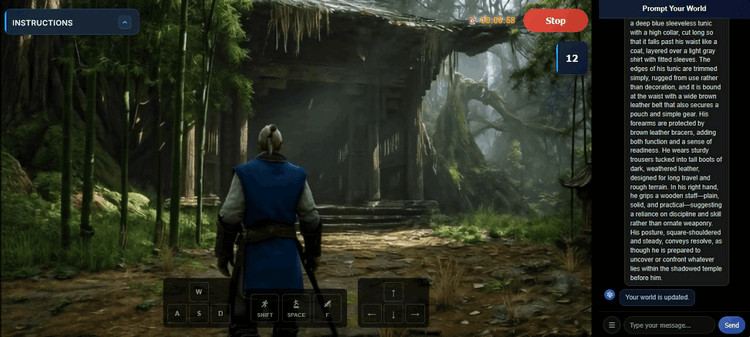
Mirage 2 is being pitched as an AI-native UGC engine running in real time, which means the user is not simply selecting prebuilt assets from a menu. The world is being generated as you push into it. In the browser. From prompts. From images. From whatever strange little seed you hand the machine.
That matters.
The closest mainstream comparison is Google DeepMind's Genie 3, which also points toward real-time, explorable AI worlds.
Google says Genie 3 can generate navigable environments from text at 720p and 24 frames per second, with consistency lasting for a few minutes.
But Mirage 2 has a different kind of swagger: continuous generation beyond ten minutes, roughly 200 milliseconds of latency, the ability to run on a single GPU, and, perhaps most importantly, something people can actually try online.
That last part is underrated. Research demos often live behind velvet ropes. Mirage 2 puts the weird machine in your hands.
The Big Question: Can We Really Call Mirage 2 A Game?
Exploring a World Is Not the Same as Playing a Game
Here is where the floor tilts.
Mirage 2 is fascinating to move through, but movement is not the same as play.
A player can wander through a generated street, enter a strange room, stare at impossible scenery, and still be doing something closer to lucid tourism than gaming.
That sounds harsh. I don't think it is.
Games are pressure systems. They give the player friction, rules, stakes, feedback, failure, recovery, rhythm.
A good game does not merely ask, "What do you want to see next?" It asks, "What are you willing to risk to get there?"
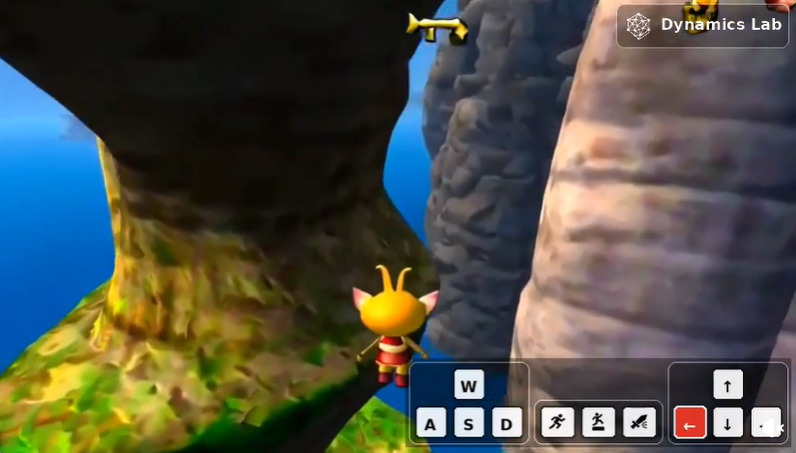
Mirage 2, at least in its current form, struggles with that second question. Goals are thin. Progression is mostly absent. Mechanics do not yet feel stable enough to become trustable. The interaction loop is often: prompt, move, marvel, notice the seams, repeat.
Wonderful for a demo. Less wonderful for a Saturday night when players want something to bite back.
And this is the uncomfortable split. Mirage 2 generates environments faster than it generates meaning. That gap is also why so many Steam players recoil from AI-generated games in the first place. The complaint is rarely just “AI was used.” The deeper complaint is that these games feel soulless, as if the content arrived before the intention.
For developers, that is electrifying. It hints at new pipelines, new prototyping rituals, maybe even a future where "level design" starts with conversational world-shaping instead of grayboxing.
For ordinary players, though, the magic has a shorter fuse. A world can keep changing forever and still feel empty if nothing inside it truly matters.

The Object Permanence Problem Is Bigger Than People Think
AI video models struggle to remember what happened between frames. Mirage 2 struggles with object permanence.
In a traditional game, the world remembers. Drop a sword on the floor, walk away, come back, and the sword is still there unless some system moved it. That simple contract tells the player: this place exists even when you are not staring at it.
Mirage 2 does not fully have that contract yet. Objects can blur, mutate, or vanish when they leave the frame. A room may feel less like a stable location and more like a fresh guess made by the model every time the camera turns.
Spatial memory becomes slippery. NPCs risk becoming costumes without continuity. World state tracking, the unglamorous plumbing of game design, suddenly becomes the whole damn house. The world only partially exists while you're looking at it.
This matters more than the demo-hype crowd admits.
Without permanence, players stop treating worlds as real spaces and start treating them as temporary hallucinations. You can admire a hallucination. You can even explore it. But you do not build trust with it.
That is the strange bargain Mirage 2 exposes. AI may soon handle the slow, expensive foundations of world-building, freeing developers to focus on narrative, systems, and interaction. Great. I want that future.
But until the world can remember what the player did, generative play remains emotionally shallow.
Fascinating, yes. Not yet inhabited.
The Cost Problem Nobody Talks About
Real-Time AI Generation Is Extremely Expensive
The fantasy version is seductive: every future game generates every frame live, forever, like some infinite arcade cabinet plugged directly into a dream engine.
Nice poster. Terrible business plan.
Real-time AI generation has a cost problem baked into its bones. The compute bill quickly reaches numbers most indie developers can't realistically handle.
Every new scene, every shift in camera, every visual guess has to be inferred by a model somewhere. That means GPU time. Often cloud GPU time. And cloud GPUs are not fairy dust. They are expensive, power-hungry little dragons sitting inside data centers, billing someone each time the magic happens.
Latency is the other bruise. A traditional game can hide enormous complexity behind optimized rendering pipelines. An AI-native world has to keep inventing while the player moves, and players are ruthless about delay. Two hundred milliseconds may sound tiny in a technical demo. In play, delay has teeth.
So no, I do not buy the idea that every future game will generate every frame with AI. Not at scale. Not cheaply. Not for millions of players hammering servers at 9 p.m.
The future cannot just be beautiful. It has to be affordable.
Hybrid AI Workflows Will Probably Win
Which leads us to the less glamorous, more believable answer: hybrid systems.
Instead of pure AI generation and old-school pipelines frozen in amber, it's something messier, cheaper, and probably more useful.
I suspect the winning model will be selective AI generation, where AI handles the flexible parts of development without being forced to hallucinate the entire universe every second.
Let it sketch environments. Let it help prototype levels. Let it generate textures, variants, dialogue drafts, NPC behaviors, quest fragments, strange weather, weird rooms, mood boards with teeth. But keep core systems under control.
That control is important. Procedural design already taught the industry this lesson. Randomness becomes powerful when it is fenced, tuned, and shaped by designers who know where the fun is supposed to live. AI will need the same leash.
What Mirage 2 Gets Right About the Future of Gaming
Players Clearly Want Responsive AI Worlds
Here is the part critics should not hand-wave away: the appetite is real.
Even when Mirage 2 feels thin as a game, people still want to touch it. That says something. Maybe not about the present quality of AI games, but definitely about the shape of desire forming around them.
Players are tired of dead scenery. Painted doors. NPCs who speak in canned soup dialogue. Worlds that look expensive but behave like museum exhibits.
Mirage 2 pokes at a different hunger.
Sure, the current version wobbles. The gameplay doubts are fair. But dismissing the whole thing because it is not yet a complete game feels too easy, almost smug. The more interesting read is this: Mirage 2 reveals that players do want dynamic AI worlds.
They just do not want empty ones.
AI-Native Games Will Eventually Exist, But They Need Structure
AI-native games will happen. I'd bet on that without much trembling.
However, the successful ones will have structure, memory, limits, and an actual reason to keep playing after the first five minutes of spectacle wear off. That is the part the industry keeps trying to skip, probably because "infinite worlds" sounds better in a pitch deck than "carefully bounded systems."
Still, for indie developers, this technology could be enormous in that it may shrink the brutal distance between idea and prototype. A tiny team could test ten worlds before lunch. A solo creator could rough out a mood, a biome, a quest space, a creature logic, then throw away the weak stuff before it calcifies into production debt.
That is where the mushrooms grow.
Generative play could become fertile ground for weird, personal, impossible-to-greenlight ideas. But only if AI is treated as material, not author. The future needs bounded AI systems, persistent memory, controlled narrative frameworks, and gameplay-first design.
Otherwise, we will get endless worlds with nothing to do inside them. A gorgeous famine.
Conclusion
Mirage 2 is not the future of games. Not yet.
It is a preview smuggled back from that future, still flickering at the edges, still unreliable, still more miraculous than satisfying. As a player experience, it can feel thin. But for developers? Different story.
Mirage 2 cracks open an enormous door. It suggests a future where world-building becomes faster, stranger, more collaborative, less chained to traditional production bottlenecks. Indie teams could prototype living spaces at a speed that would have sounded ridiculous a few years ago. Designers could sketch with motion instead of static concept art. Weird ideas could become explorable before anyone has time to kill them in a meeting.
That is the real gift here.