
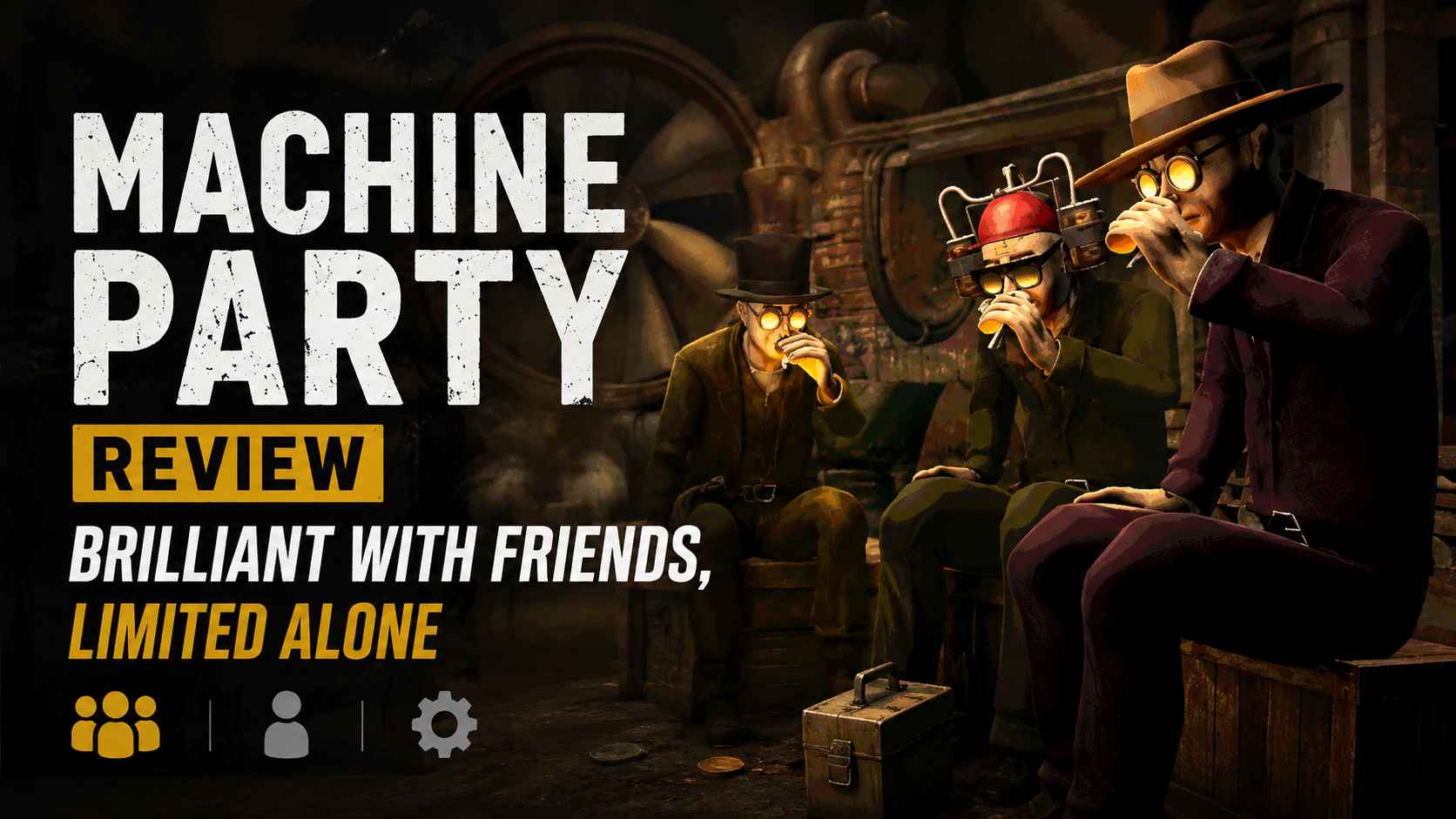
Machine Party is easy to recommend to a group of three or four friends who already use voice chat. Its 15 short, lethal minigames turn simple actions—eating peas, assembling a gun, driving a forklift—into fast rounds of bluffing, sabotage, panic, and slapstick death. It is inexpensive, immediately readable, and much richer in atmosphere than most party-game collections.
The catch is just as clear: this is a social game that does very little to create the social group for you. There is no official public server browser, built-in voice chat, or local split-screen mode. If you buy it alone and expect instant matchmaking, you may have more trouble starting a party than surviving one.
| Verdict | Recommended for an established group; wait if you need matchmaking or solo play |
|---|---|
| Players | 2–4 online players |
| Content | 15 minigames, character customization, 15 Steam achievements |
| Platform | PC via Steam; Windows and Linux; Steam Deck Verified |
| Price | $7.99 standard price; $6.79 launch offer through August 13, 2026 |
| Best with | Four friends in Discord who enjoy short competitive sessions |
What Is Machine Party?
Machine Party is a 2–4 player online co-op horror game from Mike Klubnika and GDeavid, published by Oro Interactive. It launched on Steam on July 30, 2026. Klubnika is best known for Buckshot Roulette, and the family resemblance is immediate: low-poly faces, filthy machinery, blunt rules, heavy industrial sound, and the sense that every object in the room was designed by a hostile bureaucracy.
It is often described as “horror Mario Party,” but that comparison can create the wrong expectation. There is no board to cross, no stars to collect, and almost no downtime between events. The developers deliberately removed the dialogue, transitions, and board-game structure common to the genre. In Klubnika’s announcement notes, he explains that the goal was a back-to-back sequence with minimal waiting. The closer comparison is a compact horror version of WarioWare or the minigame layer of Pummel Party.
How the 15 Minigames Actually Work

The games test different skills, but they share one design principle: the instructions are simple enough to understand within seconds, while other players make the outcome unpredictable. You may run through a minefield, carve a block into the requested shape, assemble firearms on a production line, avoid trains in a tunnel, smoke a cigarette at speed, balance on unstable debris, or survive a lethal ball game.
A complete developer-led Alpha Beta Gamer session shows the full rhythm clearly. Its chapter list runs from Minefield and Chisel Gauntlet through Firearm Factory, Duck Hunt, Tunnel Hazard, Smoke Break, Forklift Certified, and The Filter. The host singled out Duck Hunt as a favorite and praised the variety, which matters more than the raw number 15: the set moves between reflexes, spatial judgment, observation, bluffing, and direct interference instead of repeating one control trick.
The best moments come from readable sabotage
Machine Party is funniest when a player can understand exactly how a friend ruined them. In Firearm Factory, for example, completing the assembly task does not end the danger; the newly built weapon can immediately change who has the advantage. One of the most-liked comments under the Alpha Beta Gamer video points to a player patiently waiting for an opponent to finish a gun, then shooting them the moment they pick it up. That single interaction captures the game’s best quality: success creates a new opportunity for betrayal rather than a safe victory screen.
This also makes the game easy to watch. A four-player CaRtOoNz video drew more than 200,000 views during the launch window, while other group sessions reached much larger audiences in several languages. The appeal is not simply gore. Spectators can read the objective, anticipate the mistake, and enjoy the accusation that follows.
Some rounds will age better than others
Fifteen games is a healthy selection for the price, but it is not an endless content pool. Reflex challenges and obstacle courses will become more predictable once a group learns their layouts. The games with deception, weapons, or player-controlled interference should have the stronger long-term life because friends remain less predictable than hazards.
That makes Machine Party better as a recurring 30–60 minute game-night option than as the only multiplayer game a group plays for weeks. It respects your time, but its ruthless pacing also means you can see much of its mechanical range quickly.
Two Players Works; Four Players Is the Real Party
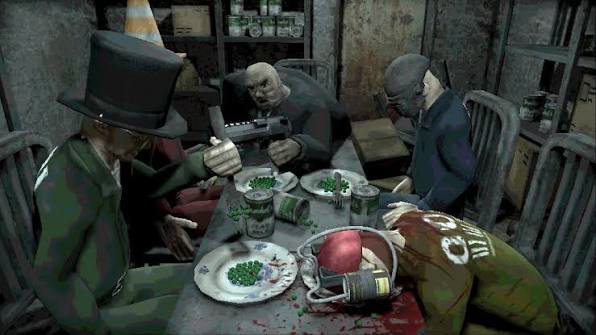
Machine Party officially supports two to four players, but the numbers do not produce equivalent experiences. With two people, rounds are cleaner and rivalries are direct. It can be useful for learning the games, yet every decision has fewer social consequences.
Three or four players create the version that the premise promises. Temporary alliances become possible, a leading player attracts attention, and one person’s mistake can rescue someone else. More bodies also make physical challenges messier without requiring complex rules.
There is no meaningful solo recommendation here. Steam lists multiplayer, online co-op, and PvP features, not a single-player campaign with bots. Treat the game as a group purchase, not a horror title you can fully enjoy alone.
The Biggest Weakness: Finding and Talking to Players
The official game uses private room codes. It does not include a worldwide lobby browser, voice chat, or text chat. That is manageable for friends already sitting in Discord, but it creates friction for anyone hoping to meet players inside the game.
The community response makes the gap unusually visible. Less than a week after launch, modders released MachineParty+, which adds a public server browser, voice and text chat, moderation tools, and mid-match joining. Replies welcomed it as exactly what the game needed. The mod remains cross-compatible for ordinary room-code play, but public listings and chat require mod users.
A mod can be useful, but it should not be mistaken for an official feature. Installation adds effort, public rooms depend on other mod users being online, and future game updates can affect community tools. Buyers who want frictionless matchmaking should wait to see whether the official multiplayer layer expands.
There is no couch co-op or shared-screen play
Despite the word “party” in the title, each participant needs their own setup. A recurring request in both Reddit launch discussion and YouTube comments is a local multiplayer option. Some minigames rely on private information or separate viewpoints, so converting the entire collection would not be simple. Still, the absence matters: this is an online friend-group game, not a plug-one-PC-into-the-TV party package.
Horror Style, Sound, and the Story Beneath the Games
Machine Party’s presentation gives the collection a stronger identity than its small price suggests. Harsh lighting, chunky models, stained industrial rooms, and deliberately ugly machines make every challenge feel like part of the same institution. Alex Peipman’s industrial soundtrack supplies pressure without turning each round into generic action noise.
The violence is frequent and graphic, but it works more like a punchline than sustained terror. Failure has a visible consequence, and the game moves on before shock becomes misery. Players uncomfortable with headshots, dismemberment, or smoking imagery should take Steam’s mature-content warning seriously.
Fans of Klubnika’s earlier games have also found a second layer. A long Reddit theory thread connects Machine Party’s simulation language, KETAS references, and strange field intermission to Tartarus Engine and s.p.l.i.t. You do not need that background to understand a minigame, but the unexplained machinery gives lore-focused players something to discuss after the jokes end.
YouTube comments reinforce that split appeal. Viewers talk about the gun-factory betrayals and forklift disasters, but some of the most engaged comments focus on the apparent shared dystopian universe. The game therefore supports two conversations at once: “who killed whom?” and “what is this machine doing to these people?”
Performance, Controls, and Steam Deck Support
The PC requirements are modest in storage but more specific than the visual style might imply. Steam lists 1 GB of storage, 8 GB of RAM on Windows, a Radeon RX 6500 XT or Nvidia GTX 1660-class GPU, Windows 11, and Vulkan support. Linux is supported separately.
SteamDB’s current compatibility record lists full controller support and Steam Deck Verified status. It also notes that external Bluetooth or USB controllers may need to be selected manually on Steam Deck or SteamOS. That is a small setup warning, not a reason to avoid the handheld.
Because multiplayer timing matters, each player should use a stable connection. The game’s visual simplicity may look forgiving, but a missed input in a short elimination round feels worse than a brief hitch in a slower co-op game.
What Players Are Saying on Steam, Reddit, X, and YouTube
The early response is strongly positive, but each platform reveals something different.
- Steam: As of August 10, 2026, the store shows a “Very Positive” rating, with 2,502 positive and 356 negative reviews across all displayed review types. That is an encouraging launch result, especially for a multiplayer game whose value depends on repeat sessions.
- Reddit: Discussion is smaller but more practical. Players praise the concept and dig deeply into its lore, while requests for public matchmaking, voice chat, local play, and people to join reveal the game’s social-access problem.
- YouTube: The game is producing exactly the loud, readable group chaos it was built for. Popular uploads emphasize brutal outcomes, betrayal, and creators turning on one another. Comments also praise the variety and worldbuilding rather than treating the game as a one-joke gore reel.
- X: The reveal generated major pre-release attention. A third-party index of Klubnika’s X posts recorded roughly two million views and tens of thousands of likes for the announcement. That shows how instantly the “deadly party game” pitch communicates, although launch hype is not evidence of lasting replay value.
The balanced reading is that Machine Party has delivered on its central fantasy. The criticism is mostly about how players gather, communicate, and keep the game populated—not about the basic idea failing to produce fun.
Is Machine Party Worth It?
Yes, if you can name the people you will play with before you buy it. At $7.99, the game does not need dozens of hours to justify itself. A few strong group sessions can provide fair value, and the 15-game set has enough mechanical variety to survive more than one evening.
Buy it now if you have three or four horror-friendly friends, already use Discord, enjoy direct competition, and prefer fast rounds over long progression systems. It is also a natural choice for Buckshot Roulette fans who want that grim industrial tension spread across a wider set of mechanics.
Wait if you need public matchmaking, want to play on one shared screen, dislike graphic deaths, or expect a substantial solo mode. Two-player-only groups should also consider whether a collection built around social chaos will hold their attention once they learn every event.
If the design inspires you, the most useful lesson is its discipline: a memorable party game does not need a huge board or complicated metagame. It needs readable rules, fast recovery, and opportunities for players to affect one another. Beginners exploring that idea can start with a single round and use this horror game maker to prototype a small browser challenge before attempting a full multiplayer collection.
Turn your idea into aplayable horror game
Describe the game you want to make, and SoonLab will help you start building it.
Frequently Asked Questions
How many minigames are in Machine Party?
Machine Party includes 15 minigames. They cover reflexes, movement, observation, timing, sabotage, and direct player conflict.
Can you play Machine Party solo?
Machine Party is designed for 2–4 online players. It is not a meaningful solo game and does not advertise a single-player campaign with bots.
Does Machine Party have public matchmaking?
The base game uses private room codes and does not provide an official public server browser. The community-made MachineParty+ mod adds public lobbies, but both host availability and mod compatibility can change.
Does Machine Party have local multiplayer?
No. Machine Party does not currently support couch co-op, shared-screen, or split-screen play. Each player needs a separate setup for online multiplayer.
Is Machine Party related to Buckshot Roulette?
Both games were created by Mike Klubnika and share a grim industrial style, lethal rules, and an interest in high-pressure social play. Machine Party is not simply Buckshot Roulette 2; it replaces the shotgun-table format with a collection of 15 different challenges.
Is Machine Party Steam Deck compatible?
Yes. Machine Party is Steam Deck Verified and supports controllers. SteamDB notes that an external controller may sometimes need to be selected manually on SteamOS.
Machine Party Review Verdict
Machine Party turns ordinary minigame verbs into miniature horror stories. Its pace is excellent, its visual and musical identity is unusually strong, and the best rounds create betrayals that players can explain, blame, and laugh about immediately. That blend of simple rules, sabotage, and instant blame also places it firmly among the best friendslop games, even though it is more competitive than the typical co-op horror hit.
Its biggest problem happens before the first round: the game expects you to bring the friends, communication tools, and lobby coordination yourself. For a prepared group of four, that is a small inconvenience around a sharp, affordable party game. For a solo buyer searching for strangers, it may be the entire experience.
Final recommendation: buy it for an established online group; wait for better discovery tools if you are arriving alone.